

Published Oct 31, 2026 | 1:05 PM ⚊ Updated Oct 31, 2026 | 1:05 PM

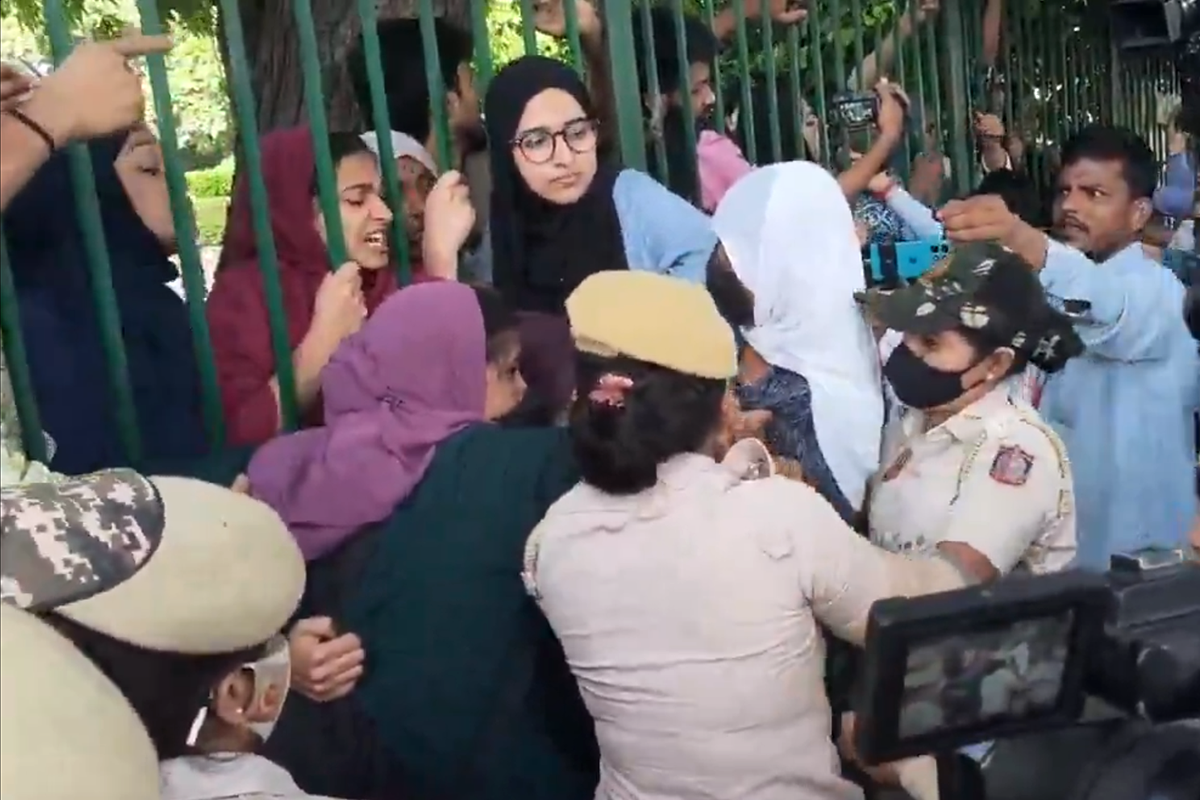
Police trying to disperse the students protesting at Jamia milia Islamia University, on October 26. (Videograb)

Jamia Millia Islamia, a prominent central university in Delhi with a history of more than a hundred years and over 24,000 students, has resembled a battlefield for some time now.
The administration has welded shut some of the main gates leading into the campus, blocked them with iron sheets and walls, and closed them off. Near the metro station and outside the campus, between 1,000 and 2,000 police, paramilitary and ITBP personnel are standing guard, preventing students from entering the university they study in and stopping those inside from leaving.
Barricades have been placed across the surrounding roads. The administration continues to threaten students with criminal action, accusing them of damaging property, disturbing peace and order, and disrupting academic work. Prohibitory orders under Section 163 of the BNSS have been imposed in the areas around Jamia University. The entire locality now looks like a police camp.
Since October 12, students have been on a hunger strike to press their demands. Today marks the 19th day of this protest.
In the early hours of October 17, campus security and police together switched off the lights in the area, dragged the fasting students out, threw them to the ground and beat them. Women students were touched inappropriately. Some were arrested. Under the pretext of “talks”, pressure was applied, and signatures were obtained from two students in the early morning hours. The administration then announced that the students had ended their protest.
The remaining students rejected this as a cunning move, alleging the students had been brainwashed and harassed into signing. Although some withdrew from the hunger strike, Ebin Basil, Rehan Khan and others continued, and several new students have now joined them.
Libraries, hostels and even toilets have now been locked. Electricity and drinking-water supply have been cut off in an attempt to force students out of the campus. Canteens and messes have also been shut.
Anyone trying to send water or food from outside to students still inside, or attempting to provide medical check-ups to those on hunger strike, is being stopped. In this atmosphere of dense darkness that has enveloped the university, students — especially the girls — continue their protest even in the middle of the night.
The current hunger strikes and agitations have a long history.
The last student union elections at Jamia Millia Islamia were held in 2005. The elected body was dissolved in March 2006. The administration then directed students to take their grievances only to departmental subject associations and class representatives. Students keep asking why elections are banned in their college when they continue to be held in Delhi University and JNU.
Their main demands are:
Restore the Jamia Millia Islamia Students’ Union (JMISU).
Immediately announce the 2026-27 election schedule. Frame a new union constitution within a fixed time limit and hold elections within 15 days thereafter.
Withdraw all suspensions, rustication orders and show-cause notices issued against students who took part in the protests.
Along with these, they are also asking for improvements in the drinking-water supply in hostels, mess and toilet facilities, and resolution of problems related to the library, fees, admissions and security.
These are all legitimate demands. Asking for a proper atmosphere, adequate facilities, safety and a democratic environment in a university is not wrong in any way.
Universities are the spaces meant to produce the scientists, intellectuals and leaders the country needs tomorrow. Above all, democracy, civil rights and constitutional values must apply to every citizen and every institution in this country. Universities cannot be an exception.
Students argue that an institution with such a proud history — one that played a key role in nation-building and produced many leaders — is suppressing their rights and using violence against them, turning it into a “detention centre.” They believe this is being done jointly by the university administration and the government in power.
During British rule, on October 29, 1920, nationalist Muslim leaders originally founded the Jamia Millia in Aligarh, Uttar Pradesh. They established Jamia Millia as an educational institution that would work with independent, nationalist ideals and modern values, in opposition to the British education system.
In 1925, the university moved from Aligarh to Karol Bagh in Delhi, and later to its present campus in Okhla, Jamia Nagar. It earned recognition as one of the leading universities in the country.
From the beginning, it has upheld values of national unity, secular education, priority for Muslim minorities, and greater opportunities for women students. Rabindranath Tagore praised it as “one of the most progressive educational institutions in India.”
When the institution faced severe financial difficulties at one stage, Mahatma Gandhi is said to have declared, “Jamia must continue. If money is a problem, I will take a begging bowl and go around.” Gandhi’s “Nai Talim” methods were experimentally implemented at Jamia.
Even during the intense violence of Partition, Gandhi called the Jamia campus an “oasis of peace.”
Zakir Husain, who later became President of India, served for many years as a professor and also as Chancellor of Jamia Millia Islamia. This university, where many prominent figures studied, and this campus with its rich history, is now being turned into “a jail, a police camp,” students allege angrily.
Other student organisations and students from many universities have come forward in support of the Jamia students. Various political parties and alumni have repeatedly appealed that the students’ problems should be discussed and resolved, and that police forces should be withdrawn.
Certain forces have been widely propagating that Jamia students wrote “Azad Kashmir” slogans and graphics on the walls, calling these anti-national acts.
Students allege that outsiders unconnected with their protest, acting together with the police, deliberately create incidents to frame students, file false cases against them and arrest them. They ask why the university security and police, who keep every movement of the students under constant surveillance both inside and outside the campus, do not catch the actual perpetrators even when students point them out.
Student agitations are not new in Jamia’s history. Important ones include the one that erupted after Professor Mushirul Hasan questioned the government’s ban on Salman Rushdie’s Satanic Verses in 1992, and agitations following the dissolution of the students’ union in 2006, and during the anti-CAA-NRC movement in 2019.
On December 15, 2019, police entered the campus, went into the library (Zakir Husain Central Library), the mosque and classrooms, and fired tear gas. They beat students with lathis and made them walk with their hands raised as if they were criminals. When police and plainclothes individuals together attacked the students, hundreds were injured. There were allegations of inhuman acts against women students as well.
About a hundred students were injured that day; many had to be hospitalised. More than fifty faced detention and cases. Some were even arrested from the hospital and taken away. That day remains an indelible stain on Jamia’s history.
Although those agitations subsided, the same issues keep returning in the form of SIR protests (and related concerns). The long-pending problems of more than 24,000 Jamia students still await solutions. A new Gen-Z generation has also arrived at Jamia.
Just as in the past, students at Jamia are once again expressing their protest peacefully, through non-violence, satyagraha and hunger strike — within the democratic framework and in the Gandhian tradition. In contrast, just as before, the university administration and the police are resorting to violence to stop them.
The student community’s questions are simple: what else can one call these actions but a violation of democratic rights? By erecting walls and sheets around the campus and sealing it so that students have no way out, are authorities turning Jamia into another Jallianwala Bagh?
This doubt and the anxiety about what will be done to the students are being expressed everywhere. It is not only the students of Jamia Millia Islamia; students from many other colleges have also taken to the streets demanding “campus democracy.” They must be heard.
Also Read:
A country between empires: Lessons from the Serbian election surprise for young Indians
Democracy’s shame: Delhi Police’s violence reverberates across India
Are we a rapist society? From Lady Shri Ram College to Hyderabad, the message from Gen Z women
(Edited by R Rajesh Kumar.)



