
Published Oct 27, 2026 | 4:00 PM ⚊ Updated Oct 27, 2026 | 4:00 PM

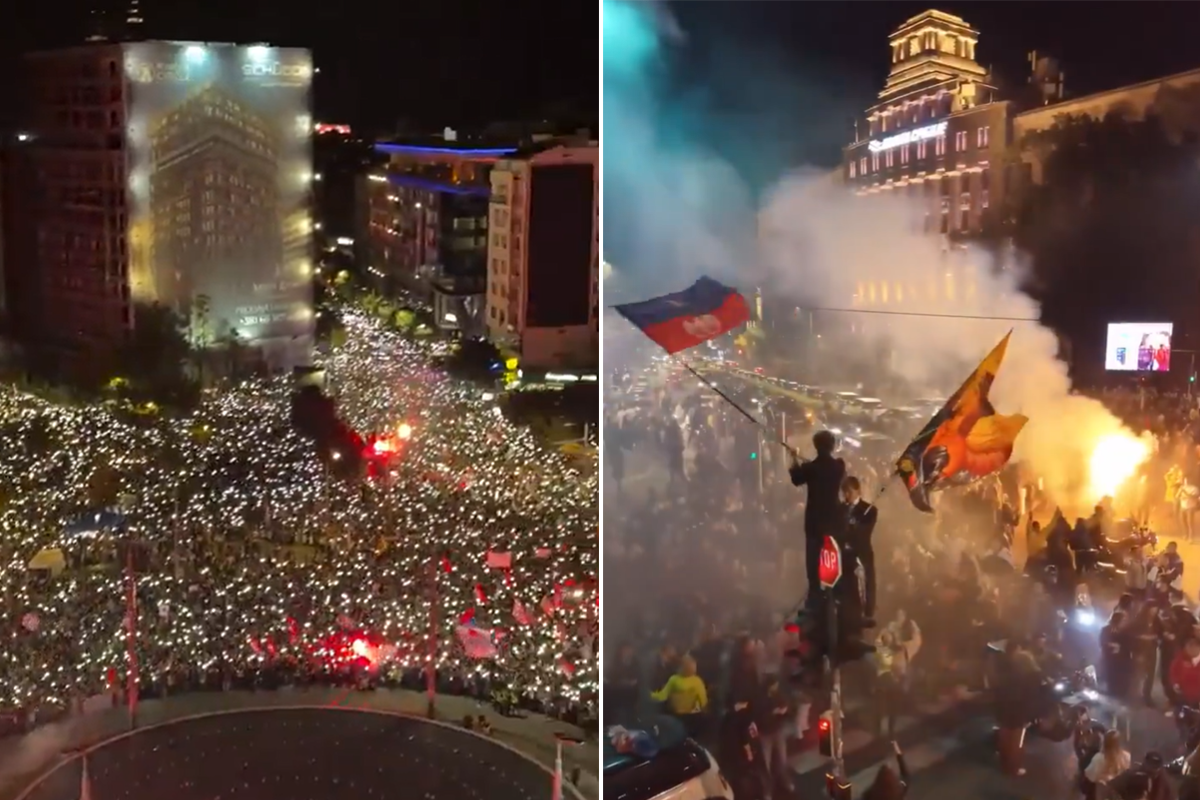
After nearly 2 years of protests across Serbia, students have won the elections. (Videograb)

It was my organisational involvement with cooperatives in the 1970s, and later the fascination with market socialism and worker-led institutions, that got me interested in the economists and the leader Josip Broz Tito of the country then known as Yugoslavia — a federation of republics of which Serbia was the most important, with Belgrade as its capital. After the Yugoslav federation came apart in stages over about fifteen years, Serbia declared independence in 2006.
On Sunday, 25 October 2026, in Belgrade, Aleksandar Vučić, who had run Serbia for the better part of fourteen years with an authoritarian fist, told his supporters that he had lost the election he called. A movement of students and their allies, protesting his rule since 2024 and calling themselves the “Student List,” had unexpectedly won a majority in parliament.
By Vucic’s own early count, they would hold between 135 and 140 of the 250 seats, against about 105 for his Progressive Party. Turnout was the highest in over thirty years. The result is now officially confirmed — the Student List has 140 seats — and has been reported in the international media.
It was a remarkable outcome, and it makes sense only against Serbia’s long and heavy history.
Serbia has always lived between larger powers.
A medieval kingdom that briefly became an empire fell to the Ottomans after the Battle of Kosovo in 1389. For centuries afterwards, its land was a frontier between the Ottoman and Habsburg empires. Uprisings from 1804 led to full and first independence, recognised in 1878.
In the twentieth century, Serbia became the heart of Yugoslavia, which Josip Broz Tito rebuilt after the Second World War as a federation of six republics. Tito began as a loyal communist, but in 1948 he refused Stalin’s orders and was expelled from the Soviet-led bloc. He then built an economy of his own, in which firms were run through workers’ councils and markets guided production. For some years Yugoslavs lived better than their neighbours in the east.
Tito also gave the country a place in the world.
In September 1961 Belgrade hosted the first summit of the Non-Aligned Movement, with Nehru, Nasser of Egypt and Sukarno of Indonesia among its leading figures. Twenty-five countries argued for peace and against colonialism and wrote to John F Kennedy of the USA and Nikita Khrushchev of the USSR, urging them to step back from nuclear war. India and Serbia share a proud and little-remembered friendship from that time.
After Tito died in 1980, the federation came apart, largely through its own economic troubles and the rival nationalisms of its republics. The Soviet Union played no part in this and, in fact, wanted Yugoslavia to hold together.
The war in Bosnia, from 1992 to 1995, took about 100,000 lives. In July 1995, Bosnian Serb forces killed more than 8,000 Muslim men and boys at Srebrenica. International courts found it to be genocide. Serbia was found not to have committed it directly but to have failed to prevent it.
The wounds remain open. Serbia became fully independent in 2006, and it still refuses to accept Kosovo’s independence, declared in 2008.
Faith and nation are closely bound.
In the 2022 census, 81 per cent of the 6.6 million Serbs said they were Orthodox Christian, and the Serbian Orthodox Church has long been a powerful voice in public life. It has been reported to have sided with Vučić during the student protests, echoing his claim that they were a foreign plot.
Vučić himself kept a practical relationship with Russia. He refused to join sanctions and relied on Russian gas, yet he also courted the European Union and China. The talk of an eternal Serbian-Russian brotherhood is more political myth than history. Tito, after all, was the first to break with Moscow.
The student movement that has now ended Vučić’s rule began with a building. In November 2024, the new concrete canopy at the Novi Sad railway station collapsed and killed sixteen people. It became a symbol of corruption and of officials never being held to account.
Students occupied their faculties and marched, and over two years they were joined by farmers, teachers, lawyers, actors and small-town families. They adopted non-violent methods of protest, stayed peaceful and kept asking for the same things — political accountability and an early election.
The visuals I had watched portrayed very enthusiastic popular participation, not restricted to Belgrade. The ethos of a participatory economy was visible in the mobilisation and political actions across all sections of society.
When Vučić finally called the vote, he first resigned the presidency to stand for prime minister. The students ran candidates who were mostly professors, doctors and teachers with no political past, and several established opposition parties stood aside. Vučić called them foreign-funded, which they deny. They won.
What can others learn from this, including the young people behind India’s Cockroach Janata Party, which began as an online joke in May and now draws millions of followers? To my mind, four things stand out.
First, a clear and concrete grievance — in the Serbian case, sixteen deaths and an unanswered question — gave a moral centre to their movement.
Second, patience matters, because Serbia’s students persisted with their demands for two years.
Third, people trusted candidates whose lives showed they were outside the system.
And fourthly, a movement needs to reach beyond the young to the labouring sections of the population and all families who feel the same pressure.
The differences matter too.
Serbia’s proportional voting system lets a new force turn votes into seats, which India’s constituency system makes far harder. Serbia’s elections were unfair in many ways but open enough for the government to lose and to accept it. Winning, in any case, is the easy part.
On election night the fireworks over Belgrade were for a government that had not yet been formed.
The students must now name a Prime Minister, hold together a loose alliance with no single leader, and govern alongside a large opposition in institutions Vučić spent years shaping. That is the harder test, and it is the one that will decide whether the ballot box was a beginning or an aberration.
For India’s young movement, watching from a distance, the lesson is not that protest wins. It is that winning buys you the right to attempt the unglamorous work — and that the patience which carried the students to the ballot box will have to be spent all over again on budgets and coalitions and the slow repair of institutions. The fireworks were the easy part.
Also Read:
Lest we forget, India resisted Modi and his men long before the Gen-Z agitation
The flag, the book and the Mahatma: The youth have already won; now Modi must choose
(John Kurien worked extensively with cooperatives and was formerly Professor, Centre for Development Studies, Thiruvananthapuram. Edited by R Rajesh Kumar.)



