

Published Oct 05, 2026 | 1:10 PM ⚊ Updated Oct 05, 2026 | 1:10 PM

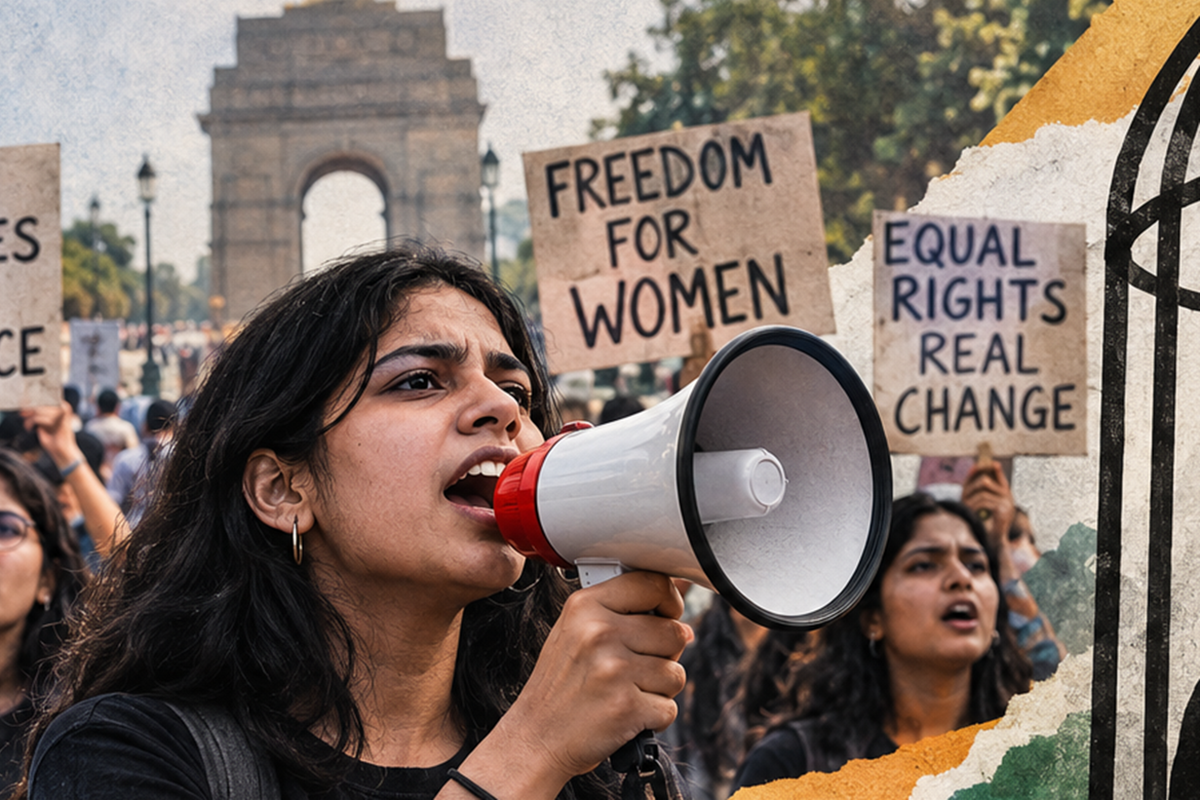
Image used for representational purpose. (AI generated image)

Synopsis: From the streets of Delhi to the wider country, Gen Z girls are demanding safety, freedom and fundamental rights, saying women remain prisoners in the cage of patriarchy. We should be listening to them.
“The day when women in this country can walk the streets without fear even at midnight is the day this country will have achieved true independence” – Mahatma Gandhi
Have you seen the protests that the students of Delhi’s Lady Shri Ram College, Gargi College, Kamala Nehru College and other colleges have been carrying out? Have you really listened to what these girls are saying?
If you have and if their words truly sink in, this country and the entire male world should hang their heads in shame. Those who understand, and those men who still remain human, must now join their voices with the crores of women who have been asking these questions for years.
“I feel very scared when I walk on the streets. From a 12-year-old boy to an old man, men everywhere look at women as if they are objects, as if they are something to be consumed. Looking at their stares, their indecent behaviour and sexual harassment, I constantly feel the fear of when they will attack me and what they will do to me,” said a 17-year-old college girl at a protest in Delhi.
“My father tracks me every moment – where I am. I have to keep telling him where I am, what I am doing and who I am with. As soon as it gets a little dark, I am not allowed to go out. If I had been a son, these restrictions would never have existed, I think. Controlling my every movement like this, having no freedom at all, feels very difficult, as if I cannot even breathe,” said another girl.
“I do not belong to myself. I am not even a human being. None of the fundamental rights given by the Constitution are mine. These families, this culture, marriage and patriarchy that keep saying I have no thought, no intelligence, no heart and that I must always remain under someone else’s control – I don’t want any of it,” said yet another girl.
These girls who are speaking like this could be your daughters or sisters living in your own homes. Society, governments, our families – and especially men – must finally listen to what they are saying.
The slogans that echoed through the streets of Delhi captured their angst.
“Lock up the rapists, not the girls!
Don’t check Beti’s location, check Beta’s intent!
Girls want their fundamental rights!
Ek kachori, do samosa… in mardon ka kya bharosa!
(One kachori, two samosas… how can one trust these men?)
Hamari skirt nahi chhoti, in mardon ki soch hai chhoti!
(Our skirt is not short, these men’s thinking is short!)
Tod kar rakh do woh samaj, naari is mein bandi hai aaj!
(Break that society in which women are imprisoned today!)
Patriarchy must be destroyed.
Women are not objects or cuties – they are revolutions.
Punish the rapists, not the girls.”
“It’s not a women’s safety issue, it’s a male violence issue.”
These girls created memes, posters, reels and songs on the spot with great creativity, mixing humour with deep understanding, and offered serious analyses of the patriarchal society. Gen Z girls have strongly told society once again not to treat them as a generation that only makes Instagram reels and knows or cares nothing about politics.
What the Gen Z girls in Delhi are actually demanding is better street lighting around universities, roads and parks; more Delhi Transport Corporation/shuttle buses; discounted metro passes for women; working public toilets and menstrual health facilities.
They want the ability to travel safely at night and the freedom to use public spaces without curfews and moral policing. Currently, parks are shut after sunset instead of providing security – that is not a solution, they say. They are demanding CCTVs, police patrolling, government accountability and strict action against those who commit rape.
There is no point in getting angry when Gen Z girls say that ours is a rapist nation, a rapist culture, and that a rapist generation is being produced in this country.
On the one hand we claim to worship women. But recall the obscene dances that took place to DJ music during the recent Kanwar yatras and the recent Ganesh immersions. The sexual gestures of men and even minor boys, and the moral policing, make the truth in these girls’ words clearer.
After the alleged gang-rape of a 17-year-old girl by three men posing as policemen near Astha Kunj Park in Kalkaji, Delhi, on September 21, the student unrest intensified. The prestigious Lady Shri Ram College, which is located near the Park, shifted to online mode, as a ‘safety measure’ for its students.
Sadly, institutions supposed to provide protection and take action once again shifted the blame onto the girls and tried to cover up their own failures, which only angered the students further.
There were other incidents. The behaviour of a group of boys towards a girl returning home from a coaching centre on a classmate’s motorcycle in Jamui, Bihar, on September 20 – and their attempt to abduct her – shocked everyone.
Similar incidents have occurred in Banka and Samastipur in Bihar, Sri Ganganagar in Rajasthan, and many other places.
An allegation of rape involving a girl at Lovely Professional University (LPU) in Punjab created fear and serious unrest in the girls’ hostel there. Because such incidents have happened before as well, girls are terrified even to step out of the hostel.
The protests that began in Delhi against the recent series of rapes and sexual assaults have now spread to many towns across the country.
In Hyderabad, on October 3, Gen Z girls, women, LGBT and queer community members held a ‘Midnight March’ protest from 9 pm to midnight, proclaiming “These streets are ours too.”
Delhi students, recalling the Nirbhaya incident of December 16, 2012, said with deep anguish that the lot of women in the country has not changed at all since then. The same is happening all over the country.
In reality, in our country, poor women, Dalit women, Adivasi women, minority women and women in rural areas face sexual violence and rape on an even larger and more open scale, along with many other forms of discrimination.
Members of the LGBT and queer communities face several times more violence and rape. Almost always, the perpetrators escape without any punishment.
Sexual violence, harassment and rape against women continue not only in open spaces such as streets, parks, hospitals, colleges, trains and buses, but also in places where one expects safety – police stations, homes, educational institutions, hostels and offices. We see that even a three-month-old infant and an 80-year-old woman cannot escape this sexual violence. It happens daily regardless of what clothes the girls/women wear, how they look, or what time it is. Living in terrifying conditions with no safety anywhere, women, in most instances, restrict themselves for self-protection and live as prisoners in the cage of patriarchy.
Official statistics (NCRB 2024) say that 4,41,534 crimes (about 1,210 cases per day) against women were registered in 2024. Of these, 29,536 (about 80 per day) were rape cases.
There are 64.6 crimes per lakh women. In Delhi it is roughly double, at 130.7. In 2025, 76,650 cybercrime complaints involving women were registered.
In 96.8% of the rape cases, the accused is known to the victim – a family member, neighbour, friend, etc. Strangers are rare. In such a situation, where can women find safety?
Like the women of previous generations, today’s Gen Z young women have also realised that rights, equality and freedom for women are not things someone else grants – they have been held captive in the hands of patriarchy. The Gen Z girls’ call to “smash the cage of patriarchy” must become a reality if this has to end.
Also Read:
Bombay High Court finds Tarun Tejpal guilty of rape, sentences him to 10 years in prison
(Edited by R Rajesh Kumar.)



