

Published Oct 18, 2026 | 7:00 AM ⚊ Updated Oct 18, 2026 | 7:00 AM

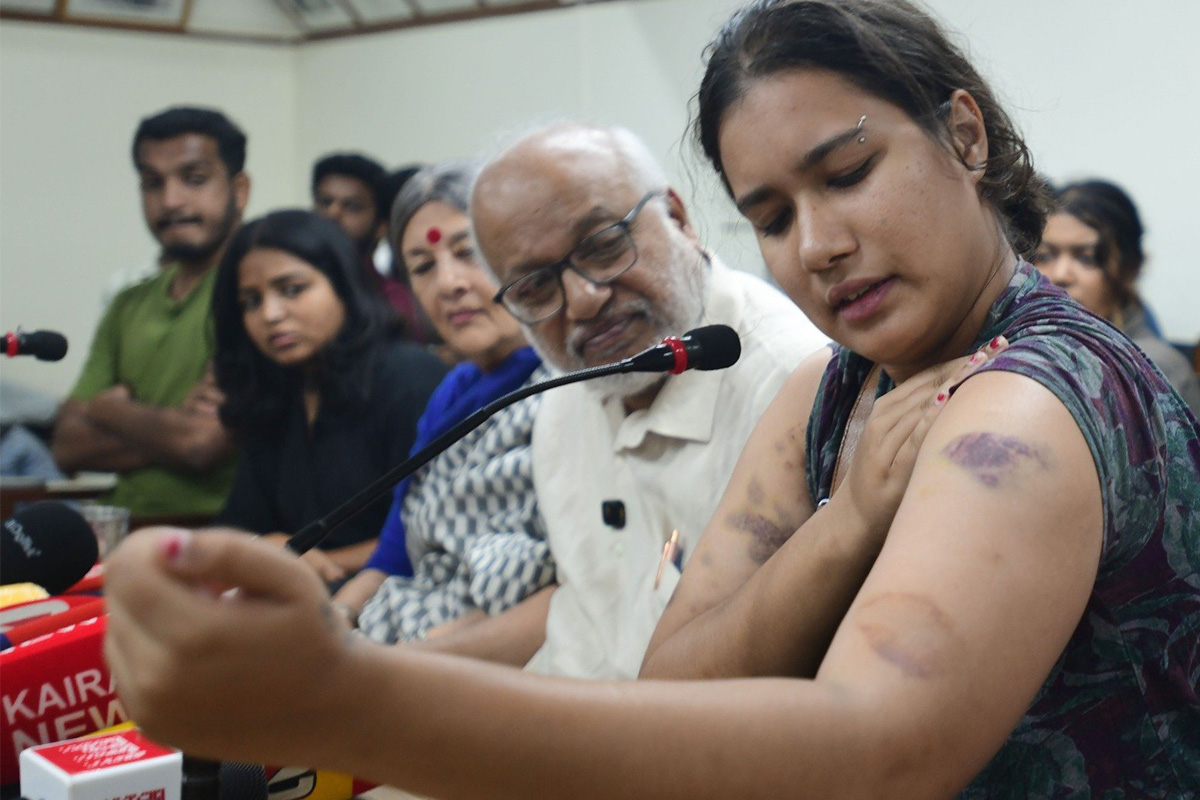
On 12 October, CPI(M) held a press conference where victims recounted alleged police brutality during Delhi protests.

They beat women, young men, and children. They beat those raising slogans, those walking along the roads, those going to hospitals and offices, and lawyers who uphold the law. They beat farmers and university professors who teach. They beat members of opposition parties. They beat numerous MLAs and MPs who represent lakhs of people.
Blocking paths, dragging people, throwing them to the ground, four or five men grabbing protesters by the hair and hauling them away, flinging them into police vans, tearing clothes, and beating indiscriminately until blood flowed — all of this has been happening for days right on the streets of Delhi.
Finally, they arrested hundreds of people and took them to specially set-up detention camps. Cases were registered against many.
A complete ban (denotification) at Jantar Mantar came into effect on 11 October 2026—after 30 years.
Abhijit Dipke, Saurav Das, and Ashutosh Rankha were arrested preventively the moment they landed in Delhi from Mumbai, cases were filed against them, and they were sent to jail. They were picked up again later.
Even journalists who had come simply to report were beaten indiscriminately and arrested.
Press freedom has been reduced to a mockery; the wings of the media are being broken. People across the country are watching these repeated incidents in Delhi in stunned silence. Several international organisations have warned that democracy in India is in danger.
At least 37 journalists — among them women — who had gone to report the protests demanding the resignation of the Chief Election Commissioner Gyanesh Kumar and the repeal of the SIR were taken into custody by the police. Some of them were beaten severely. Their phones and cameras were seized. They were pressured to delete footage.
Private individuals who claimed to have come in support of the police and called themselves “Hindu protectors” also insulted reporters, abused them, and behaved indecently with the women.
Correspondents from Newslaundry, Scroll, Business Standard, Caravan, Peek TV, The Hindu, The Indian Express, Nava Bharat, and even the BBC were among those who faced detention.
After such repression, the Cockroach Janta Party and other student organisations issued a call for ‘Lehra Do Tiranga’ on October 16 and 17.
But even those who came peacefully onto the streets to wave the national flag were beaten. Many, including Abhijit Dipke, were arrested again. Force was used against Neha Bora while taking her into custody. Until midnight, no one knew where she was being held; intense anxiety spread everywhere. She was released in the early hours of October 17. It was only later in the evening that news of the Delhi Special Executive Magistrate (SEM) Court granting bail to Dipke arrived.
On September 3, 2026, police arrested Shaheen Khan and her sister Nafisa Khan, who work as reporters for the YouTube news network Channel 4PM, detained them at Saket police station in Delhi, and beat them severely.
Barely a month later, on October 3, three women journalists again faced sexual harassment and assault from the police.
A dharna had to be organised simply to get a case registered against ACP Vivek Bhagat for sexually inappropriate behaviour towards a woman journalist. Now, that same police officer has filed a counter-case against the woman journalist.
In reality, the Constitution lays down rules that the police themselves must follow. While on duty, they must wear identification badges and khaki uniforms. They must not behave indecently towards women. There are rules against keeping women in custody after sunset. Victims have the right to complain against police officers who overstep their limits.
What is causing the greatest alarm now is the presence, at the forefront of protest crackdowns, of people in khaki without nameplates. Men and women who claim to be police are dragging and abusing protesters in vehicles without number plates. Are these people really the police?
Even when protesters and journalists showed the police brand-new khaki uniforms, lathis, and vehicles being ferried in cars without number plates on the streets of Delhi, the police took no action.
On another front, gangs openly declaring “We are from Hindu Sena, RSS, Bajrang Dal; we have come to protect Hindu religion and dharma; we stand with the Delhi Police” are roaming the streets. They are attacking protesters and are said to be sexually harassing young women and women journalists. When protesters repeatedly appealed to the police to stop them, the police, to the astonishment of the complainants, simply let these groups go without a word.
Who are these people roaming with the police, shouting “Delhi Police Zindabad”, and attacking demonstrators? Who sent them? Where have they come from? Even though all this is happening before the eyes of the police, why are they staying quiet?
Even when public pressure forces the arrest of some of those who behaved indecently with young women, why are they released immediately? These questions are now being asked across the country.
Similar allegations arose during Jantar Mantar 1.0, demanding action on the NEET paper leak and the resignation of Dharmendra Pradhan: men in plain clothes carrying lathis attacked protesters. The police first described them as “spotters” from the Special Branch and Crime Branch for crowd control. After widespread criticism, orders were supposedly issued that such personnel must wear only uniforms, not plain clothes.
That is perhaps why an unidentified woman protester mocked the police, saying, “They ordered khaki from Amazon just now and put it on.” Neha Bora and AISA have also called upon the Delhi Police to “Take off their uniform and put on RSS knickers” in condemnation of their behaviour.
Whatever the disguise, allegations are pouring in that private mobs have been given extensive powers to crush protests.
Sexual assaults have taken place against young women and some young men as well. Women have long said that sexual violence is used as a weapon to control them, to frighten them, and to force them into submission.
Sexual violence was carried out openly—groping, pulling clothes, taking photographs and videos for doxxing, and making rape threats. After the July protests against the NEET paper leak, women protesters faced widespread online threats of rape and murder, morphing of photographs, and the publicising of their addresses. Even now, photographs of young women who are participating in or questioning the protests continue to be taken and circulated.
When Neha Bora was taken into custody, her chest was pressed, and she was pushed back, according to complaints by the SFI and other organisations, women protesters, journalists, and lawyers. Male police officers behaved indecently and groped women protesters, journalists, and lawyers. The use of sexual violence is also a way of telling women: “Stay at home. Don’t come onto the streets.”
Women constables without nameplates also committed sexual violence. People are wondering whether these are real policewomen or members of the RSS and VHP’s women’s wings, such as Durga Vahini. Many of these women constables beat women on their breasts and private parts, choked them, abused them, and issued rape threats.
Allegations have also been made that when student-organisation protesters and women were taken into custody, not only male but also female police officers touched them indecently and lifted their kurtas — acts of sexual humiliation.
History has already proved that fascist women who support patriarchy and dictatorship also exist.
When Yogendra Yadav and Prashant Bhushan were in custody on Ashoka Road, some media reports alleged that a policeman touched them indecently from behind. Most disgustingly, images of women dancing around an effigy of Rahul Gandhi have been circulating on social media. Who knows whether such women have also joined the ranks of those without nameplates who are suppressing protests?
The attacks on journalists have been strongly condemned by the Press Club of India (PCI), the Delhi Union of Journalists (DUJ), Reporters Without Borders (RSF), and other national and international organisations.
They described it as “a gang attack on press freedom.” Journalists held protest demonstrations in several cities. The Editors Guild of India and others have demanded clear guidelines for the safety of journalists and the framing of court-standard Standard Operating Procedures (SOPs).
The Network of Women in Media, India (NWMI) has filed a petition in the Supreme Court. Senior advocate Indira Jaising brought the petition before the bench, stating that this is an attack on the freedom of the press guaranteed under Article 19(1)(a) of the Constitution and that journalists — especially women journalists — have been forced to face a terrifying situation.
At a time when mainstream media outlets are being criticised for having turned into “Godi media” and press freedom is disappearing, many stories and facts that had been rendered “invisible news” over the past few months are now coming to light.
Hundreds of young women and men, and ordinary citizens, have become “people’s reporters” with the mobile phones in their hands, emerging as anonymous correspondents. They are bringing to light numerous issues and truths that the mainstream media does not cover or does not wish to report, thereby creating an “alternative media.”
In the end, perhaps this will bring about the redemption of the news industry on this soil.
Also Read:
From Jewish Gandhi’s lonely speeches to a chorus for democracy: Inside Kochi’s ‘Chalo Jantar Mantar’
The road to Jantar Mantar: A day inside India’s sealed capital
In groups of four, through back lanes: How students tried to reach a sealed Jantar Mantar
(Edited by R Rajesh Kumar.)



