

Published Jul 24, 2026 | 7:00 AM ⚊ Updated Jul 24, 2026 | 7:00 AM

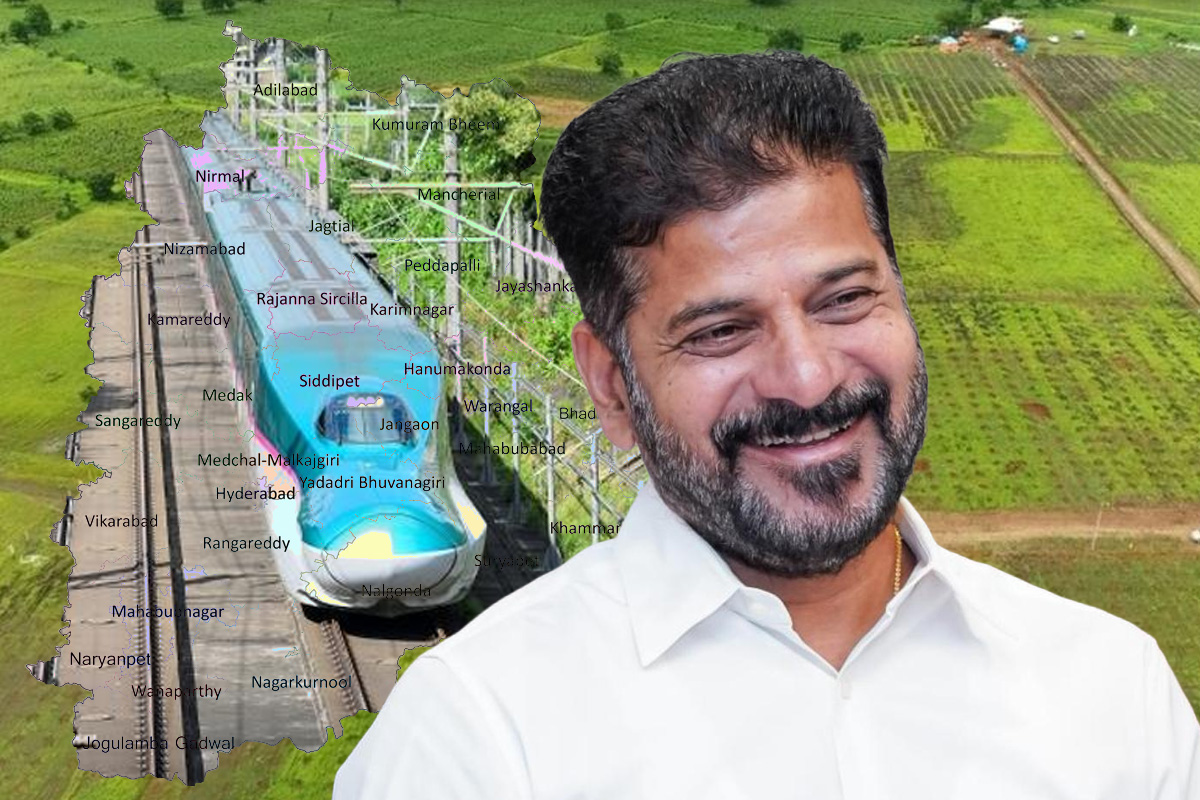
Telangana government has already rushed into land acquisition for bullet train project.

Synopsis: The Telangana government is running short of money. But when it comes to the three proposed bullet-train corridors, there is no dearth of enthusiasm. Strangely, all this comes at a time when the Detailed Project Reports essential for the Central government’s nod haven’t been prepared. The state’s haste in rushing into acquisition even before all this and the manner in which they have set about it raise many uncomfortable questions.
The Telugu proverb, “There isn’t a morsel to eat, but there’s fragrant oil for the moustache”, aptly describes the Telangana government today.
Since assuming office thirty months ago, it has allowed a long list of unpaid dues to pile up, including relatively small payments running into just a few lakh rupees. Reports suggest that even essential expenditure is being deferred. Contractors who have supplied hired vehicles for government officials for the past two and a half years are still awaiting payment. Those providing lunches, snacks, tea and coffee at the State Secretariat have also not been paid.
Government advertisement bills owed to newspapers and television channels have reportedly remained pending for more than two years. Reimbursements due to colleges and hospitals are moving at a snail’s pace, while contractors in several other sectors continue to complain of mounting arrears.
Yet, despite this apparent inability to meet routine financial commitments, the government is enthusiastically pursuing participation in three proposed bullet train corridors, each expected to cost between ₹1.3 lakh crore and ₹1.7 lakh crore. These projects envisage high-speed rail links connecting Hyderabad with Pune, Chennai and Bengaluru. The state government is moving with remarkable urgency to establish a Hyderabad Bullet Train Hub, from where trains travelling at 350 kmph are expected to reach Mumbai, Chennai and Bengaluru in less than three hours.
Beyond a mention in the Union Budget of 2026, however, virtually no preparatory work has begun. Detailed Project Reports (DPRs) have yet to be prepared. Only after the DPRs are completed can the projects receive Central Government approval, environmental clearances and public hearings. Land acquisition must follow before construction tenders can be invited and contractors appointed. Since even the DPR stage has not been reached, it is impossible to specify any concrete milestones today. Technical experts estimate that if land acquisition is completed by 2029 and construction begins soon thereafter, the bullet trains may become operational sometime between 2035 and 2037.
Also Read | The bullet train as optics: Questions Hyderabad’s high-speed rail push leaves unanswered
Yet the Telangana government has already rushed into land acquisition, reminding one of another Telugu saying about naming a child before either the house or the hearth exists. Land acquisition comes only at the fifth or sixth stage of such a project. The government’s haste in beginning it before even the first step has been completed raises an obvious suspicion: even if the project itself never materialises, the land would already be in government hands. One only wishes the same urgency, speed and determination were shown in carrying out projects that address the people’s immediate needs.
For the proposed Hyderabad Bullet Train Hub, the government has identified 650 acres near Shamshabad Airport in Bahadurguda village—500 acres in Survey No. 62 and another 150 acres in Survey No. 28. Officials claim these are government lands presently under cultivation by farmers and therefore can be resumed for the project.
If the land indeed belongs to the government, it certainly has the legal authority to reclaim it. But the first question is to verify whether these lands are actually government property. Even if they are, if farmers have cultivated them continuously for decades and remain in possession, the law prescribes due process before such lands can be taken over.
Instead of following that legal procedure, the authorities resorted to the familiar methods that have increasingly become associated with HYDRAA—bulldozers, intimidation and coercion. Around a thousand police personnel accompanied revenue and HYDRAA officials, along with bulldozers and labourers carrying fencing materials, in a pre-dawn operation last Saturday.
Villagers were prevented from leaving their homes or reaching their fields. Those who protested were arrested. Electricity supply to the village was cut off, an atmosphere of fear was deliberately created, and fencing work began even around fields where standing crops were ready.
For over a week before this operation, farmers had been staging continuous protests after learning that officials planned to take possession of the land. Naturally, when the authorities arrived, the cultivators resisted. They argued that the government itself had originally assigned these lands to them, although it had repeatedly failed to provide the necessary documentation despite their representations.
Even in the absence of formal papers, they argued, land that had remained in their possession and cultivation for decades could not legally be seized without due process. During the confrontation, the police resorted to a lathi charge. Villagers, especially women, actively resisted the officials, some throwing chilli powder into the eyes of the police. Opposition parties, including the BRS and the BJP, supported the protesting farmers, and several opposition leaders were also arrested.
The authorities present a different version. They claim that even if these were assigned lands, they had subsequently been illegally alienated, with purchasers constructing buildings and farmhouses, and that these very people were instigating the protests. Officials say the farmers had initially agreed to accept developed residential plots measuring 500 square yards for every acre surrendered, but later demanded 1,200 square yards under outside influence. The government now says that of the 650 acres being acquired, 400 acres are required for the Bullet Train Hub, 100 acres for a bus terminal, 50 acres for a Metro terminal, while another 96 acres will be developed as a residential layout from which displaced farmers will receive 600 square yards per acre.
Without even a Detailed Project Report, however, it is impossible to determine which of these assurances are credible and which are not. Even the present acquisition process is riddled with contradictions. While the government claims that acquisition is confined to Survey Nos. 62 and 28, fencing has also been erected around lands in other survey numbers. For example, fencing has enclosed twenty-six acres of privately owned patta land in Survey Nos. 3 and 5, where crops are presently standing.
Also Read | Hyderabad’s high-speed rail push: An American example that serves as a cautionary tale
Four farmers—Jakkidi Yadireddy, Jakkidi Srinivas Reddy, Thurpu Sudarshan Reddy and Thurpu Sudhakar Reddy—have challenged this before the Telangana High Court. Each owns between six and eight acres of land on which they cultivate paddy, vegetables and flower gardens. Appearing before Justice B Vijay Sen Reddy on Monday, senior advocate V Raghunath secured interim orders directing the government not to take any coercive action with respect to these twenty-six acres.
Their ninety-eight-page petition includes sale deeds dating back to 1990-92, pattadar passbooks held continuously in their names for over thirty-six years, and corresponding Dharani and Bhu Bharati land records. They ask what authority the government has to fence off land that has remained in their lawful possession and cultivation for over three decades and prevent them from even entering their own fields. They further informed the court that officials had entered their private property, demolished gates and compound walls with bulldozers, fenced the land and even encroached upon the area where their ancestors are buried.
At the same time, R Krishnamohan Raju and eighty-four other farmers have separately approached the High Court alleging that HYDRAA, revenue and police officials illegally entered their private lands across several survey numbers in the village, caused extensive damage and dispossessed them. They have sought court directions restraining the authorities and restoring possession of their lands. According to them, nearly five hundred families in the village have suffered severe psychological trauma because of these actions.
For sections of the urban middle class captivated by dreams of bullet trains and futuristic infrastructure, the anguish of these farmers may not matter much. Many may even ask whether people cannot make such sacrifices in the interest of “development”.
This argument is hardly new. Since the days of British colonial rule, millions of acres have been grabbed from peasants and Adivasis in the name of public purpose, creating generation after generation of displaced people. In India, since the era of economic liberalisation beginning in 1992, land acquisition in the name of development has expanded enormously. Every such project is accompanied by sermons about individual sacrifice for national progress. Yet the real question remains: who sacrifices, and who ultimately benefits?
One only has to compare the hundreds of so-called development projects implemented across India with the millions displaced by them. Those who sacrificed rarely became beneficiaries. At best, they received monetary compensation.
Many, suddenly receiving sums far beyond anything they had previously handled, found that they didn’t possess the experience or the institutional support to invest them wisely. Some squandered the money, others were cheated, and many eventually slipped into poverty.
Even such compensation reaches only landowners. Those who depend on agriculture and the village economy without owning land—the agricultural labourers, artisans and numerous other occupational groups—receive virtually nothing. In most villages, such landless families constitute more than half the population. Their only option is to migrate to towns and cities as casual wage labourers.
If development simultaneously impoverishes landowners and turns the landless into destitute migrants, who exactly enjoys its fruits? Ten years from now, if the proposed bullet train ever begins operating, will even a single member of the displaced families of Bahadurguda be among the thousands of passengers rushing to Chennai or Bengaluru in just two hours?
Whose sacrifice is it? For whose benefit?
Is it not time we began questioning this upside-down model of development itself?
Also Read | Telangana: A state rich in corruption
(Edited by R Rajesh Kumar.)



