

Published Jul 08, 2026 | 3:12 PM ⚊ Updated Jul 08, 2026 | 3:12 PM

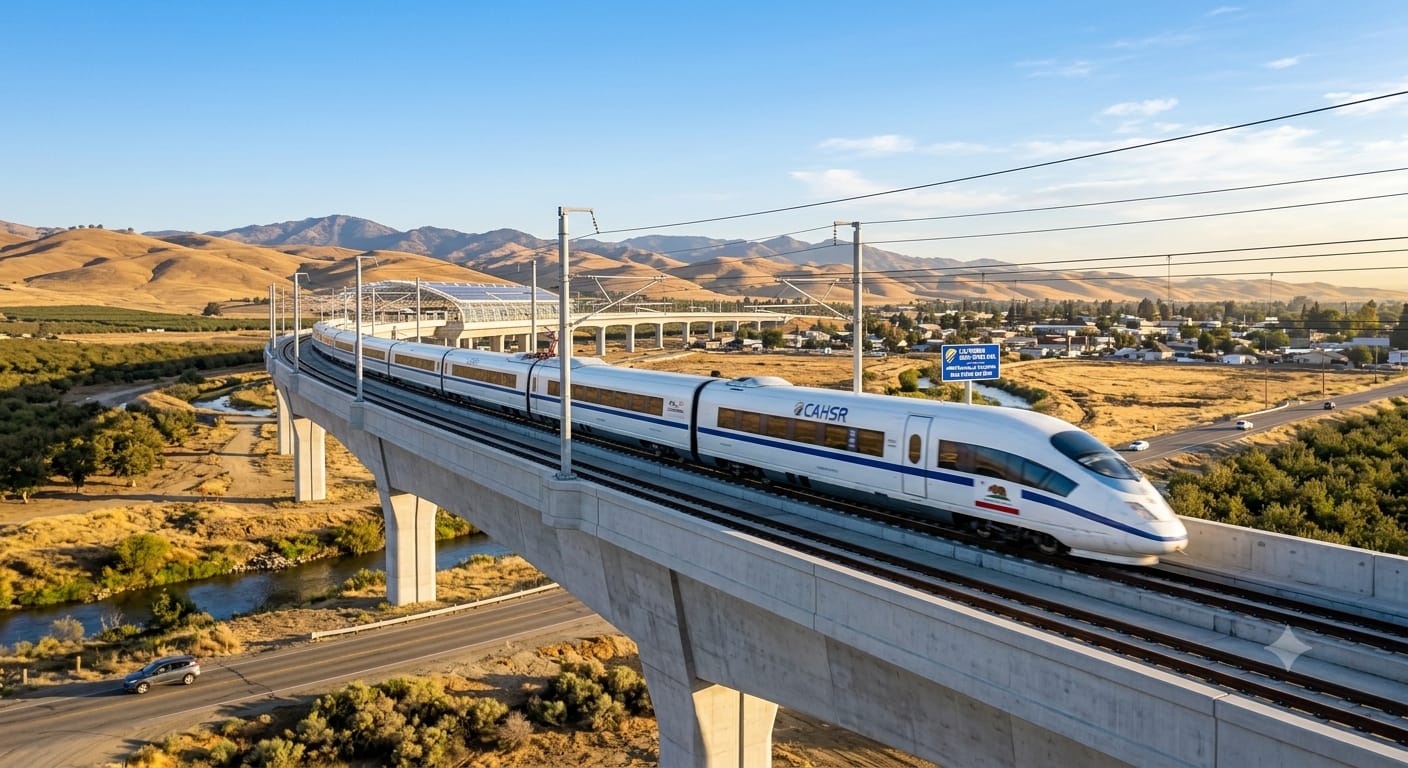
Bullet train. (Representational Image)

Synopsis: A bullet train is, without doubt, a strikingly visual symbol of a modernising, “developed” India. While that symbolic value is real, it cannot be a substitute for the arithmetic of who rides it, who pays for it, and who is displaced to build it.
As we had highlighted while examining the questions that Hyderabad’s high-speed rail push leaves unanswered in the first part of this article, the city is almost always abuzz with news surrounding the bullet-train project.
But what’s being sold and what’s being skipped in the rush to get there and who actually gets to ride the bullet trains? Also, was the cheaper domestic alternative that already exists studied? Finally, why is nobody discussing the domestic precedent that could help check how assumptions of such projects have fared against reality. These were the critical points we had touched upon there.
Now, it’s time to move farther afield in our search of answers.
California’s high-speed rail programme is the starkest cautionary tale available, precisely because it began the same way India’s southern corridors are beginning now: political approval and land acquisition ahead of a fully worked-out plan. Voters approved a $9.95 billion bond in 2008 against a projected $33 billion total cost and a 2020 completion date. California’s own state auditor later found that construction had begun before the authority had secured the necessary land parcels or accounted for utility relocation costs.
Eighteen years on, current cost estimates run as high as $126–128 billion, the timeline has slipped past 2033 for even a partial segment, and the federal government has withdrawn billions of dollars in funding, citing missed milestones and an unresolved funding gap. The project may yet be judged worthwhile once finished, but the sequence by which California got there—starting construction on the strength of, in one commentary’s phrase, “concepts of a plan” rather than a completed one—is exactly the sequence now being repeated in Telangana: land surveys and alignment-marking well ahead of any published cost-benefit case.
Much of the difficulty above traces back to a constraint that conventional Indian Railways lines simply do not face: at 320–350 km/h, a train cannot safely turn the way a 130 km/h Vande Bharat can. High-speed rail design standards specify minimum curve radii of roughly 5,500–7,000 metres for 300–350 km/h operation—several kilometres wide, not the tight bends a conventional railway or highway can take around a hill, a lake, or a town. This is precisely why India’s conventional rail lines, and highways, can hug river valleys, skirt forests, and curve around villages, while a bullet train alignment is, by physical necessity, close to a straight line over long stretches, deviating from it only in broad, gentle arcs.
The practical consequence is that a bullet train alignment cannot be quietly threaded around whatever happens to be in the way. Where a conventional road or rail project can bend to avoid a reserve forest, a lake, or someone’s homestead, a high-speed line generally cannot, without expensive tunnelling or viaducts of the kind already driving up Mumbai–Ahmedabad’s costs. This is also why these corridors run straight through farmland that other infrastructure has learned to route around, and why the alignment overlaps, rather than avoids, other major projects already under construction in the same districts.
That overlap is not hypothetical. Telangana’s own Regional Ring Road and the accompanying Regional Ring Railway—a separate ₹12,070 crore, 392-km project with its final alignment approved in 2025—run through many of the same districts now being surveyed for the bullet train: Vikarabad, Ranga Reddy, and Nalgonda among them. The state government’s own 2025 announcement of the Regional Ring Road explicitly folded the bullet train corridor into the same development band as the ring road and a “Regional Ring Railway”.
Three major linear infrastructure projects—a ring expressway, a ring railway, and a bullet train line, each independently requiring land, are converging on the same rural districts within a short span of years, without any published document showing how their land requirements, resettlement obligations, or environmental impacts have been jointly assessed rather than added up sequentially, project by project, on the same farming communities.
The terrain itself compounds the problem. NHSRCL’s own officials have acknowledged that the Hyderabad–Mumbai alignment will need to negotiate reserve forest near Vikarabad, with a tunnel under active consideration specifically to limit disturbance to wildlife there.
Separately, the Hyderabad–Chennai corridor’s Telangana and Andhra Pradesh stretches run through Nalgonda and Guntur districts to reach Amaravati—the same two districts, among five, that together host the Nagarjunasagar-Srisailam Tiger Reserve, India’s largest, spread across the Nallamala hills. Whether the finalised alignment comes close enough to the reserve or its buffer zone to require a wildlife clearance has not been addressed in any public document; given the reserve’s footprint across exactly the districts this corridor must cross, it is a question that should have been settled, and published, before survey teams began marking farmland.
Beyond terrain, a meaningful share of the demand case for these corridors is pointed at destinations that do not yet function as cities. The Hyderabad–Chennai corridor’s justification leans in part on connectivity to Amaravati, Andhra Pradesh’s capital project—first announced in 2015, substantially stalled between 2019 and 2024 amid a change of state government and a rival three-capital proposal, and revived only after the 2024 election, with its capital-city status settled in law only as recently as April 2026.
Telangana’s own “Bharat Future City,” expected to anchor demand on other legs of the network, is a proposed 30,000-acre greenfield city near Shamshabad whose master plan is not due for completion until December 2026 and whose development authority is, as of May 2026, still building its own headquarters. A farmers’ welfare organisation, Rythu Swarajya Vedika, has publicly questioned the project’s transparency, arguing it was conceived without adequate consultation, a clear land-use framework, or clarity on compensation and rehabilitation for the villages being absorbed into it—while Hyderabad, Secunderabad, and Cyberabad still have unused urban capacity of their own.
In other words, a meaningful part of the ridership case for these corridors rests on economic activity expected to materialise from two cities that are themselves still being built, more than a decade after one of them was first announced. A rail line’s demand projection is only as credible as the demand it is projected onto; right now, part of that demand exists mainly on master-plan renderings rather than in any operating city.
Survey teams have already begun marking agricultural land with red-and-white paint across Shamshabad, Maheshwaram, Kandukur, and Yacharam mandals for the Hyderabad–Chennai and Hyderabad–Bengaluru alignments—the customary first step before formal land acquisition proceedings. This is happening against the backdrop of a state where farmers have, in the last two years, resisted land acquisition for the Regional Ring Road, a proposed pharma village, an industrial park, and other projects, citing inadequate compensation and an absence of prior consultation. There is no visible reason to expect the bullet train land acquisition to unfold differently, because the sequence is identical: alignment and acreage first, consultation and impact disclosure later, if at all.
None of this is unique to railways. It fits a broader pattern in how big-ticket infrastructure gets built in India: the announcement precedes the assessment, the ground-breaking precedes the cost-benefit study, and by the time the underlying assumptions are tested against reality, the political credit has already been claimed and the land has already changed hands. A bullet train is, among other things, a strikingly visual symbol of a modernising, “developed” India—the kind of image that photographs well at a summit or a foundation-stone ceremony. That symbolic value is real, but it is not a substitute for the arithmetic of who rides it, who pays for it, and who is displaced to build it.
The corridors through Hyderabad may well turn out to be worth building. Nobody can currently say so with confidence, because the analysis that would answer that question has not been done in public. Until a needs assessment, a comparison against upgrading existing rail and air capacity, an independent cost-benefit and risk analysis, an environmental and social impact assessment, and a resettlement plan grounded in actual consultation are published—before further land surveys, not after—this remains an infrastructure decision built on faith in the announcement, and in cities still being built, rather than evidence for the outcome. As currently structured, it also risks being a mode of transport that excludes the ordinary rail traveller on cost while failing to conclusively outcompete the flight for everyone else—leaving open the question of who, exactly, this is being built for.
(Edited by R Rajesh Kumar.)



