
Published Sep 08, 2026 | 11:45 AM ⚊ Updated Sep 08, 2026 | 11:45 AM

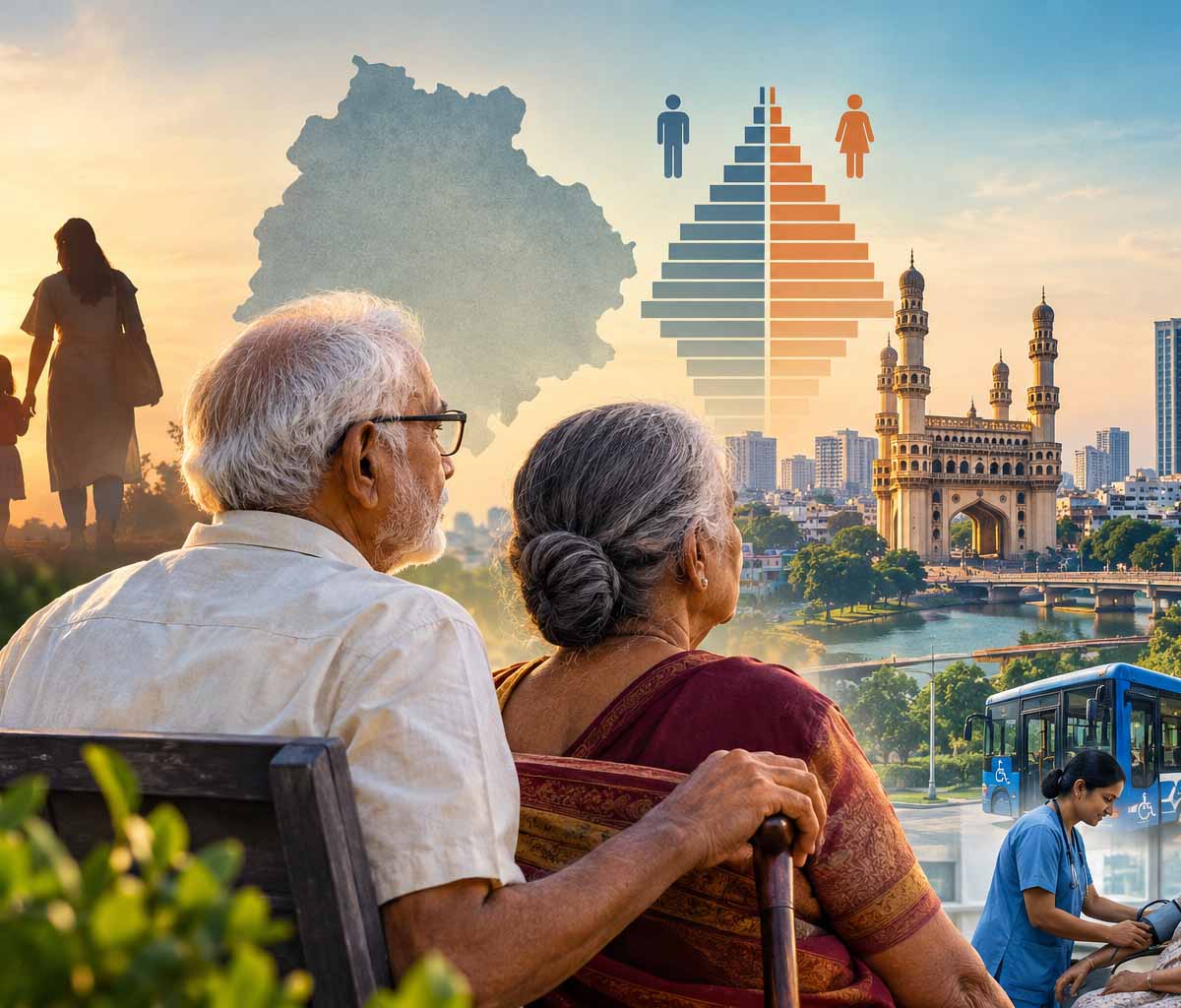
Image used for representational purpose. (AI generated)

Synopsis: India is ageing, and Telangana is ageing faster. The projected elderly share of 17.1 per cent in the State by 2036 should be treated not as a statistic for demographic reports but as a firm deadline for public policy.
Telangana’s elderly population is growing faster than the national average. What was once treated as a distant demographic projection has become a present reality in the State, visible in its growing elderly share, mounting care pressures and shifting family structures. India’s long-celebrated demographic dividend is yielding to a quieter but more consequential transformation: the country is ageing, and Telangana is ageing faster.
Nationally, India had roughly 153 million people aged 60 and above in 2022. By 2050 that number is projected to reach 347 million, or nearly 21 per cent of the population — more than doubling in three decades and adding almost 200 million older citizens. Fertility has fallen sharply while gains in healthcare, nutrition and living standards have extended survival into old age. The demographic pyramid is losing its broad base: the elderly population is expanding even as the relative size of younger cohorts declines.
For India, this creates a dual imperative. The country must still harness its youth dividend, yet it must simultaneously prepare for a society in which one in five citizens will be a senior. Telangana offers an early and clear signal of what that future will demand.
According to the India Ageing Report 2023, the share of people aged 60 and above in Telangana stood at about 11 per cent in 2021, against a national figure of around 10.1 per cent. By 2036 the elderly share in the State is projected to climb to 17.1 per cent, well above the anticipated national level of about 15 per cent. A difference of two percentage points may seem modest; in policy terms, it can be decisive. A State in which nearly one in six residents is elderly will require fundamentally different systems from one dominated by children and young adults.
Healthcare for the elderly will have to absorb a far higher burden of chronic disease, disability, rehabilitation and long-term care. Public transport, housing and urban design must become age-friendly. Social security coverage will need to expand. Families will increasingly juggle the care of ageing parents with the education and employment needs of the young. Telangana’s trajectory reflects a broader southern pattern: southern States experienced fertility decline earlier than many northern counterparts, producing a more mature population structure. Projections leave little doubt that the elderly population will continue to grow substantially in the years ahead.
The language of the “demographic dividend” is therefore incomplete. A dividend is temporary; demographic ageing is structural. Telangana cannot assume that today’s working-age population will automatically generate the resources needed to support tomorrow’s elderly. A large segment of the State’s workforce remains in the informal economy, where formal pensions and employer-sponsored retirement benefits are limited. For many households, old-age security still rests heavily on children.
That social contract is itself eroding. Urbanisation, internal and international migration, and the rise of smaller nuclear families are weakening the traditional multigenerational household. Children often live in different cities or countries. Women, who have historically shouldered much of the unpaid care for elderly relatives, are entering the paid workforce in greater numbers. The result is a growing care deficit that public policy has only begun to address.
The gender dimension sharpens the challenge. Older women live longer than men and are more likely to face widowhood, financial insecurity and dependency. Nationally, the population aged 80 and above is expected to expand by roughly 279 per cent between 2022 and 2050; very old women form a particularly vulnerable group within that subset.
Telangana cannot treat old-age welfare as merely a monthly pension. Pensions remain essential, yet they address only one slice of the problem.
What the State needs is a comprehensive ageing policy built around geriatric and preventive healthcare, home-based care, day-care centres, assisted living, accessible public transport, age-friendly housing and wider social-security coverage. Primary health centres must be equipped to detect and manage age-related conditions before they escalate into costly emergencies.
At the same time, an economic opportunity lies within the challenge. An ageing population will generate sustained demand for nurses, physiotherapists, caregivers, home-health services, medical devices, insurance, pharmaceuticals and specialised housing. Hyderabad’s established strengths in healthcare, pharmaceuticals and technology position Telangana particularly well to build a “silver economy” centred on healthy ageing.
Older people should not be viewed solely as dependants. Many remain capable of working, mentoring, volunteering and contributing to community life. Policies that enable flexible employment, continued learning and social participation can turn longer lives into both an economic and a social asset.
The greatest risk is not that India will grow old. The risk is that it will grow old without having prepared.
Telangana possesses an advantage few regions enjoy: the demographic shift is already visible, giving policymakers time to act. The projected elderly share of 17.1 per cent by 2036 should be treated not as a statistic for demographic reports but as a firm deadline for public policy.
India’s youth dividend has offered a historic opportunity. Telangana’s ageing trajectory delivers an equally urgent message: the future will not belong only to the young. The State that prepares today for the needs and dignity of its elderly will be the one that safeguards every generation tomorrow.
From our archives:
Grey wave rising as South India’s population ages fast
How does migration change the way we age? AKKARE looks for answers among Kerala Americans
Kerala’s search for an elder-care model from Japan runs into fiscal and social realities
(Edited by R Rajesh Kumar.)



