

Published Oct 12, 2026 | 3:21 PM ⚊ Updated Oct 12, 2026 | 3:21 PM

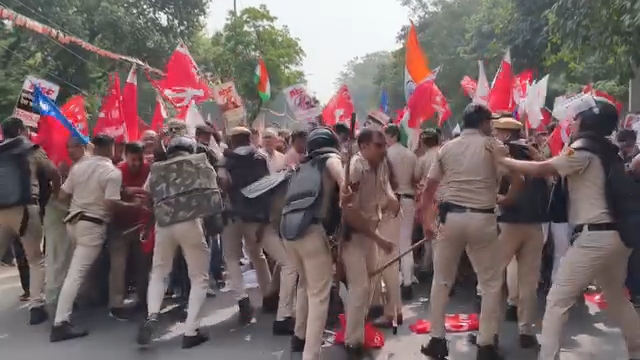
The protest carried out by various Left organizations in New Delhi on 10 October

On October 10, as many as 7,000 citizens attempting to reach Jantar Mantar to protest against the Chief Election Commissioner over the deletion of the names of almost 13 crore voters were stopped at multiple locations across Delhi and detained.
Some were picked up from planes, others from trains, others right from their homes, and ex-West Bengal Chief Minister Mamata Banerjee reportedly from a bus stop area near Delhi’s South Avenue. Abhijeet Dipke’s “This is something not even Indira Gandhi had done” called attention to the unprecedented manner of these arrests.
The Constitution guarantees the right to peaceful assembly, yet citizens attempting to exercise this right encountered barricades, mass detentions and restrictions on movement.
The Delhi Police, with 30,000 boots on the ground, denied permission for the demonstration at Jantar Mantar, citing procedural and security concerns. No effective alternative venue was made available for protesters to exercise their democratic rights. It was only on Monday that the Delhi Police announced Ramlila Maidan, the Burari Ground and the CBD Ground to be new designated sites for protests.
The authorities left citizens with a deeply troubling choice: abandon their protest or risk detention while attempting to assemble. What does the right to protest mean when the established venue is rendered inaccessible, and no workable alternative is provided?
The Supreme Court had asked, “Should you use a hammer to kill a fly?”
Yet, the crackdown continued on Sunday.
Rajya Sabha MP and CPI(M) leader John Brittas was among those at the receiving end.
“I was speaking to the press… was dragged to a police van by CRPF men, despite me telling them that I haven’t violated any law and despite the SC verdict that peaceful protest is a fundamental right… I did not even go near the barricade. In the bus, they pinned me down and assaulted me,” Brittas said.
All this highlights the brute attempt to stifle democratic dissent.
In On Violence, Hannah Arendt distinguishes political power from violence.
“Power and violence are opposites; where the one rules absolutely, the other is absent. Violence appears where power is in jeopardy, but left to its own course it ends in power’s disappearance,” she wrote.
Power emerges when people act collectively and sustain political relationships through shared action. Violence, by contrast, relies on instruments of coercion.
Although governments possess the authority to enforce laws, their capacity to compel obedience should not be confused with democratic legitimacy. The crackdown at Jantar Mantar illustrates the danger of substituting coercion for political engagement.
Extensive barricading, preventive detention and an unprecedented security blanket transformed a planned political demonstration into a security operation. Rather than facilitating peaceful assembly under reasonable safeguards, the authorities created conditions in which participation itself became difficult.
Arendt’s argument is particularly relevant here: violence may secure immediate compliance, but it cannot manufacture consent.
A government may clear streets, disperse demonstrators and prevent a gathering from taking place. But these actions do not resolve the grievances that brought citizens into the public sphere.
Nor does the absence of protest signify public agreement. The critical question is whether the state increasingly relies on coercion when faced with political challenges that require democratic engagement. When force becomes the first response rather than the last resort, it reveals a troubling transformation in the relationship between citizens and authority.
The brutality witnessed on the streets of Delhi on October 10 and 11 exposes the human cost of suppressing democratic dissent. Videos from the ground show protesters being dragged, forcibly picked up from the streets and pushed into police buses and vans. Students were detained before they could even reach the planned protest site, while journalists attempting to document the crackdown were also dragged away and detained.
The police did not merely restrict access to Jantar Mantar; their actions turned public spaces across the capital into sites of confrontation, where citizens attempting to exercise their democratic rights were met with force. When the government makes peaceful assembly practically impossible and responds to political mobilisation through mass detention, it is not simply maintaining public order. It is obstructing the exercise of constitutional freedoms.
That Brittas, a sitting Member of the Rajya Sabha, had to be taken for medical examination after his detention raises serious questions about the conduct of the Delhi Police.
“The police personnel assaulted me and pinned me to the seat. The assault continued even after I identified myself as a Member of Parliament. My status as an elected representative did not deter them from subjecting me to this degrading and physically abusive treatment. I was then abandoned on the wayside as there was an order from the concerned DCP to release me, as he found the detention completely unlawful. Following the assault, I continue to experience severe physical pain and discomfort,” he wrote to the President.
What kind of policing treats even an elected representative in this manner? More importantly, what does this reveal about the treatment of ordinary students and protesters who possess neither parliamentary privilege nor public visibility?
The violence did not end when protesters were taken off the streets. Accounts from detention centres describe male protesters being separated and beaten inside buses and detention facilities. There have also been reports of protesters’ clothes being torn, alongside physical intimidation and verbal abuse.
Detention cannot become an opportunity to punish, humiliate or terrorise those who dissent. Once individuals are in police custody, the responsibility for their safety rests with the authorities. Any use of custody to inflict violence or extract submission represents a grave abuse of state power. The police cannot invoke public order to justify conduct that violates the dignity and rights of the very citizens they are legally bound to protect.
Journalists were not spared either. Videos show them being dragged and forcibly placed into buses and vans as they attempted to cover the crackdown. Their presence was not a threat to public order; it was part of their responsibility to document what was happening. Some journalists who were detained were reportedly told, ‘Koi media nahin hai‘.
When journalists are manhandled while recording police action, the consequences extend beyond the immediate violence. Such conduct obstructs public scrutiny and creates an environment in which the exercise of state power becomes harder to question.
A government that claims democratic legitimacy must accept scrutiny, particularly when its police are accused of using excessive force. The press cannot perform its public responsibility if documenting the actions of those in authority exposes journalists themselves to intimidation and detention.
The events of October 10 cannot be reduced to a dispute over permission, barricades or crowd management. They expose a deeper conflict over who controls democratic public space and whether citizens can meaningfully challenge those who exercise state power.
Arendt’s analysis reminds us that coercion cannot substitute indefinitely for political legitimacy. A state may compel obedience, but the excessive use of force risks weakening the trust on which democratic authority depends. The more the state relies on coercion to manage dissent, the greater the danger that citizens will experience constitutional institutions as instruments of control rather than safeguards of freedom.
Democracy does not mean the absence of law, nor does the right to protest place demonstrators beyond legal accountability. But a government cannot claim democratic legitimacy merely because elections take place. Democracy also requires meaningful opposition, peaceful assembly, independent institutions and effective remedies when rights are violated.
When the state denies citizens a place to protest, detains them before they can assemble and leaves questions of accountability unresolved, the damage extends beyond a single demonstration. It becomes a crisis of constitutional trust. The measure of democracy is not how efficiently the state can silence dissent, but whether it can protect the right to challenge power without treating that challenge as a threat.
Also Read:
Indira Gandhi, Narendra Modi and the march of folly: The same mistake, fifty years apart
SIR ji, no more! A country of 13 crore ‘living dead’ has found its voice
Lest we forget, India resisted Modi and his men long before the Gen-Z agitation
(Akhilesh Kumar is a PhD Research Scholar at Jamia Millia Islamia, New Delhi, Ambedkarite activist and an independent writer. Views are personal. Edited by R Rajesh Kumar.)



