
Published Aug 22, 2026 | 7:00 AM ⚊ Updated Aug 22, 2026 | 7:00 AM

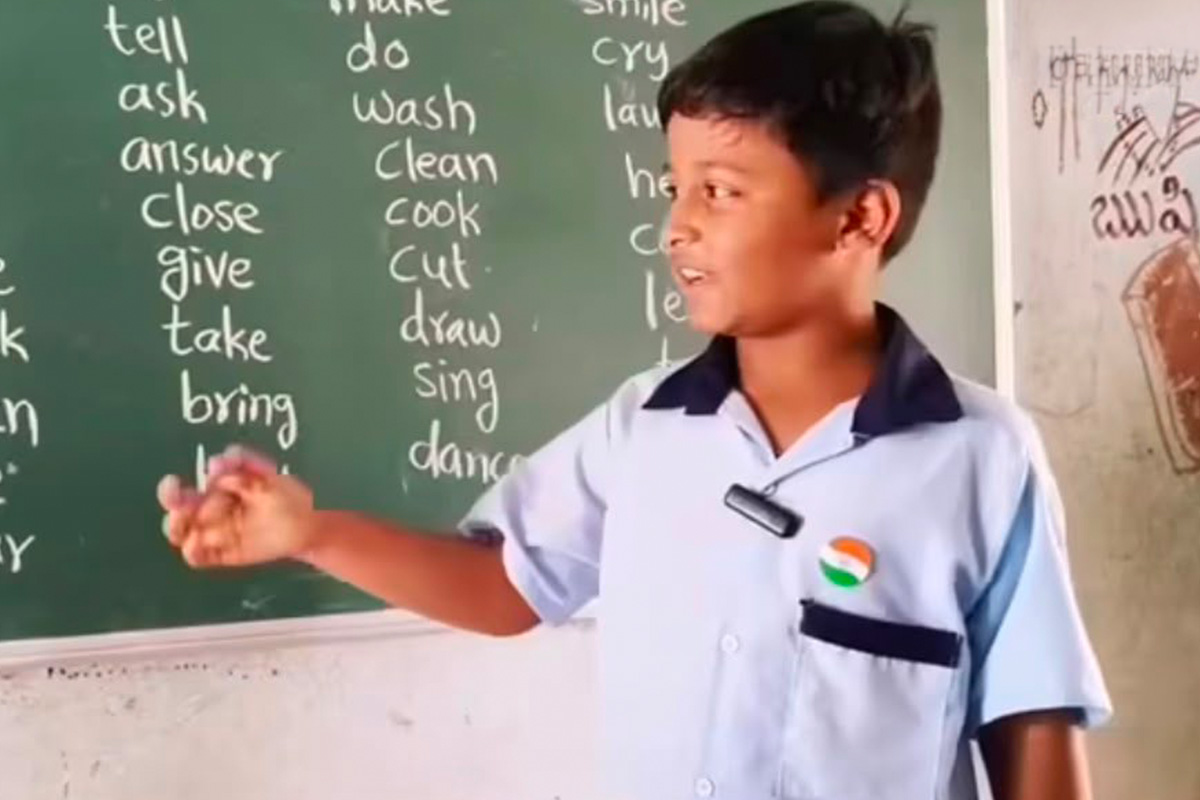
Varun, a fifth-class student from Yadadri Bhuvanagiri district in Telangana.

Synopsis: A fifth-grader who is the son of a farm labourer in Telangana has drawn attention on social media for his prodigious recall and range of knowledge. Varun’s story reminds government schools and teachers of the importance of identifying talent and nurturing it. But the lure of turning the childhood of gifted children into an endless performance must also be avoided.
Sometimes, it takes a child to remind adults of how much talent remains hidden in ordinary places. Varun, a fifth-class student from Yadadri Bhuvanagiri district in Telangana, has become one such reminder. A series of social-media video clips showing the young boy answering questions with remarkable ease and confidence has attracted attention and generated admiration. But what makes his story particularly striking is not merely what he knows. It is where he comes from.
Varun, from the Mandal Parishad Primary School in Pahalwanpur, Valigonda Mandal, belongs to a family of farm labourers. His extraordinary recall and apparent command over a wide range of subjects have not emerged from an elite school, expensive coaching centre or privileged educational environment. The videos instead offer a glimpse of a child whose curiosity and ability have found expression despite the limitations that often accompany an economically modest background.
That is perhaps the most interesting part of the story.
India has never been short of intelligent children. What it has often lacked is an effective system for identifying them early and allowing them to flourish. Talent is distributed widely; educational resources are not. A child in an affluent urban household may have access to books, computers, private tutors, extracurricular programmes and a range of intellectual stimulation. A child from a farm-labour family may possess the same curiosity and ability but have considerably fewer avenues to develop it.
Varun’s emergence therefore deserves to be seen as more than a feel-good social-media story.
The videos have done something that formal systems sometimes fail to do: they have made people notice. In the past, a gifted child from a rural or economically disadvantaged family might have remained known only to parents and teachers. Today, a mobile phone camera can place that child before a much larger audience. Social media, for all its excesses, has democratised the discovery of talent.
Yet admiration must be accompanied by responsibility.
It is tempting to call a child a “prodigy” when he demonstrates an exceptional memory or answers questions beyond his age level. Varun’s videos certainly suggest unusual ability. But intelligence is much larger than the capacity to remember facts and produce correct answers quickly. The real measure of exceptional ability lies in curiosity, reasoning, imagination, problem-solving and the capacity to ask the next question.
That is where the education system must step in.
If Varun has an unusually strong appetite for knowledge, his schooling should not be restricted to what is prescribed for the fifth class. He should be encouraged to read beyond his syllabus, explore science and mathematics, develop his language skills and, equally importantly, question what he learns. Teachers can play a decisive role by moving from merely asking him questions to encouraging him to explain how he arrived at an answer.
The larger challenge is to ensure that recognition does not become pressure.
A child who suddenly attracts attention on social media can easily become an object of constant demonstration. Relatives, visitors and even strangers may want to test his memory. More videos may be recorded. Expectations may rise. The child may gradually begin to feel that he has to perform his intelligence rather than simply enjoy learning.
That would defeat the purpose.
Varun should be allowed to remain a fifth-class student first and a “prodigy” later, if that label ultimately proves appropriate. His childhood must not be sacrificed to public fascination.
Also Read | What AI can’t teach: The power of serendipity in learning
His story also raises questions about how Telangana identifies gifted children in government schools. There may be hundreds of children with exceptional abilities whose potential remains unnoticed because their families lack resources or information. A systematic talent-identification programme at the school and district levels could help discover such children in mathematics, science, languages, arts, sports and other fields.
Government schools, in particular, need mechanisms through which teachers can flag unusual abilities and connect children with mentors, libraries, laboratories, scholarships and advanced learning opportunities. The objective should not be to separate gifted children from their peers, but to give them additional intellectual nourishment while keeping them rooted in their communities and ordinary school life.
Varun’s story is also a quiet challenge to the notion that quality education is necessarily synonymous with expensive education. His background does not prove that resources are irrelevant. They matter enormously. But it does demonstrate that resources alone do not create curiosity. Sometimes the spark is already there, waiting for somebody to notice it.
The farm-labourer’s son studying in a government school has therefore become more than a subject of viral videos. He represents a question that Telangana’s education system cannot afford to ignore: how many more Varuns are sitting in classrooms, waiting to be discovered?
The social-media clips may eventually disappear into the endless stream of content that the internet produces every day. The applause may fade. But the responsibility that his story creates should remain.
The true test of Varun’s success will not be the number of views his videos receive or the number of people who call him a child prodigy. It will be whether the right opportunities reach him without taking away his childhood; whether his memory develops into reasoning; whether his knowledge develops into wisdom; and whether his curiosity survives the pressures of growing up.
A viral video can make a child visible.
Only a good education system can help him realise his potential.
And perhaps that is the real lesson from a fifth-grader in Yadadri Bhuvanagiri: extraordinary talent does not always arrive from extraordinary circumstances. Sometimes, it is sitting quietly in a government-school classroom, in the family of a farm labourer, waiting for someone to ask the right question.
Also Read:
The timeless satire of C Northcote Parkinson and what it teaches about our work life today
“Unseen University” of Bengaluru: Why the city’s informal classrooms are pulling ahead



