
Published Jun 16, 2026 | 7:00 AM ⚊ Updated Jun 16, 2026 | 7:00 AM

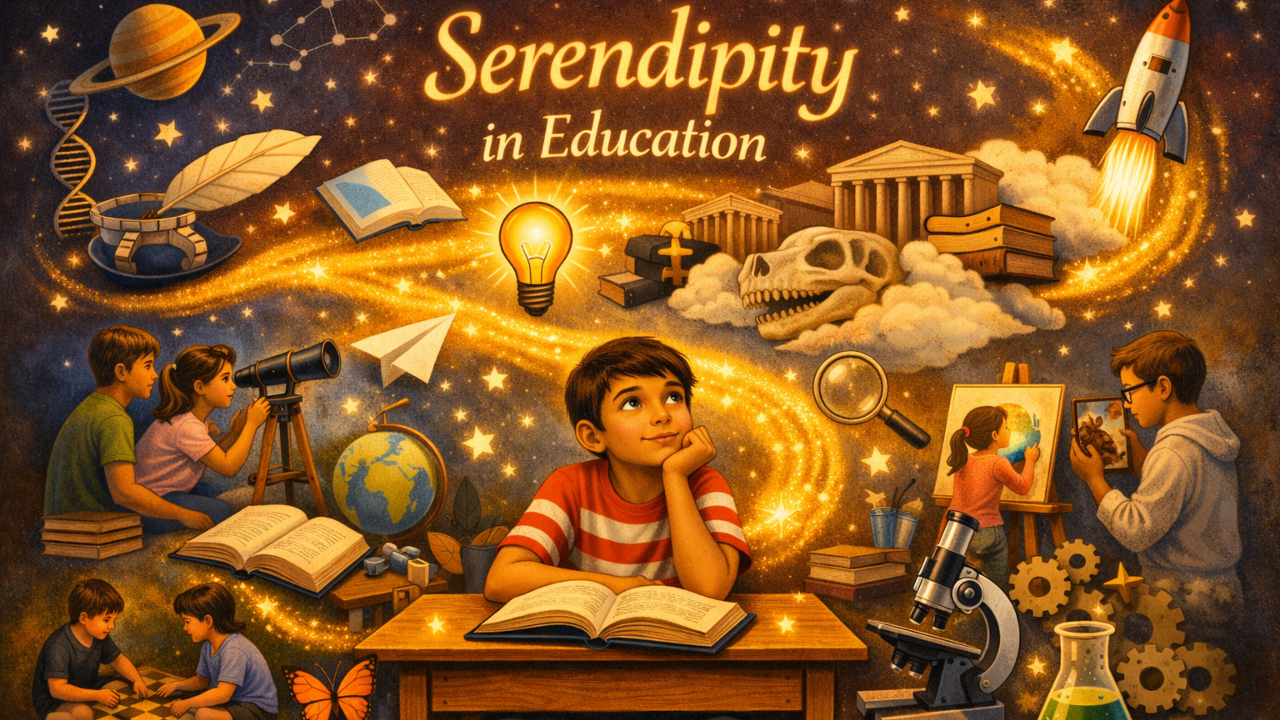
AI-generated representational image

Synopsis: AI systems can make, recommend, classify and predict things at amazing speed. But schools need to protect places where students can actively go beyond recommendation algorithms. Here’s what they need to do.
“What people call serendipity sometimes is just having your eyes open.“— Jose Manuel Barroso
Have you ever looked for something and found something else that is much more important? In school, serendipity often looks like small, happy accidents that lead to big discoveries.
A child can discover a new favourite author by picking up the wrong book at the library, make a lifelong friend by sitting in the wrong seat, or become very curious by messing up a science experiment. Or when someone is sick or loses a competition, stepping in for them can help them find a hidden talent or boost their strength and motivation. During these unplanned times, kids often discover new interests, friends, and strengths they didn’t know they had.
These are when they, by chance, find something they weren’t looking for.
We make classes, set goals, decide what the results should be, and see how well students are doing in school. But some of the most important times we learn are when we don’t plan. They happen when chance and curiosity come together.
The word “serendipity” was first used by Horace Walpole in 1754 after he read the Persian story The Three Princes of Serendip. He said that the princes “always found things they weren’t looking for,” by chance or by coming up with new ideas. That observation is important.
History is replete with resplendent examples of serendipity.
For example, Alexander Fleming saw mould-killing bacteria in his petri dishes and invented penicillin. Henrietta Leavitt came up with a way to measure huge distances in space while making a list of stars. Louis Pasteur knew that weakened germs could be used as vaccines.
In every case, something unexpected happened, but only a mind that was ready and interested saw how useful it was. This is why Pasteur said: “Chance favours the prepared mind.”
Education is meant to help people get ready for new relationships by making them more curious, open to the unknown, flexible in their thinking, and willing to look inside themselves. But in many of today’s schools, strict schedules, regular tests, and the pressure to do well don’t leave much room for calm focus.
When every minute is strictly controlled, the room for surprise to turn into discovery is shut.
Classrooms need to be organised, and structuring gives learning its shape and direction. But when structure gets too strict, exploration dies.
In school, serendipity happens when students find surprising but related ideas while researching a topic, or when a debate veers off course to a deeper point of view, or when a question that seems unrelated brings to light fresh insight.
A student who is reading about sociolinguistics might end up in cultural geography and learn how language relates to place. That one change can transform the whole question.
We cannot plan these things to happen in class, but we can welcome them. Not every deviation is a distraction; some are gateways to real discovery.
Also Read | ‘Magnifica Humanitas’: What the Pope’s AI Encyclical means for India
People have always been able to make discoveries in libraries, both by accident and on purpose.
A student who is just looking at the shelves might grab a book and, while looking around, find a topic they were not expecting, which sends them on a whole new path of research.
Digital systems, on the other hand, are putting more emphasis on accuracy and customisation. Algorithms quickly show users more of what they already like, which limits the choices they have. This relevance may silently limit intellectual surprise, even if it is helpful.
Teachers and librarians must then look at bringing back constructive randomness by making spaces, projects, and experiences that gently push students to think about new ideas similar to what they already know. A lively learning environment strikes a balance between structure and freedom, giving direction without stifling the chance meetings that often lead to the most important growth.
We can’t make happy accidents happen on command, but we can set up classrooms where they are more likely to happen. Teachers can help kids learn further by letting them explore on their own and encouraging them to ask questions that stem from real curiosity.
Learning deepens when different fields talk to each other, like when philosophy and physics talk, biology and ethics talk, and literature and technology talk. Such a coming together sparks new, combustible ideas.
The probability of accidental discovery also gets stronger when students have time to think and even get bored. They turn bolder when taking intellectual risks pays off in an environment that values new ideas instead of ignoring them. They also do well when teachers are genuinely interested in what they are teaching. This shows that learning is not just about reading books; it is an ongoing adventure.
Such classrooms do more than teach; they also prepare students to learn anew.
Giving students credit for both asking original questions and getting the right answers sends a quiet message that both wondering and knowing are important. Interdisciplinary projects break down artificial lines between subjects, letting ideas clash in ways that are truly surprising.
Reflective pauses—times when students are asked not what they learned but what they are now interested in—help them get used to being uncertain, instead of rushing to a conclusion.
Serendipity is not just a private thought; it often comes from talking to other people, like a casual comment in the staff room, a deep question at a lecture, or a partnership that brings together fields that were thought to be unrelated. Schools that promote this type of cross-pollination through shared research spaces, team teaching, and open academic discourse cultivate dynamic ecosystems where ideas confront and transform.
There is a paradox at the heart of this: we can’t plan for serendipity, but it happens more often in places that are well-planned.
Too much control stops new ideas from germinating, and too little organisation makes things messy. The best places to learn are those that are structured enough to help people do so but also open enough to let in new ideas.
People now care much about accuracy, algorithms, measurable results, and linear advancement. Because of this, we might confuse efficiency with enlightenment. Most of the time, breakthroughs don’t happen in a straight line. They happen when we make mistakes, take wrong turns, or ask questions that don’t seem to fit at first.
If education focuses only on what is likely to happen, it could lead to competence without curiosity. Real learning needs something more daring: the ability to stay in the unknown, to think deeply (as John Dewey said, reflection turns experience into insight), and to see chances where other people see mistakes.
Serendipity, it must be reiterated, is not luck; it is being ready for the unexpected.
Schools get kids ready to learn and discover new things by making them curious, giving them time to think, and encouraging them to take intellectual risks. Also, that is the best kind of education: not just finding answers, but also figuring out truths we didn’t know we were looking for and being smart enough to see them when they come up.
We are also living in a time when AI is becoming more common. AI systems can make, recommend, classify and predict things at an amazing speed. AI loves patterns. It looks at what has already been said, picked, and liked, and then tries to figure out what the next step is most likely to be. But serendipity doesn’t come from chance; it comes from going off course.
In these kinds of settings, students are gently guided toward what is most likely, popular, or predictable. They are pushed along pre-lit paths instead of being left to find their own way. But it is in the dark places—when we wander, when we deal with uncertainty, and when we come across an idea we don’t know—that curiosity is born and flourishes.
Students run the risk of becoming information consumers instead of question seekers when answers come too quickly and intellectual paths are already filtered. Technology speeds things up and makes it easier, but without careful, human-centred design, it can take away the friction, surprise, and productive discomfort that make people want to learn more.
In an AI-run world, schools must actively protect places where students can go beyond recommendation algorithms. People who can see when something doesn’t fit the pattern and ask why will own the future, not people who get answers the fastest.
Teachers can create simple but effective classroom activities that use AI to spark curiosity instead of giving students quick answers. For example, after students get an AI-generated explanation of a topic, they can be told to look for an opposing point of view, find a minority point of view, or ask whose voice might be missing.
Students can ask AI to come up with interesting questions instead of asking for summaries. Then, they can choose one to look into on their own.
Teachers could give students “random intersection” challenges, which ask them to find connections between the lesson topic and something else that isn’t related. Students can also compare their own predicted answers to those given by AI before they change their minds, which keeps the value of productive struggle.
Sometimes, students can be asked to critique AI outputs by pointing out mistakes, gaps, or strange things that don’t fit. This helps them get used to noticing things that don’t fit. By doing things like this on purpose, technology becomes not a replacement for thinking but a partner in expanding it. This keeps classrooms places where inquiry, surprise, and intellectual risk-taking can continue to thrive.
When classrooms maintain a careful equilibrium between guidance and openness, and when they regard exploration with the same seriousness as correctness, they transform from mere instructional environments into unique spaces that foster curiosity and allow serendipity to flourish.
(Edited by R Rajesh Kumar.)
Also Read: The significance of President Trump’s AI security order for India and the rest of the world



