

Published Jul 03, 2026 | 7:00 AM ⚊ Updated Jul 03, 2026 | 7:00 AM

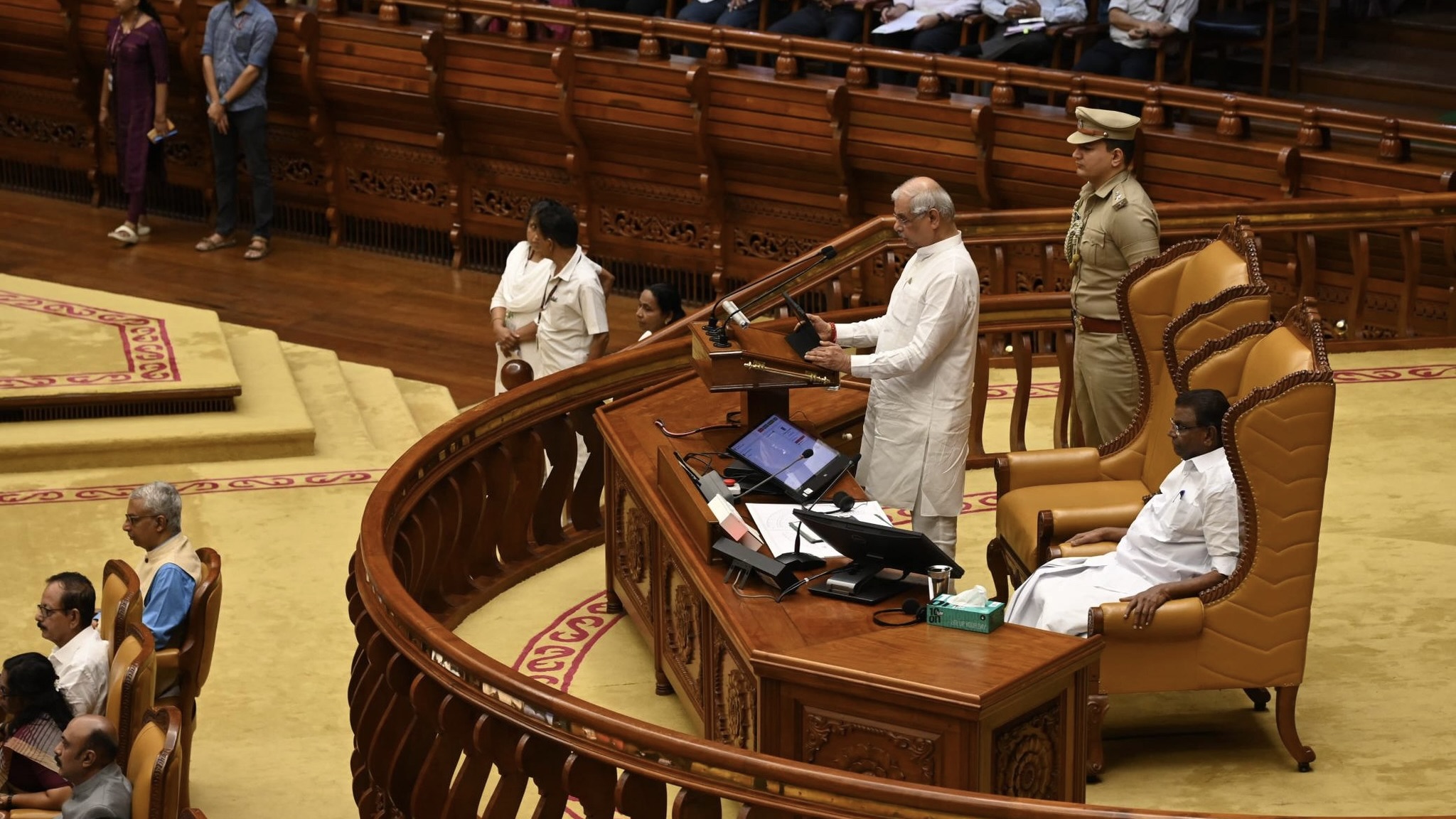
Governor Rajendra Vishwanath Arlekar seen delivering the policy address in the Kerala Legislative Assembly.

Synopsis: Resolution of the Governor-state government disputes we have been seeing in recent times requires an appeal to constitutional propriety—a concept built on institutional humility, mutual respect, and the recognition that the ultimate sovereign in a democracy is the electorate. If not, there’s always a masterclass in governance from Europe that can be considered…
The recent controversy over the appointment of the interim Vice Chancellor at the Kerala Agricultural University (KAU) is the latest iteration of the recurring friction between Governors and state cabinets over university governance and reveals a deeper systemic malady. By reducing public administration to a strict reading of legislation, institutional actors are undermining the democratic architecture of federalism. To prevent total administrative paralysis, statutory literalism must ultimately yield to the higher virtue of constitutional propriety.
The widening fractures in contemporary Indian federalism are rarely caused by a lack of text. Rather, they emerge from an over-reliance on it—specifically, a tendency among constitutional functionaries to treat statutory clauses as absolute mandates, divorced from the structural architecture of a parliamentary democracy. The recurring, bitter standoffs between Lok Bhavans and elected state governments over the governance of public universities offer a sobering case in point.
In the Kerala Agricultural University (KAU) incident, the Kerala Governor, exercising his statutory authority as the ex-officio Chancellor, had bypassed a three-member panel recommended by the state government and unilaterally appointed an interim Vice-Chancellor. While defended on the strict legal ground of seniority, the act triggered immediate executive pushback, with the state government labelling it an assault on democratic principles.
Lok Bhavan retreated into the fortress of statutory literalism; the state government stood on the ground of political legitimacy. This impasse is not merely an administrative hiccup; it is a profound constitutional failure born out of a refusal to recognise that the letter of a statute must always remain subordinate to the spirit of constitutional propriety.
To understand the legal mechanics of this friction, one must examine the split personality that the law imposes upon a Governor. Under Article 163 of the Constitution, the Governor is the constitutional head of the state, explicitly bound—save for rare, well-defined exceptions—by the “aid and advice” of the Council of Ministers. However, when acting as the Chancellor of a state university, the Governor steps into a different legal avatar. This role is not birthed by the Constitution; it is a creature of state legislation.
The judiciary has historically viewed this distinction through a lens of strict textualism. In Bhuri Nath v. State of Jammu & Kashmir (1997), the Supreme Court held that when a statute vests power in the Governor as an ex-officio Chancellor, he does not act as the constitutional head of the state. This judicial dictum has become the primary shield for gubernatorial overreach. Armed with the letter of the university Act, Chancellors increasingly treat public universities as autonomous fiefdoms, insulated from the policy directions of the elected government.
Yet, this literalist interpretation creates an absurd administrative fiction. A public university does not exist in a vacuum; it relies on the state exchequer for funding, requires legislative approval for its statutes, and serves the socio-economic priorities of the state’s populace. To suggest that the head of such an institution can act in total isolation from, or in direct opposition to, the cabinet that commands the democratic mandate of that very populace is to introduce a structural contradiction into the heart of governance.
Also Read | The ‘winter crow’ and the ‘pookie CM’: A metamorphosis in Kerala’s political aesthetic
When constitutional machinery faces such existential friction, legal literalism offers no answers. Resolution requires an appeal to constitutional propriety—a concept built on institutional humility, mutual respect, and the recognition that the ultimate sovereign in a democracy is the electorate. History offers no finer example of this delicate art than the extraordinary constitutional crisis that unfolded in Belgium in April 1990.
The Belgian Parliament had overwhelmingly passed a bill liberalising the nation’s abortion laws. The Head of State, King Baudouin, was a deeply devout Roman Catholic who had spent decades grieving his own inability to have children with Queen Fabiola. His personal faith and conscience absolutely forbade him from signing the bill into law. In a rigid system governed solely by text, this would have triggered an irreversible breakdown: either the King would be forced to violate his soul, or the democratic will of a sovereign parliament would be vetoed by an unelected monarch.
Rather than forcing a destructive showdown, the political executive, led by Prime Minister Wilfried Martens, and the Crown engaged in an act of profound constitutional accommodation. They turned to Article 82 (currently Article 93 of the Belgian Constitution, following the 1994 constitutional renumbering) of the Belgian Constitution, a provision originally intended to handle physical illness, mental incapacity, or wartime capture, which allowed the Cabinet to declare the King “unable to reign.”
On April 4, 1990, with King Baudouin’s explicit consent, the Cabinet declared the King temporarily unable to reign, gracefully stepping around his crisis of conscience. Hours later, as per constitutional protocol during a royal incapacity, the collective body of Ministers assumed the duties of the Head of State, signing and promulgating the abortion law to fulfill the democratic mandate. Next day, the Parliament convened in a special session, voted that the King’s temporary inability to reign had ceased, and seamlessly restored King Baudouin to his full constitutional powers.
This 36-hour “constitutional fiction” remains a masterclass in governance. The text of Article 82 was undoubtedly stretched beyond its original historical context, but it was done to preserve a higher virtue: the harmonious co-existence of a constitutional figurehead and an elected executive. The government respected the King’s personal dignity and conscience; the King respected the parliament’s democratic legitimacy. Neither side retreated into stubborn obstructionism. They chose propriety over ego
The contrast between Brussels in 1990 and the current state of play in Indian Lok Bhavans is stark and distressing. In India, statutory provisions are increasingly being used not as tools for administrative smoothness, but as weapons of political attrition.
When a Chancellor completely discards a panel of names submitted by an elected cabinet to choose an interim Vice-Chancellor unilaterally, it is a textbook exercise in statutory literalism. The text of the statute may technically permit the choice, but the act fundamentally violates the unwritten conventions that keep a parliamentary system functional.
Public law cannot be reduced to a game of semantic trapdoors. As Justice Felix Frankfurter of the United States Supreme Court once wisely observed, “the life of the law is not logic, but experience.” The experience of governance tells us that an institution cannot survive when its nominal head is at permanent war with its financial and political engine. When a Chancellor bypasses the state government, they are not protecting academic autonomy; they are creating an administrative impasse that paralyses the university itself, leaving students, faculty, and research in limbo.
The Second Commission on Centre-State Relations, headed by Justice MM Punchhi, foresaw this precise crisis. The Commission explicitly warned that burdening the Governor with statutory positions like the Chancellorship would inevitably expose the office to local political controversies. It recommended a clean break: Governors should not be made Chancellors of universities by statute, precisely because the lines of executive accountability must never be blurred.
As several states—including Kerala, Tamil Nadu, and West Bengal—move toward amending university legislations to divest the Governor of the Chancellorship, the deeper structural lesson must not be lost. Stripping the Governor of statutory roles may solve the immediate administrative gridlock, but it is a symptom of a larger, systemic failure to internalise constitutional conventions.
A constitution, no matter how detailed, is an incomplete document. It leaves vast spaces to be filled by conventions, manners, and institutional courtesy. If every constitutional functionary insists on exercising their powers to the absolute, literal limit of the text, governance becomes impossible. The Governor’s statutory discretion as a Chancellor must always be tempered by the overarching reality of our constitutional scheme: that the real executive power rests with the representative government.
The Belgian precedent teaches us that constitutional figureheads are most secure when they act in harmony with the democratic will, and that the elected executive is most effective when it handles the dignity of constitutional offices with care. For Indian federalism to thrive, our institutional actors must step out of their legal trenches. Statutory literalism must yield. If public institutions are to survive the current climate of political polarisation, constitutional propriety must be allowed to reign.
From our archives | Governor, CM and the Supreme Court: A three-way carol in Kerala
(Faisal CK is Deputy Law Secretary to the Government of Kerala. Views are personal.)



