

Published Nov 05, 2026 | 7:15 PM ⚊ Updated Nov 05, 2026 | 7:15 PM

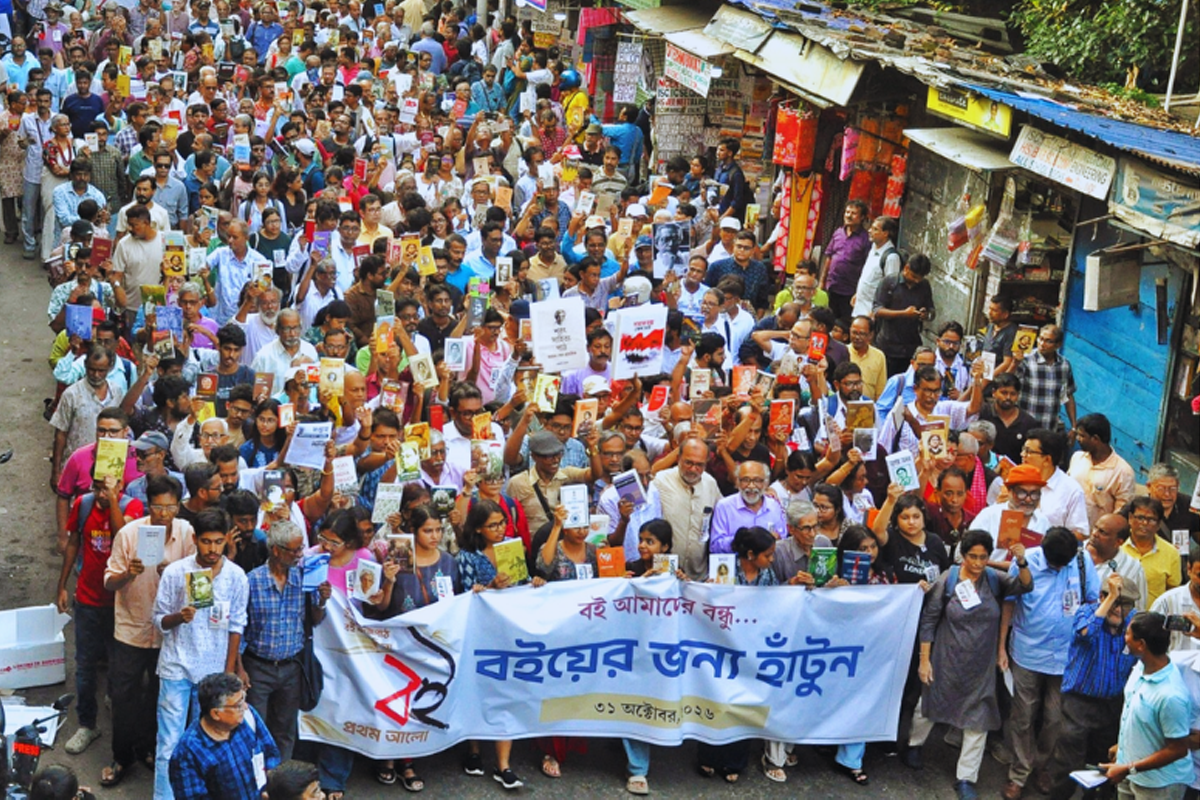
The march was organised in protest against the alleged vandalism of Left-affiliated bookstalls by BJP workers and police.

Citizens in Kolkata, in bold defiance against the politics of book-vandalism, marched on October 31 to protect independent bookstores. This powerful rally called ‘Let’s Walk for Books’ (Bojer Jonno Hathun/ Boi Amader Bondhu) transformed targeted destruction into an inspiring celebration of free expression, democratic resilience, and the enduring power of literature.
The modern democratic imagination is perpetually haunted by a recurring historical anxiety: the fear that the written word — that fragile, ink-stained vessel of human memory and dissent —will be consumed by the flames of sectarian intolerance and authoritarian zeal. We witnessed a vivid manifestation of this anxiety in the historic lanes of Kolkata’s Boipara (College Street), a neighbourhood globally celebrated as a veritable sanctuary of intellect, ink, and discourse.
Hundreds of ordinary citizens, academics, students, writers, and political activists converged in a powerful, non-partisan demonstration. They marched not with placards of partisan fury, but with books clutched tightly against their chests, their spines serving as shields against the rising tide of censorship.
This massive public mobilisation was born out of outrage. During the recent Durga Puja festivities across West Bengal, nearly 292 Left-affiliated bookstalls were subjected to systematic, coordinated vandalism. Stalls that had for decades stood as open forums for diverse ideological viewpoints, literary experimentation, and political debate were smashed, ransacked, and treated as targets for political elimination.
To dismiss this chilling episode as mere localised hooliganism or election-season skirmishing is to fundamentally misread the alarming global trajectory of our times. What happened in West Bengal is a symptom of a wider, creeping ideological malaise — a global drift toward the sanitisation of public thought, the muzzling of uncomfortable historical truths, and the forcible reduction of humanity’s vibrant, multicultural plurality into a sterile, mandated uniformity.
To truly grasp the philosophical dimensions of this assault and the brilliant, defiant geometry of Kolkata’s street-level response, we must look beyond the immediate headlines. We must step into the literary universes forged by Ray Bradbury in Fahrenheit 451 and Salman Rushdie in Haroun and the Sea of Stories, where the battle lines between totalizing control and human freedom are drawn across the pages of books.
In Ray Bradbury’s dystopian classic Fahrenheit 451, books are outlawed not because they carry inherent physical danger, but because they possess “pores” — they bear the uncomfortable, uneven, textured, and contradictory face of actual human existence. The firemen of Bradbury’s totalitarian world burn books precisely to maintain a superficial, state-mandated happiness, enforcing absolute ideological obedience under the comforting illusion that the elimination of intellectual friction will create a peaceful society.
The systematic ransacking of nearly 300 bookstalls in West Bengal operates on this exact totalitarian wavelength. When political or sectarian extremists target spaces dedicated to the circulation of literature, they are performing a modern, decentralised act of book-burning. They recognise a fundamental truth that tyrants, inquisitors, and censors have understood since the dawn of civilisation: books are permanent vessels of collective memory, archives of dangerous dissent, and unyielding mirrors that reflect society’s most unflattering, complex realities at it. To smash a bookstall is to attempt to incinerate the independent, questioning mind.
Yet, Bradbury’s novel also offers an immortal prophecy of resistance—a prophecy that played out with literal, breathtaking accuracy on the pavement of Kolkata. In Fahrenheit 451, when physical volumes are reduced to ash, the “Book People” preserve the totality of civilisation’s heritage by memorising texts, carrying entire libraries within their minds. In Kolkata, when stalls were smashed by the agents of intolerance, the immediate response of the citizenry was not despair or retreat, but embodiment. People spanning generations — from children of eight to elders of eighty — did not merely replace the destroyed merchandise; they transformed themselves into the living library.
They marched holding volumes aloft, singing, reciting revolutionary and lyrical poetry, and clutching literature to their chests as living armour. In doing so, they enacted a profound sociological truth: an idea inscribed on paper and embraced by a conscious citizenry cannot be crushed by iron rods, truncheons, or political intimidation. When attacked, it simply migrates deeper into the collective soul of the public, mutating into an indestructible force of cultural resistance.
If Bradbury warns us of the physical pyre and the state-sanctioned bonfire, Salman Rushdie’s enchanting masterpiece Haroun and the Sea of Stories warns us of an even more insidious danger: the deliberate pollution of our cultural and imaginative wellsprings. In Rushdie’s luminous fable, the magical Ocean of the Streams of Story represents the infinite repository of all human narrative, linguistic possibility, and imaginative freedom. Each stream within this ocean is colored by a different emotion, history, and perspective, feeding the world’s capacity for empathy, nuance, and wonder.
This vibrant ocean is targeted by the forces of silence, tyranny, and absolute control, personified unforgettably in Khattam-Shud, whose name translates literally to “completely finished,” “the End,” or “conclusion.” Khattam-Shud’s ultimate philosophy is an obsession with turning the living, breathing world into a realm of absolute uniformity, mechanical obedience, and deadening silence. Khattam-Shud hates stories because stories are inherently multiple, fluid, open-ended, ambiguous, and deeply subversive of absolute power. Monoliths require single, undisputed narratives; stories introduce doubt, empathy, and alternative futures.
The calculated attacks on bookstalls in Kolkata represent an attempt by the real-world disciples of Khattam-Shud to introduce industrial-grade “Dark Ocean” poison into India’s pluralistic cultural fabric. By targeting spaces that circulate diverse political, philosophical, and historical thought, the perpetrators seek to murk the streams of public discourse. They aim to replace the sparkling, discordant currents of democratic debate with the stagnant, monolithic sludge of dogmatic certainty.
Against this engineered intellectual pollution, the ‘Walk for Books’ functioned as a massive metaphysical filter. The organic, unstoppable outpouring of common citizens, which dramatically drove up sales past ₹1.5 crore in a stunning cultural counter-offensive, proved that the wellspring of public curiosity cannot be easily fouled. When thousands of people rushed to buy books, read openly in public squares, and invest their resources in independent publishing, they were performing a sacred act of cleaning the cultural streams. They were shouting down the purveyors of silence with the vibrant, cacophonous, and irrepressible symphony of free expression.
There is an exquisite, poetic irony woven into the aftermath of the Kolkata violence.
Rather than cowing the reading public into fearful compliance, the calculated destruction produced an unprecedented surge in solidarity, public engagement, and commercial revival for the targeted stalls. The attempted suppression backfired spectacularly because it momentarily shattered the comfortable complacency of daily life, shocking citizens into a sharp awareness of how fragile their democratic freedoms truly are — and how fiercely those freedoms must be guarded.
History repeatedly demonstrates that censorship and book-bashing carry within themselves the seeds of their own defeat. When power attempts to dictate what a citizen may read, think, or encounter, it inadvertently invests those very texts with an aura of forbidden urgency.
The young research scholar from Jadavpur University who joined the march captured this sentiment precisely when noting that the current political impulse to crack down on education stems from a desire to ensure people “do not learn and do not ask questions”. Yet, the very act of trying to suppress inquiry awakens a sleeping counter-consciousness.
As long as urban streets can transform into sanctuaries of literature, and as long as citizens walk shoulder-to-shoulder holding books as their banners, the pyres of the censors are destined to fail. Kolkata’s historic march stands as an enduring testament to a timeless truth: the ultimate antidote to the politics of erasure, violence, and dogmatic control is not timid silence, but an irrepressible, resounding chorus of stories and poems.
Also Read:
When a language fights to avoid being eaten: The Tulu lesson for India
Sonia Gandhi’s memoir: When publishers start censoring ideas
The timeless satire of C Northcote Parkinson and what it teaches about our work life today
(Faisal CK is Deputy Law Secretary to the Government of Keralam. Views are personal. Edited by R Rajesh Kumar.)



