
Published Sep 24, 2026 | 11:00 AM ⚊ Updated Sep 26, 2026 | 10:10 PM

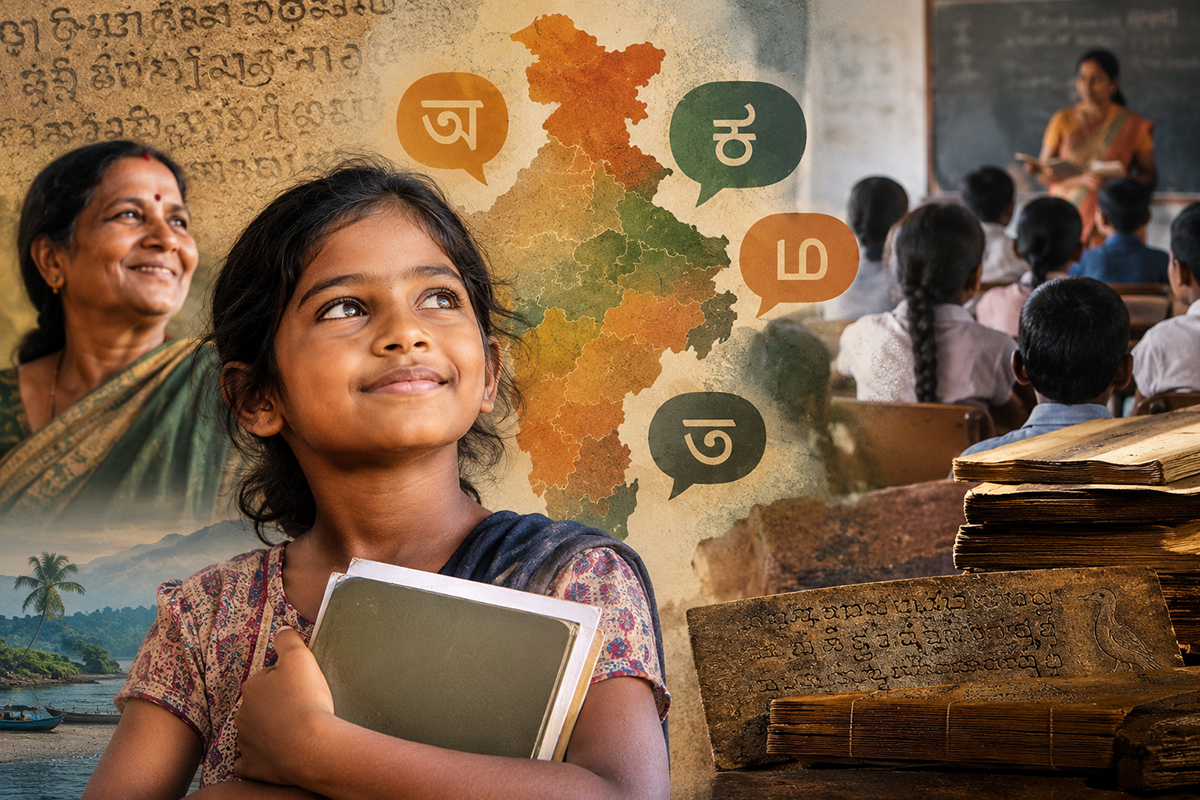
Image used for representational purpose. (AI generated image)

Synopsis: Major languages can quietly absorb the minor ones. Tulu’s recognition matters precisely because it disrupts that absorption, even in this narrow, administrative sense. It also underscores the need for a principled basis for language recognition.
A language does not need forty million speakers or a state of its own to deserve the acknowledgement of a government.
The Karnataka government, on September 18, granted Tulu, a Dravidian language spoken by an estimated 4-5 million people, the status of a ‘second additional administrative language’ in two districts of the state. The state government has allocated Rs 82 lakh in annual funds to facilitate this policy change. In fiscal terms, this is a small decision.
However, from India’s linguistic perspective, this is significant: recognition need not wait for a language to become large or for its speakers to demand a separate state.
The legal basis for this decision has existed since the Constitution’s commencement.
Article 345 lets a state legislature adopt “any one or more of the languages in use in the State” for official purposes. Article 347 goes further, allowing the President to direct that a language spoken by a substantial section of a state’s population be officially recognised, if a substantial proportion of that population so desires.
These provisions have existed since the Constitution came into being. But states have rarely used them. Karnataka’s decision on Tulu‘s recognition, and Andhra Pradesh’s earlier grant of similar status to Urdu, are reminders that states do not need Parliamentary intervention to recognise a language.
India’s linguistic image is built around the 22 languages mentioned in the Eighth Schedule, many of which are more or less anchored to a state. Kannada is Karnataka’s language, Bengali is West Bengal’s, and so on.
This mapping is not a description of how India actually speaks. The Indian linguistic reality is far more granular and even more localised.
Within Karnataka alone, Tulu, Kodava, Konkani and Beary all have footholds that Kannada does not fully encompass. This pattern repeats everywhere. Major languages can quietly absorb the minor ones. Tulu’s recognition matters precisely because it disrupts that absorption, even in this narrow, administrative sense.
Tulu’s own history is a case study in how this absorption happens even to a language with real institutional and cultural depth. It had its own script – Tigalari, in which literary works from the 15th-17th centuries survive, but somewhere (between then and now) the script became almost entirely obsolete.
Modern Tulu literature is written in Kannada script instead. If this can happen to a language with two millennia of epigraphic, cultural and literary history, it is worth asking what chance survives for languages that never had a script to begin with.
India has an undocumented territory of dialects: spoken by millions of people, yet they do not have independent scripts. A dialect without a script is vulnerable.
Bhojpuri, spoken across western Bihar and eastern Uttar Pradesh, is the most visible example; it is carried nationally through cinema and music into something close to a recognisable brand. However, Bhojpuri’s visibility in official spaces is obscured by Hindi.
I am from the Magadh region in Bihar, and my mother tongue is Magahi. However, I am often asked whether I speak Bhojpuri because in the popular imagination, “Bihari speech” is a single, undifferentiated mass, with Bhojpuri standing in for it all. Magahi, Angika, and a dozen other dialects of Bihar are folded into Hindi for official purposes and into Bhojpuri in ‘popular imagination’.
Linguists term this as ‘glottophagy’ or simply ‘language-eating’: the process in which a dominant language swallows the space, prestige and eventually the speakers of the languages around it. The term captures something that “language shift” or “language death” describes too vaguely, as if it were a normal event.
Glottophagy occurs because education systems, the media, and labour markets reward one language over another. So much so that speaking these minor languages becomes a liability rather than an identity. In the process, it stops percolating, and parents stop transmitting it to children because they have made a rational calculation about the child’s future career.
The Finnish linguist Tove Skutnabb-Kangas and the British linguist Robert Phillipson have given this process a sharp theoretical framing. They argued that the loss of linguistic diversity should be understood in the same way as the loss of biodiversity. Moreover, they contend that state education systems are the primary instrument of linguistic genocide.
This genocide occurs not through violence but through the systematic denial of mother-tongue usage, which over a generation or two produces the same outcome as violence: a language with no speakers left. Their broader argument for ‘linguistic human rights’ holds that access to education, justice, and administration in one’s own language is a ‘right’, not merely a cultural necessity.
None of this means that ‘administrative recognition’ solves the linguistic problem. Recognition without sustained funding, trained translators and genuine use in classrooms will remain symbolic. We need a principled basis for language recognition. Karnataka’s own process, a decade of committee reports, a study of the Andhra Pradesh precedent, and a final Cabinet decision, offers a template for the process as much as for the recognition itself.
Bihar could build on the existing administrative recognition to Maithili and extend it to Magahi and Angika in the districts where they are actually spoken, rather than defaulting everyone into Hindi. None of this threatens the primacy of the state language. It acknowledges that a state is not linguistically homogeneous and that districts can be considered legitimate units for language policy.
India is a civilisation of extraordinary linguistic diversity. However, true diversity requires institutions, schools, courts, and government offices that are willing to work in more than one official language. The next time someone asks me if I speak Bhojpuri, I would say, “No, I speak the other one, ‘Magahi’, with pride.”
Also Read:
Tulu’s official language demand, the Kannada question and the politics of Coastal Karnataka
When spirits say ‘I do’: Inside the fascinating world of Tulunadu’s ‘Kule Madime’
(Views are personal. Edited by R Rajesh Kumar.)
(Abdullah Ghazali teaches at GITAM Deemed-to-be University, Visakhapatnam. He can be reached at abdullahghazali83@gmail.com.)



