

Published Aug 10, 2026 | 9:29 PM ⚊ Updated Aug 10, 2026 | 9:32 PM

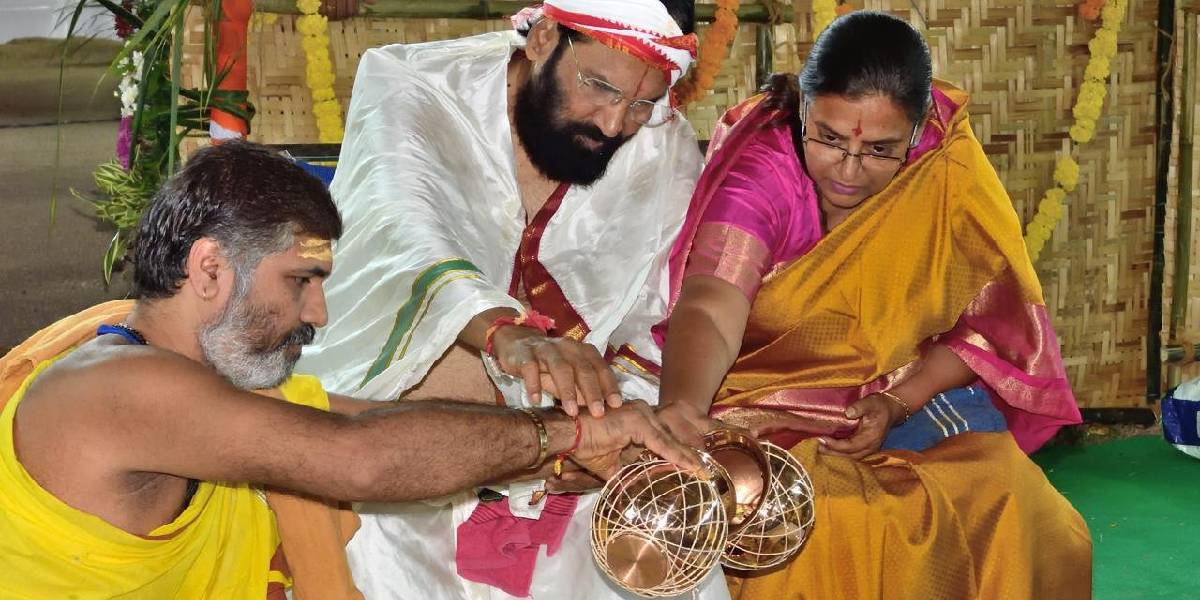
Minister for Irrigation and CAD Uttam Kumar Reddy performing Maha Varuna Yagam with his wife N Padmavathi

Synopsis: The Telangana government’s Maha Varuna Yagam has been dismissed by critics as a stunt that encourages superstition. Others accused the government of deceiving people with public funds.
What was the Telangana government thinking of when it held the ‘Maha Varuna Yagam’ with 108 priests and Chief Minister A Revanth Reddy and Irrigation Minister Uttam Kumar Reddy participating?
The Nehruvian vision of “scientific temper” was lost on the Congress government in Telangana when it decided to ‘pray for rain’ and poured public money into it.
“It is foolish to believe that yagnas and yagams such as this will bring rains. What is the Telangana government doing to improve the situation? How can a ritual fix the problem? They are telling the people to believe that a divine intervention will help. It sets a dangerous precedent,” said B Sambasiva Rao of Manava Vikasa Vedika, while slamming the Yagam held on Monday, August 10.
Conducted under the orders of Chief Minister Revanth Reddy, the priests from the Yadagirigutta temple led the rituals. It comes in a year when the state is battling to overcome a monsoon deficit blamed on the El Niño phenomenon.
The rituals were held across 11 homa kundams set up on the premises of the Vijay Vihar Tourism Guest House beside the banks of the Krishna River.
Minister Uttam and his wife N Padmavathi performed the yagam rituals in the early hours of Monday, while the CM participated in the concluding ceremony later in the day.
Critics argued that instead of tackling the issue scientifically, the state is trying to legitimise superstition and using public money to exploit people’s religious views. Ironically, during K Chandrasekhar Rao’s CMship, Congress, as the then opposition party, had mocked him for being “superstitious”.
El Niño-induced monsoon shortfall is a complex phenomenon that requires interventions in terms of irrigation planning, water management, and relief for farmers. The frequency of El Niño and La Niña in recent years is linked to climate change.
Rao said that governments across the world have evaded responsibility in tackling environmental issues and climate change, and the Telangana government was also guilty on this count.
He pointed out that Article 51A(h) of the Constitution prescribes a fundamental duty for every citizen, including those in leadership, to promote “scientific temper, humanism, and the spirit of inquiry and reform.”
“Instead of adhering to the constitutional duty, the government is encouraging superstition and scientific illiteracy among the citizens for its own benefit,” shared Rao.
The Maha Varuna Yagam was officially funded and organised by Telangana’s Endowments Department. South First tried to reach the Department officials to know how much was spent on the yagam but did not get a reply.
Meanwhile, Communist Party of India’s spokesperson John Wesley accused the government of evading responsibility and misusing public funds.
“People elect the governments and expect them to solve their problems. But the current administration and the Chief Minister are busy deceiving the people by performing such rituals instead of taking action to address their concerns. The sad thing is, they are doing it with public funds,” Wesley told South First.
He argued that while people could have their own personal beliefs on religion and rituals, State-sponsored rituals like the Varuna Yagam were an exploitation of people’s beliefs.
“They are using the public’s beliefs to manipulate them, without actually doing the work they promised to do. They should be spending the time and money for the wellbeing of the people instead,” said Wesley.
Citing El Niño’s disruption of the season, officials had framed the Maha Varuna Yagam ritual as a plea to rain gods aimed at securing irrigation for nearly 22 lakh acres of agricultural land.
It comes after a Monsoon season that witnessed a shaky start in Telangana. By the end of June, the state was already running a 12% rainfall deficit.
Conditions deteriorated further in early July. The shortfall had widened to 61%, with just four districts recording normal rainfall while 27 others were lagging and two districts were classified as being in the severe deficit zone.
Widespread spells in the second half of July pulled the month’s deficit down to just 5%. Some districts like Mancherial, Jagtial, Kamareddy and Peddapalli even recorded surplus readings. However, the Hyderabad metropolitan region spanning GHMC, Cyberabad and Malkajgiri corporations, and roughly a dozen districts, including Khammam and Warangal, remained at below-normal levels.
Reservoir levels tell a different story. Nagarjunasagar remains at dead storage as Srisailam has yet to receive the expected inflows, with experts estimating it will take another week for the reservoir to fill. The situation is significant as Nagarjunasagar supports irrigation across nearly 22 lakh acres. On Sunday morning, the reservoir held 145.65 tmcft against its 312.045 tmcft capacity, with the water level at about 518 feet, far below its 590-foot FRL.
A year ago, it held 310.25 tmcft and stood at 589.40 feet. Telangana’s water prospects also depend heavily on rainfall and inflows from upstream catchments in Karnataka and Maharashtra.
By August, the rain deficit decreased to only 6%. The state has received 406.5 mm of rainfall between June 1 and August 10, against the normal 430.3 mm, leaving the state with a 6% deficit. Despite the overall deficit, the state is classified as having received “normal” rainfall under the official classification.
The deficit, however, is unevenly distributed. Twelve of Telangana’s 33 districts are in the deficient category, with the worst shortfalls recorded in Hanumakonda (-43%), Warangal (-41%), Jangaon (-37%), Khammam (-30%) and Medchal-Malkajgiri (-29%).
In contrast, Kamareddy (+32%) and Medak (+31%) have received excess rainfall. Overall, 19 districts have normal rainfall and two, Kamareddy and Medak, have excess rainfall.
It’s not the first time a government ruling over Telangana has drawn inspiration from ancient Hindu religious scriptures.
Former Chief Minister of united Andhra Pradesh, YS Rajasekhar Reddy (YSR), repeatedly directed the Endowments Department and the Tirumala Tirupati Devasthanams (TTD) to conduct state-wide “Varuna Yagnas” and “Sahasra Ghatabhishekams” during droughts. YSR even sent cabinet ministers to perform “Gangamma Puja” at major reservoirs.
Similarly, former Chief Minister K Chandrasekhar Rao (KCR) regularly turned to massive ceremonies. Most notably, during the grand inauguration of the Kaleshwaram Lift Irrigation Project in 2019, KCR performed the “Jala Sankalpa Mahotsava yagam” right at the Medigadda barrage site before releasing Godavari waters.
From our archives:
When the rains fail: El Niño and drought-hit Telangana’s search for a climate-resilient future
Alarming decline in groundwater levels in Telangana; situation in Hyderabad ‘critical’
(Edited by R Rajesh Kumar.)



