
Published Oct 25, 2026 | 2:20 PM ⚊ Updated Oct 25, 2026 | 2:20 PM

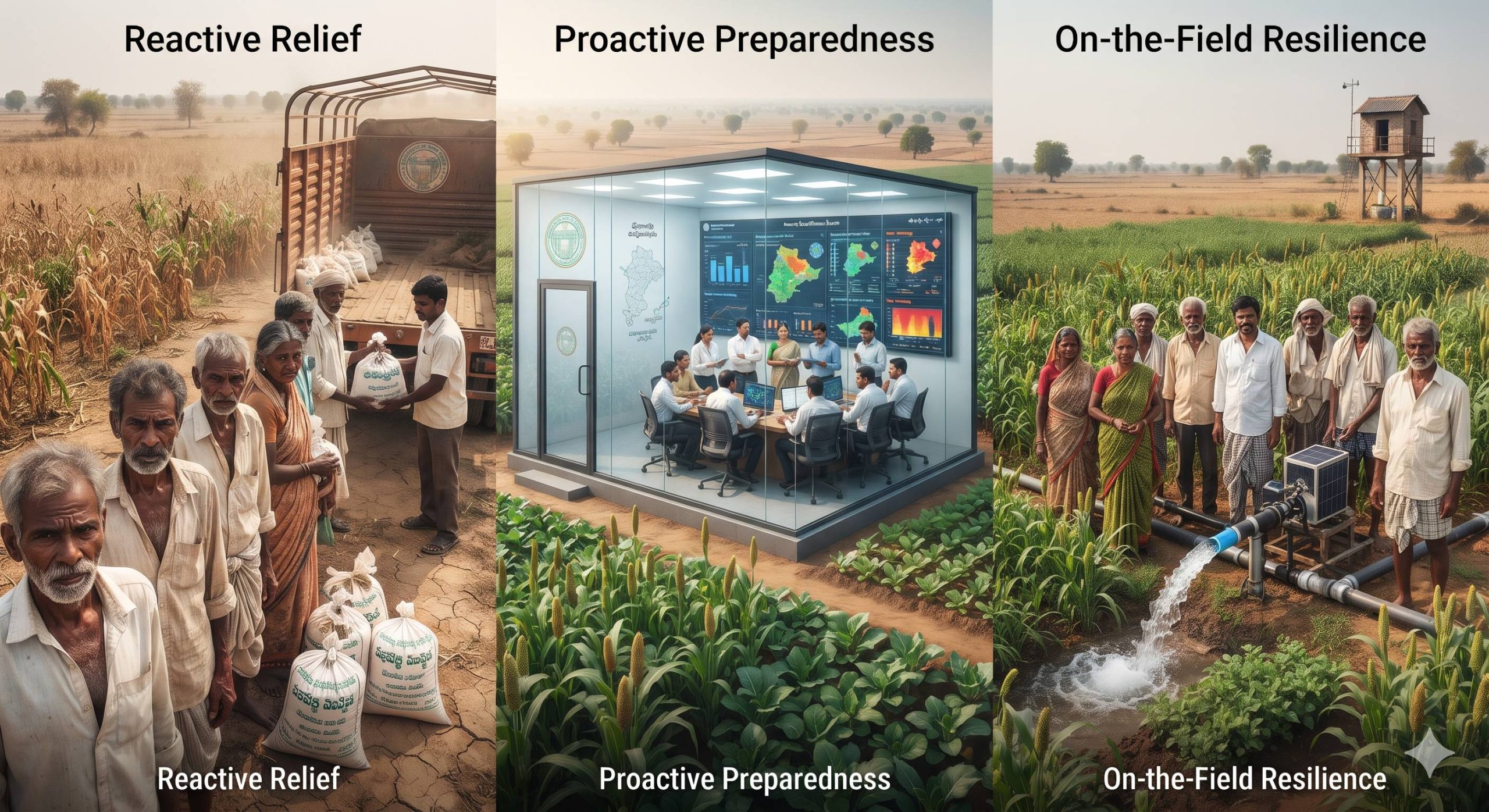
(AI-generated image)

Telangana cannot afford to approach a climate emergency with the same administrative playbook used for routine welfare delivery. Cash assistance, subsidised supplies and financial support remain essential, but an intensifying El Niño demands something more fundamental: a government capable of anticipating shortages, managing scarce resources and protecting livelihoods before distress becomes a crisis. The priority must shift from distributing relief after damage occurs to preventing avoidable losses.
Telangana’s 17% rainfall deficit during the 2026 Southwest monsoon has heightened concerns about water availability, agricultural productivity and rural livelihoods. Although the precise impact of El Niño on the State remains uncertain, the possibility of prolonged dry spells and elevated temperatures demands preparation.
Scientific precision is essential: a super El Niño does not automatically mean drought in Telangana. Its consequences depend on monsoon circulation, Indian Ocean conditions and regional weather patterns. Uncertainty, however, must not become an excuse for administrative inaction.
Telangana receives most of its annual rainfall during the southwest monsoon, making reservoirs, tanks and groundwater particularly vulnerable when the monsoon is deficient. The government should prepare district-wise water balance sheets covering reservoir storage, groundwater availability, drinking-water demand and irrigation requirements. Every municipality and gram panchayat must identify vulnerable habitations, failing borewells and alternative supply points.
Tankers, emergency pipelines and drinking-water transport should be arranged before shortages become acute. Reservoir releases must follow transparent priorities, protecting drinking water while allocating irrigation supplies according to actual availability. Leak repairs, wastewater reuse and restrictions on non-essential consumption deserve immediate attention.
The second priority is agricultural adaptation rather than indiscriminate compensation.
Farmers need timely, village-level advisories on soil moisture, sowing windows, crop duration and water availability. Where conditions warrant, extension agencies should encourage suitable short-duration pulses, millets and oilseeds instead of water-intensive crops. Such decisions must reflect local soils, market demand and scientific advice rather than blanket instructions.
Seed availability, crop insurance settlements and contingency credit should be streamlined. Procurement arrangements and remunerative markets for alternative crops must accompany changes in cultivation. Otherwise, farmers may bear the financial consequences of adaptation without receiving its benefits.
Third, electricity and groundwater management must be integrated. Prolonged dry spells increase dependence on borewells precisely when groundwater replenishment weakens. Uncontrolled pumping can turn a seasonal shortage into a structural crisis.
Telangana should map groundwater stress, monitor water levels and promote drip and sprinkler irrigation wherever appropriate. Solar pumps can reduce energy costs, but their deployment must not encourage unlimited groundwater extraction.
Reliable electricity for essential irrigation should be balanced with conservation incentives and scientific monitoring. Power utilities must prepare for increased summer demand without compromising essential household and agricultural supply.
Fourth, the State needs a comprehensive public-health and heat-action strategy.
Hospitals, schools, construction sites, transport hubs and workplaces require heat protocols. Local administrations should establish drinking-water points, shaded rest areas and early-warning systems.
Outdoor workers, elderly people and children require particular protection. Hospitals must prepare for dehydration, heat exhaustion and heatstroke, while municipalities should identify neighbourhoods with inadequate tree cover and excessive heat exposure. Public communication must explain hydration, safer working hours and symptoms requiring urgent medical attention.
Heat preparedness should be treated as an essential public service, not merely a seasonal awareness campaign.
Fifth, livestock, forests and rural employment deserve equal attention.
Fodder banks, veterinary camps, drinking-water troughs and emergency feed supplies can prevent avoidable animal losses. Watershed restoration, tank desilting and soil-moisture conservation can generate employment while strengthening long-term resilience.
Rural employment programmes should prioritise scientifically selected water-conservation works instead of fragmented projects with little lasting value. Protecting livestock is particularly important because animal losses can destroy household savings accumulated over several years.
Finally, preparedness requires institutional accountability. A State-level climate coordination mechanism should bring together revenue, agriculture, irrigation, energy, health and local-government departments. Weekly district dashboards should track rainfall, reservoir storage, groundwater levels, crop stress and drinking-water complaints. Publicly accessible information would help citizens understand restrictions, discourage misinformation and enable communities to monitor official action. Contingency funds must be released quickly when predefined warning thresholds are crossed.
Welfare remains indispensable, but welfare without preparedness can become an expensive cycle of recurring distress. Telangana must use the El Niño warning to strengthen its water systems, agricultural choices, public health and local institutions. The real measure of governance during a climate emergency is not the volume of relief distributed afterwards, but the number of families whose lives and livelihoods are protected beforehand.
Also Read:
Telangana’s looming water crisis: Responsibility and response
Prepare before we panic: Every dam in Telangana needs a water protocol
Cloudy outlook: Telangana’s rice bowl faces a season of reckoning
(Edited by R Rajesh Kumar.)



