

Published Oct 15, 2026 | 4:35 PM ⚊ Updated Oct 15, 2026 | 4:35 PM

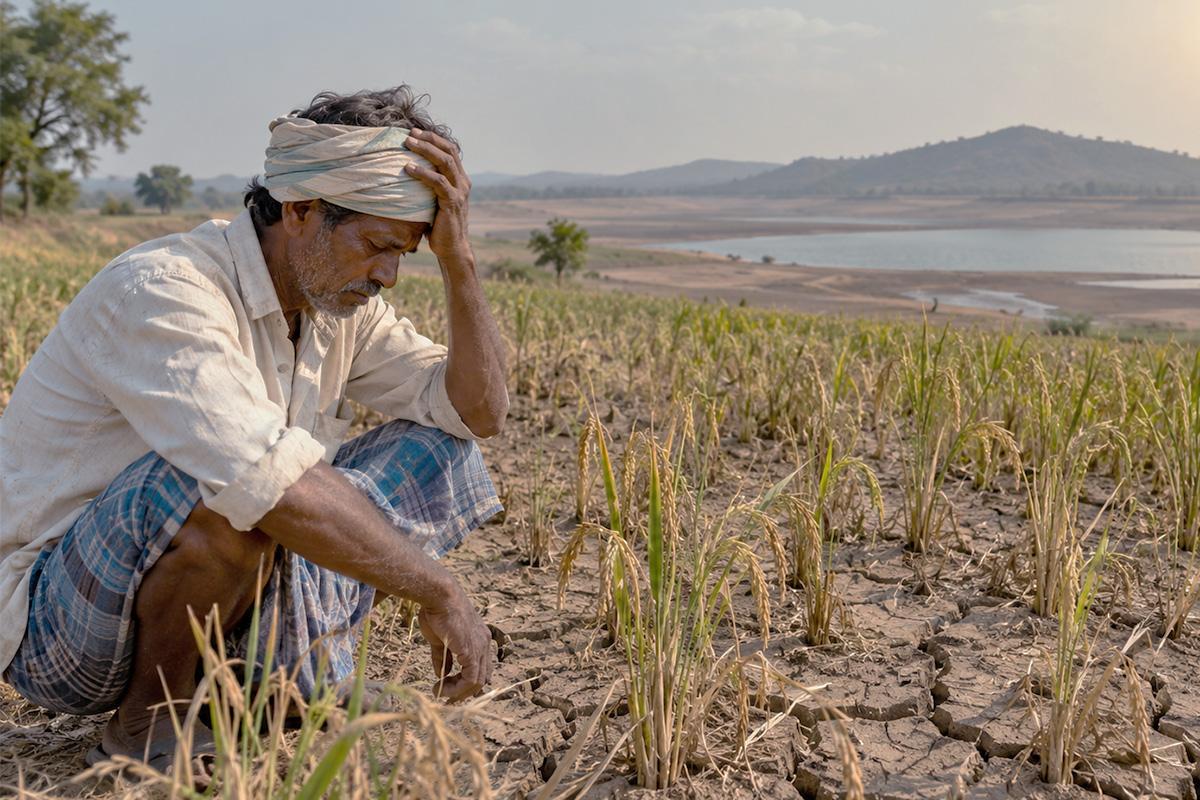
Image used for representational purposes only. (AI generated image)

Synopsis: Telangana may remain a rice-surplus State, but surplus is not a guarantee against a bad season. The difference between last year’s abundant harvest and this year’s threatened crop is a warning about the fragility of a system dependent on water-intensive cultivation and uncertain monsoons.
Telangana’s reputation as a rice bowl was built on expanding irrigation, assured procurement and farmers’ willingness to cultivate paddy on a massive scale. This year, that confidence is under severe strain.
The southwest monsoon, which ended on September 30, delivered only about 615 mm of rainfall against a normal of roughly 740 mm. As South First had earlier reported, 18 of the state’s 33 districts recorded deficient rainfall.
Erratic rainfall, depleted water reserves and rising dependence on groundwater are combining to threaten both the area under paddy and the yield from fields already planted. The danger is no longer a distant forecast: it is visible in the acreage figures, reservoir storage and the electricity being consumed to keep crops alive.
The scale of the setback is evident from the transplantation numbers.
In the ten years between 2014 and 2024, paddy acreage soared by 230 per cent and production by about 300 per cent. And during the 2025 kharif season, paddy covered roughly 67.6–69.9 lakh acres and production reached about 148 lakh tonnes.
But this year, paddy had been transplanted in only around 56.8 lakh acres, according to reports in early October — the first kharif season since 2022 in which coverage fell below 60 lakh acres. The difference from last year is more than 10 lakh acres.
The shortfall had emerged well before the season closed.
By August 25, paddy had been raised on about 50.11 lakh acres against a target of 65.96 lakh acres, a deficit of 24 per cent. Rainfall across the kharif period was uneven, with a particularly damaging dry spell in August.
The problem was not simply how much rain fell over the season, but when and where it arrived. Heavy showers in a few days cannot fully replenish depleted soils, tanks and aquifers after weeks of dry weather.
The State’s irrigation position explains why the rainfall deficit has had such a powerful effect.
Telangana’s irrigation dashboard reported cumulative rainfall of 596.8 mm against a normal 826.83 mm as of October 14 — a deficit of 27.82 per cent.
On October 15, the State’s 87 reservoirs held 492.53 thousand million cubic feet (TMC) against a combined capacity of 1,059.3 TMC, or 46.5 per cent. Minor irrigation tanks held only 93.51 TMC of their 253.8 TMC capacity, around 36.9 per cent. Storage must also meet drinking-water needs, planned releases and downstream commitments, underlining the narrow margin for irrigation.
The Krishna basin situation is especially worrying. By September 17, Srisailam held 61.65 TMC, compared with 153.56 TMC a year earlier; Nagarjuna Sagar held 44.89 TMC against 174.25 TMC.
These sharp year-on-year differences constrain the ability to sustain irrigation releases, particularly if the coming months fail to bring adequate inflows. Groundwater is the fallback, but it is neither limitless nor equally accessible.
Electricity consumption offers another measure of the crisis. With canals and tanks unable to meet demand, farmers increasingly depend on borewells, pushing up agricultural power use during peak periods. Reports indicate that State power utilities have been buying an additional 30–50 million units (MU) a day from the Indian Energy Exchange during peak hours to meet rising demand.
Hydel generation during the monsoon was reported at only 983.17 MU, compared with 3,707.99 MU in the corresponding period last year. Thus, the same dry conditions are reducing water available for crops while weakening hydropower generation and increasing the need for costly power purchases.
Acreage alone will not determine the impact on production. Paddy transplanted late may mature unevenly; fields that receive insufficient water at tillering, flowering, or grain-filling stages can suffer substantial yield losses. Lower plant density, pest pressure and the cost of repeated pumping can further reduce returns.
Agricultural university estimates have placed kharif paddy output around 107–113 lakh tonnes under different water-availability scenarios, compared with last year’s record harvest. They are projections, not final figures.
The Government must now manage water as a scarce public resource, not assume that every acre planted can be irrigated. Reservoir releases should be transparent and coordinated across drinking-water, irrigation and power needs. Officials should publish weekly district-wise figures on crop condition, storage and power supply. Farmers whose crops are beyond recovery must receive prompt assessment, compensation and accessible crop-insurance support.
Procurement agencies and rice millers should also prepare for a smaller, uneven arrival of grain, while ensuring that farmers are not penalised for moisture-related quality variations caused by drought stress during the coming weeks.
Telangana may remain a rice-surplus State, but surplus is not a guarantee against a bad season. The difference between last year’s abundant harvest and this year’s threatened crop is a warning about the fragility of a system dependent on water-intensive cultivation and uncertain monsoons.
Protecting the rice bowl requires more than celebrating production records. It demands honest accounting of water, reliable power, crop diversification and support that reaches farmers before losses become irreversible.
Also Read:
Telangana’s invisible farmers need a name before they need a scheme
Can a non-existent Varuna stop El Niño, Mr Chief Minister?
(Edited by R Rajesh Kumar.)



