

Published Aug 22, 2026 | 9:00 AM ⚊ Updated Aug 22, 2026 | 9:00 AM

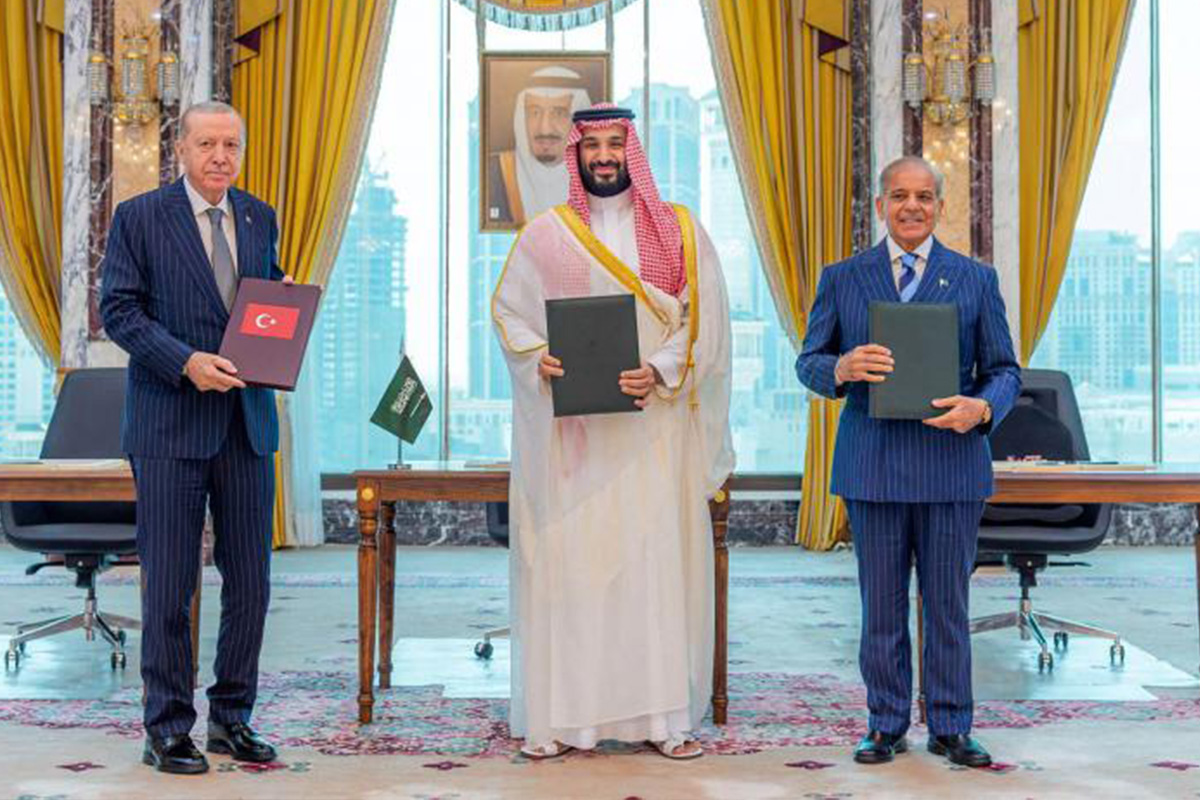
The inclusion of Pakistan and Turkey inevitably gives the Mecca accord a South Asian dimension.

Synopsis: The Mecca Accord is neither the beginning of an “Islamic NATO” nor a merely symbolic pact with little military substance. The real story behind the coming together of Saudi money, Turkish technology and Pakistani military experience is a lot more nuanced than that...
The signing of the Mecca Joint Defence Agreement by Saudi Arabia, Turkey and Pakistan on August 7 is seen as one of the more consequential developments in the rapidly changing security architecture of the Middle East.
Signed in Mecca by Saudi Crown Prince Mohammed bin Salman, Turkish President Recep Tayyip Erdoğan and Pakistani Prime Minister Shehbaz Sharif, the agreement stipulates that an armed attack against any one of the three states will be regarded as an attack against all three.
Turkey’s foreign minister has compared the provision to NATO’s Article 5, although the three governments have stressed that the agreement is defensive and is not directed against any particular country.
The pact, however, did not emerge in a vacuum.
Pakistan and Saudi Arabia have had an unusually close security relationship for decades. Saudi Arabia financed the Faisal Mosque in Islamabad and, in 1979, Pakistan renamed Lyallpur as Faisalabad in honour of the late King Faisal. During the Cold War, the two countries became important partners of the United States in supporting the Afghan mujahideen against the Soviet Union. Pakistani military personnel have also served in Saudi Arabia at different times, while Riyadh provided important economic assistance to Islamabad after Pakistan’s 1998 nuclear tests.
This article is less concerned with whether the Mecca Accord creates an “Islamic NATO” than with what the agreement actually means in the current strategic environment and what it could become in the future.
Its significance lies in the convergence of three very different forms of power: Saudi financial resources and regional influence, Turkish military technology and industrial capacity, and Pakistan’s large, experienced and nuclear-armed military, and in whether these assets can be converted into sustained cooperation.
The agreement also needs to be assessed against the recent experience of Saudi-Pakistani defence cooperation, the evolving Saudi-Turkish relationship, the threat perceived from Iran, and the reactions of countries such as India and the UAE. The central question is therefore not simply whether the three countries will fight each other’s wars, but how far they are prepared to make each other militarily stronger.
The historical background is particularly important because Saudi Arabia and Turkey were until recently far from natural partners. The Saudi-Turkish tensions had become particularly pronounced in the last few years.
Turkey’s decision to deploy more troops in Qatar, which was facing a blockade from the Saudis, exacerbated the tensions between the Saudis and Turkey. In July 2020, Erdogan visited Qatar to further cement the strategic relationship between the two countries.
Saudi Arabia and Turkey have often pursued different foreign policy priorities. For instance, in Libya, Turkey was backing Libya’s Government of National Accord to push back Khalifa Haftar’s Libyan National Army, which was supported by the Saudis.
The tensions had become more apparent after the killing of the Saudi journalist, Jamal Khashoggi, in Saudi Arabia’s Istanbul consulate in 2018. The facts presented by the Turkish authorities hinted at the direct involvement of Crown Prince Mohammed Bin Salman in the killing. A trial had already started in Turkey that accused 20 Saudi citizens in absentia; Saudi Arabia declined to extradite them.
There was a counter-reaction sweeping through Saudi Arabia as the leadership had decided to refer to the Ottoman rule over its territory in the context of colonialism and revise textbooks. In Riyadh, a sign bearing the name of the Ottoman sultan, Suleiman the Magnificent, was reportedly removed from one of the main streets.
But geopolitics changed. Beginning in 2021, Riyadh and Ankara embarked on a process of reconciliation. Erdoğan visited Saudi Arabia in 2022, followed by Mohammed bin Salman’s visit to Turkey. Economic ties expanded and, increasingly, so did defence cooperation.
Saudi Arabia became an important customer for Turkish defence products, including drones. The relationship moved from ideological competition towards a pragmatic exchange in which Saudi Arabia provided capital and markets while Turkey offered a sophisticated and increasingly independent defence industry.
The regional environment has now given this rapprochement a much stronger strategic rationale. Saudi Arabia has been directly exposed to attacks from Iran and Iran-aligned groups, including the Houthis, while the wider Gulf has been caught up in the escalating confrontation between Iran, the United States and Israel. Riyadh has reportedly increasingly sought to diversify its security partnerships rather than depend exclusively on Washington.
Iran has consequently been one of the clearest voices of opposition. Reports suggest that an Iranian parliamentarian dismissed the accord as a “paper agreement” and argued that it would not provide Saudi Arabia with security. Tehran’s reaction is significant even though the three signatories insist that the pact is not directed at any particular country. Iran will inevitably examine the agreement through the prism of its own rivalry with Saudi Arabia and the changing balance of power in the Gulf.
Yet the Iranian reaction should not automatically turn the accord into an anti-Iran alliance. Turkey, for instance, has maintained channels with Tehran and President Erdoğan has continued to advocate diplomacy between Iran and the United States even amid the current crisis.
The reaction in India has been notably measured. New Delhi’s Ministry of External Affairs has said that it is examining the implications of the agreement for India’s national security and regional stability. This cautious response is understandable.
The inclusion of Pakistan and Turkey inevitably gives the accord a South Asian dimension, particularly because Ankara has developed close defence ties with Pakistan. At the same time, Saudi Arabia has invested heavily in its strategic and economic relationship with India. The question for New Delhi is therefore whether Riyadh can compartmentalise its relationship with Pakistan while preserving its expanding partnership with India.
The UAE presents a different complication. Abu Dhabi and Riyadh remain close partners, but their regional policies have not always been identical, while Turkey’s earlier relationship with the UAE was itself marked by rivalry.
There has been no clear public UAE government statement specifically rejecting or endorsing the Mecca Accord in the reporting reviewed. That is perhaps unsurprising: the UAE has traditionally pursued a diversified security policy and is unlikely to want to be seen as automatically joining any new regional bloc. The absence of a strong public reaction should therefore not be interpreted as indifference.
Turkey is particularly significant to the Mecca Accord because it brings into the arrangement the perspective of a major non-European NATO power whose own foreign policy is shaped by disputes with several of its neighbours.
Ankara remains at odds with Greece and Cyprus over territorial waters, airspace, maritime boundaries and energy resources in the eastern Mediterranean, while its military presence in northern Cyprus remains a central issue in the unresolved Cyprus question. Its relations with Syria and Iraq have likewise been deeply affected by security concerns, Kurdish militancy and Turkish cross-border military operations.
At the same time, Turkey occupies a unique position within NATO: it is a Muslim-majority country, controls the strategically vital Turkish Straits, and sits at the intersection of Europe, the Middle East, the Caucasus and the Black Sea. Its participation therefore gives the Mecca Accord a dimension that extends beyond Arab and Islamic diplomacy, linking it to the wider strategic calculations of NATO and the broader international security order.
More importantly, it would be facile to assume that the three signatories will automatically fight each other’s wars. The Saudi-Pakistan experience is instructive. In 2025, when Pakistan and India fought a limited military confrontation, Saudi Arabia did not enter the conflict militarily. Conversely, during the 2026 Iran conflict, Pakistan reportedly did provide substantial defensive support to Saudi Arabia, reportedly deploying around 8,000 troops, fighter aircraft, drones and an HQ-9 air-defence system. Yet Pakistan did not become a belligerent in an offensive war against Iran.
This distinction is crucial. Defence cooperation today does not necessarily mean sending troops to fight whenever an ally goes to war. It can mean intelligence-sharing, air defence, logistics, training, technology transfer, joint exercises and financing. The Mecca agreement explicitly envisages cooperation in areas including joint exercises, unmanned systems, electronic warfare, artificial intelligence and defence production and technology transfer.
Pakistan is facing severe economic constraints while warfare is becoming increasingly technology-intensive. Turkey has developed a formidable defence industry, especially in drones, unmanned combat systems and electronic warfare. Saudi Arabia possesses the financial capacity to fund procurement, research and potentially joint production. Pakistan brings operational knowledge. The three countries therefore may possess complementary capabilities.
The Chinese-Pakistani relationship provides a useful precedent. China’s technology transfers and joint production have enabled Pakistan to acquire sophisticated military capabilities that it could not easily have developed independently. The Mecca framework could eventually provide a different but complementary source of technology, financing and defence-industrial cooperation.
With enormous financial resources at its disposal, the Saudi royal family has been knocking on multiple doors in search of a greater sense of security in an increasingly volatile region. One example of this Saudi search for a broader security network is the Islamic Military Counter Terrorism Coalition (IMCTC), established by Riyadh in December 2015 and headquartered in the Saudi capital. Initially announced as a 34-country grouping, it has since expanded to 43 members, including Pakistan, Turkey, Egypt, Jordan, Malaysia, Qatar and the United Arab Emirates. General (retd.) Raheel Sharif, Pakistan’s former army chief, has served as its military commander since 2017.
The coalition was conceived around four areas of cooperation: military coordination, counter-terrorism financing, communications and combating extremist ideology, with its military component intended to facilitate intelligence-sharing, operational planning, training and capacity-building among member states. Yet, despite its impressive membership and Saudi financial and political backing, the IMCTC has never developed into a clearly defined collective military force, and it remains difficult to assess its independent operational capacity. Its recent activity has largely centred on training, coordination, intelligence-sharing and capacity-building, rather than joint combat operations.
The real test of the Mecca Accord will thus not be whether Saudi soldiers fight in Pakistan, Pakistani soldiers fight in Turkey, or Turkish forces fight for Saudi Arabia. The more consequential test will be whether the three can convert their very different strengths into a durable security partnership. This is also where the regional rivals of each one of these three countries will be watching closely, particularly in the Middle East and South Asia, assessing whether the arrangement remains largely declaratory or evolves into a meaningful strategic alignment.
Perception will be almost as important as substance. Given that Saudi Arabia, Turkey and Pakistan are all Sunni-majority states, the initiative could be viewed in parts of the Shia world as the emergence of another Sunni security alignment, particularly given the region’s history of Saudi-Iranian rivalry. How Tehran and other Shia constituencies interpret the arrangement, and whether the three countries make a conscious effort to prevent it from acquiring a sectarian character, could therefore prove critical to its wider regional legitimacy.
Of course, the domestic situation in all three countries, particularly Pakistan and Turkey, also needs to be considered, including challenges related to counterinsurgency and political disaffection. Significant resources can be consumed by internal conflicts arising from political missteps or a lack of constitutional accommodation. The accord, however, is primarily an instrument of external strategic projection, although these internal challenges remain an important factor in assessing the three countries’ ability to translate the agreement into meaningful strategic capability.
If they succeed, the Mecca Accord may become a potent regionally driven security architecture. If they do not, it will remain what many critics already suspect: a powerful symbol whose collective-defence language is considerably stronger than its practical obligations.
Also Read:
Who is a Kashmiri? The contradictions in Pakistan’s Kashmir discourse
‘His thoughts were faster than his words’: MP Parameswaran and the Fourth World
(Edited by R Rajesh Kumar.)



