

Published Aug 18, 2026 | 7:00 AM ⚊ Updated Aug 18, 2026 | 7:00 AM

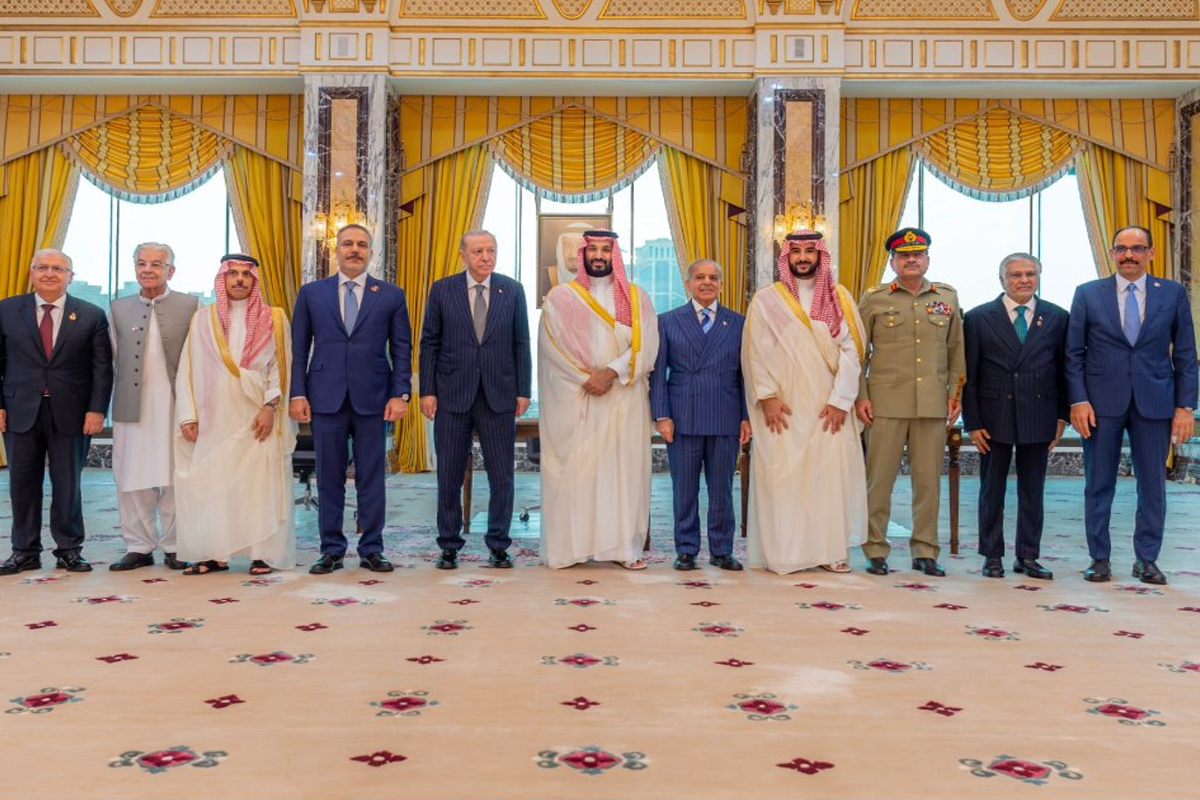
The agreement was signed by Saudi Crown Prince Mohammed bin Salman, Turkish President Recep Tayyip Erdoğan, and Pakistan Prime Minister Shehbaz Sharif

Synopsis: The recent Mecca Joint Defence Agreement unites Saudi Arabia, Pakistan and Turkiye in a mutual-defence pact signed amid regional turmoil. It carries significant strategic symbolism, but the absence of a joint command or confirmed extended nuclear deterrence suggests that India and the wider world can track its evolution without immediate alarm.
The leaders of Saudi Arabia, Pakistan and Turkiye on August 7, 2026, signed a trilateral collective-defence agreement at Mecca’s Al-Safa Palace. The landmark Mecca Joint Defence Agreement (MJDA) establishes a simple but consequential principle: “an armed attack against any one of the three countries will be treated as an attack against all three.”
The agreement was signed by Saudi Crown Prince Mohammed bin Salman, Turkish President Recep Tayyip Erdoğan, and Pakistani Prime Minister Shehbaz Sharif at the “Makkah Al-Mukarramah Summit for Joint Defence”. The choice of Mecca as the venue added considerable religious and diplomatic symbolism to an argument that could have wider implications for the security architecture of West and South Asia. Some observers have already begun describing the pact as the beginning of an “Islamic Nato”. Such a comparison, however, may be premature.
At its core, the MJDA rests on a single, powerful clause of mutual defence. The agreement states that an attack on any one of the three countries is an attack against them all, according to Pakistan.
Beyond this central provision, the pact commits the three nations to broader cooperation, though many operational details remain undisclosed. According to Pakistan’s Ministry of Foreign Affairs, the key objective of the agreement is to strengthen collective deterrence against any form of aggression. The agreement also seeks to strengthen cooperation across all areas of defence, potentially including joint military exercises, troop training, defence technology cooperation and intelligence sharing, although the detailed operational framework has not yet been made public.
The official joint statement added that the pact also “provides for the enhancement of all aspects of defence cooperation” among the three countries. The joint statement also said that the agreement is intended to promote peace, security and stability in the region and has not been presented as an alliance directed against any particular country.
One question that has dominated the discourse is whether the pact extends Pakistan’s nuclear deterrent to its two partners. Multiple reports and analysts have been careful to clarify that this is not the case. Experts note that Pakistan’s nuclear capability is not formally part of this agreement, and its nuclear deterrence remains primarily India-focused. A regional-affairs commentary makes the same point even more directly and states that the trilateral agreement did not confirm nuclear sharing, forward deployment, or extended deterrence of any kind.
Also missing, at least publicly, is any formal military architecture under this trilateral. There is still no public evidence of an integrated command, permanent joint force, common military budget or formal alliance secretariat. Without those elements, the agreement is better understood as a strategic framework rather than the formation of an “Islamic NATO.” Its real weight will depend on what the three governments build after the signing.
Each country brings distinct strengths to this partnership, which analysts say is the real strategic logic behind the pact. The trilateral deal will harness the military and financial strengths of each country: Turkiye has NATO’s second-largest military, Saudi Arabia is the world’s top oil exporter, and Pakistan is the only Muslim nation with nuclear weapons. Hence, the partnership combines Gulf capital, Turkish defence production and Pakistani military manpower, a potentially powerful trifecta; that is why the agreement is being watched beyond West Asia, including in New Delhi, Tehran, Tel Aviv and Washington.
This trilateral pact did not emerge overnight. It is the culmination of a layered process of bilateral ties that were gradually stitched together.
The foundation was laid nearly a year earlier. The Strategic Mutual Defence Agreement (SMDA) was signed on 17 September 2025 at Al-Yamamah Palace in Riyadh by Crown Prince Mohammed bin Salman and Prime Minister Shehbaz Sharif, committing both countries to treat any act of aggression against one as an act against both. The agreement was signed during Prime Minister Shehbaz Sharif’s state visit to Riyadh and was built on a partnership extending nearly eight decades, grounded in bonds of brotherhood, Islamic solidarity and shared strategic interests.
As the Pakistan-Saudi track progressed, Turkiye was also simultaneously and independently strengthening its own defence relationships with both nations. Turkey and Pakistan had separately deepened their own defence ties, exchanging warships and training aircraft, and in 2023 Saudi Arabia agreed to purchase Turkish-made drones in what Ankara described as its largest defence export contract at the time.
Then came the trigger that pushed the bilateral arrangement toward a full trilateral pact: a new regional war. The agreement was signed against the backdrop of a wider regional war involving Iran that began in February 2026, during which Saudi Arabia and other Gulf states came under repeated missile and drone attack.
The deal followed nearly a year of negotiations before the agreement was sealed in Mecca. In the days leading up to the signing, the leaders’ movements underscored the summit’s religious and diplomatic symbolism. Pakistani Prime Minister Shehbaz Sharif, accompanied by army chief General Asim Munir, arrived in Jeddah on August 6, 2026 and was received by the deputy governor of the Mecca region, Prince Saud bin Mishaal bin Abdulaziz. On the morning of August 7, Sharif performed the Umrah pilgrimage in Mecca, and Turkish President Recep Tayyip Erdoğan travelled to Jeddah later that day and met Crown Prince Mohammed bin Salman ahead of the signing.
A deeper geopolitical driver behind Saudi Arabia’s push for diversified security guarantees is also a perceived erosion of trust in Washington as the traditional security guarantor of the Gulf. Trita Parsi, executive vice president of the Quincy Institute for Responsible Statecraft, argued that “the Doha strike exposed a crisis of confidence in the US security umbrella,” with Gulf capitals now hedging in multiple directions at once, including towards Beijing. Riyadh’s calculus is similar: Saudi Arabia, having watched the reliability of its traditional guarantor come under question during a season of missile, drone and maritime crises, is diversifying its security portfolio.
New Delhi has responded to the pact cautiously, choosing measured official language over alarm. When the bilateral Pakistan-Saudi pact was first signed in September 2025, the Ministry of External Affairs (MEA) said it would study the implications of the strategic mutual defence pact for India’s national security as well as for regional and global stability. MEA spokesperson Randhir Jaiswal added that the government remains committed to protecting India’s national interests and ensuring comprehensive national security in all domains.
Following the expanded trilateral pact in August 2026, the Indian government’s stance has remained one of close observation rather than public concern. Responding to a media query, MEA spokesperson Randhir Jaiswal said New Delhi was keeping a close watch on the agreement, calling it “a development that we are closely following.”
On the substantive question of threat perception, most independent analysts advise against overreaction, largely because of what the agreement explicitly does not contain. As already noted, Pakistan’s nuclear deterrence remains primarily India-focused rather than being extended to its new partners, and the absence of an integrated command structure means the pact is, for now, more symbolic and political than an operational military alliance capable of rapid mutual reinforcement.
That said, this development could impact India’s interests in several tangible ways. Trade and energy security constitute one dimension, as Saudi Arabia sits close to the Red Sea, Persian Gulf, Bab el-Mandeb and Strait of Hormuz, all critical to global energy and trade flows. India draws heavily on the region for oil, remittances and expatriate employment.
A second dimension concerns diplomacy. Riyadh has cultivated close ties with both Islamabad and New Delhi simultaneously, and how it balances that dual relationship going forward will be tracked closely in Indian strategic circles.
A third dimension is the rebound in Pakistan’s regional standing that some analysts highlight. Pakistan finds itself, for the first time in decades, less a supplicant than a supplier of manpower and military experience to wealthier patrons. A stronger, more self-assured Pakistan, bolstered diplomatically and potentially militarily by Gulf capital and Turkish technology, could complicate India’s calculus on its western front, even without a formal nuclear or command-level linkage.
The Mecca Joint Defence Agreement marks a significant shift in West Asian security architecture, born out of a bilateral Pakistan-Saudi pact, accelerated by regional war, and formalised through the addition of Turkiye’s military weight. While its “attack on one is an attack on all” clause makes headlines, the absence of a nuclear-sharing arrangement, joint command structure or standing multinational force means its practical implications will depend heavily on how the three nations choose to operationalise it in the months ahead. For India, the appropriate posture for now appears to be watchful, informed engagement, tracking how this framework matures, rather than immediate alarm.
Also Read:
Who is a Kashmiri? The contradictions in Pakistan’s Kashmir discourse
(Views are personal. Edited by R Rajesh Kumar.)



