
Published Jul 29, 2026 | 7:00 AM ⚊ Updated Jul 29, 2026 | 7:00 AM

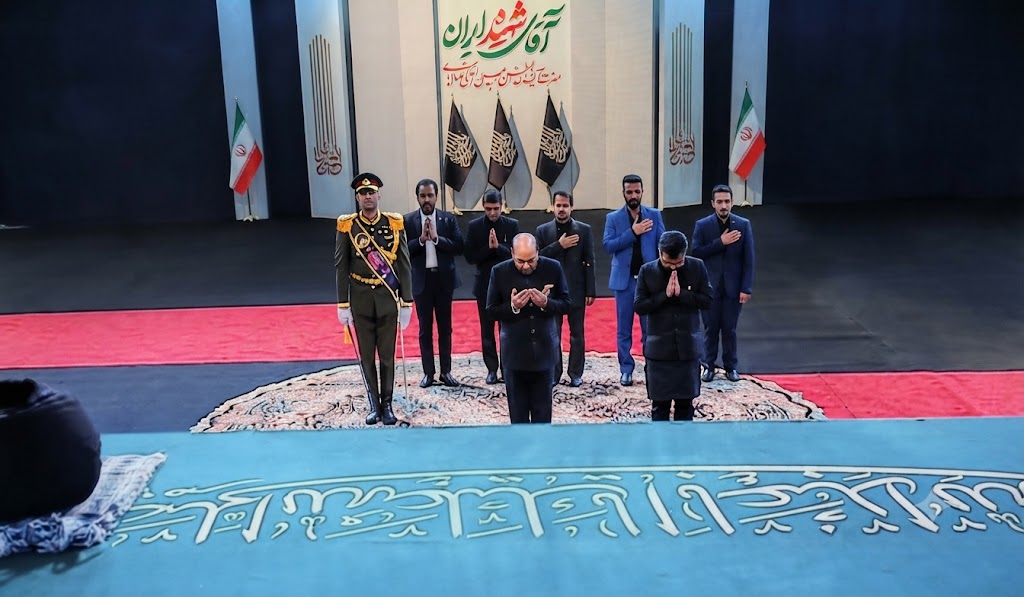
The Indian delegation seen paying their respects at the slain Iranian leader's funeral. (X/Iran in India)

Synopsis: By sending an interfaith, pluralistic delegation to Tehran, New Delhi has shown a glimpse of a sophisticated diplomatic narrative that rests on civilisational coexistence.
When Iran held the marathon state funeral for its late Supreme Leader Ayatollah Ali Khamenei in July 2026, the global focus naturally gravitated toward the geopolitical posturing of the West and the strategic calculations of the Islamic Republic. Yet, for a discerning observer of West Asian geopolitics, the most striking subtext emerged from the composition of the foreign dignitaries. Amid the standard political envoys, New Delhi dispatched a high-profile, multi-party, and distinctly interfaith delegation to Tehran, featuring prominent cross-party leadership and retired strategic officials.
By sending a delegation composed of Hindu, Muslim, and Sikh representatives, India did not merely pay formal diplomatic respects; it projected its foundational ethos of secularism and composite culture directly into the heart of a fractured region. While the visit signaled New Delhi’s calculated strategic autonomy—underlining that its partnerships in the International North–South Transport Corridor (INSTC) and the Chabahar Port remain non-negotiable—it did something far more profound. It quietly broadcasted India’s status as a safe, celebratory, and organic home to the world’s second-largest Shia population. It was a masterclass in an asset New Delhi has long possessed but rarely deployed: its Shia soft power.
To understand the depth of this soft power, one must look beyond contemporary oil routes to the deep civilisational tissue connecting India to the Shia world. This link is uniquely anchored in the cultural landscapes of Awadh (Oudh), Kashmir, and the fascinating syncretic heritage of the Indian subcontinent.
For centuries, the Nawabs of Awadh cultivated a highly sophisticated, inclusive Indo-Persian culture. In Lucknow and the surrounding districts, Shia religious traditions like the Azadari (mourning assemblies during Muharram) evolved not as isolated community rituals, but as composite cultural expressions. The grand Imambaras of Lucknow stand as architectural monuments to a syncretic past where Hindu communities actively participated in Marsiya recitations and funded public sabeels (water stalls).
Similarly, in Kashmir, the historical roots of Shia Islam run deep, tied to medieval sufis like Mir Shams-ud-Din Iraqi. Despite localised historical turbulences, the valley’s Shia community has preserved a distinct socio-cultural identity characterised by rich Persian literary traditions, exquisite craftsmanship, and a commitment to communal harmony that remains highly resilient.
Perhaps the most poetic testament to this cross-cultural matrix is the legacy of the Hussaini Brahmins. Belonging to the Mohyal Brahmin lineage, this community uniquely bridges Hindu identity with deep Shia devotion. According to persistent historical tradition, their ancestor, Rahab Sidh Dutt, traveled to Karbala with his sons and fought alongside Imam Hussain, the grandson of the Prophet Muhammad, sacrificing his own progeny in the battle against tyranny. To this day, Hussaini Brahmins observe Muharram with solemn devotion, epitomising an extraordinary cultural synthesis where the tragedy of Karbala is woven into the sacred tapestry of Indian heritage.
Furthermore, the ultimate symbol of this civilisational genealogy lies in the lineage of Ayatollah Ruhollah Khomeini, the architect of Iran’s 1979 Islamic Revolution. Khomeini’s paternal grandfather, Seyyed Ahmad Musavi Hindi, was born in Kintoor, a village in the Barabanki district of Uttar Pradesh. Even after migrating to Najaf and eventually settling in Khomeyn, the family carried the moniker “Hindi” for generations, textually anchoring the modern identity of post-revolutionary Iran to the fertile cultural soil of Awadh.
Also Read | ‘The world’s most misunderstood country’: Saurabh Shukla on wartime Iran
This flourishing pluralism stands in sharp contrast to the ideological choices that shaped India’s neighborhood.
The historical stance of India’s Shia community against the partition of the subcontinent is a critical, yet frequently overlooked, chapter. Before 1947, the All India Shia Political Conference stood firmly against the All India Muslim League’s two-nation theory, accurately anticipating that a majoritarian state would warp the internal socio-political fabric of the region.
As historian Professor Shamsul Islam documents in his seminal work, Muslims Against Partition of India (2021):
“All India Shia Political Conference was another important Muslim organisation which repudiated the claim of the Muslim League that the latter was the sole guardian of interests of Indian Muslims. Shia Conference mainly represented those Shias of India, who were generally well-off so far education, wealth and social status were concerned.
“It took principled stand against Two-Nation Theory propagated by the Muslim League. In a revolutionary development it formed a united front against the scheme of Pakistan with Sunni organizations thus heralding an era of cooperation with leading Sunni organizations in India. It is to be noted that most of Indian Shias had allegiance to the Shia Political Conference. Shia Conference was described as ‘Constituent Assembly’ of Shia Muslims of India and it was open to all shades of opinions among the Shias. Shia Conference was one of the conveners of Azad Muslim Conference in 1940, too, which was held by the patriotic Muslims to challenge the scheme of Pakistan propagated by the Muslim League.”
Following a resolution by the Conference rejecting Muhammad Ali Jinnah’s assurances as unsatisfactory, Syed Ali Zaheer president of the Shia Conference, (who later went to become India’s first ambassador to Iran), issued a scathing condemnation of the Muslim League’s separatist rhetoric, warning of the long-term futility of communal polarisation:
“One wonders how long will the Mussalmans [of] India to realise the futility of the propaganda of hatred and animosity against the Congress and the Hindus generally which is the underlying plank of the entire appeal of the Muslim League High Command. After all the Muslims and Hindus have to live as neighbours throughout the country and must sooner or later evolve a philosophy of toleration and good will towards each other. Is it wise to continue to harp on this song of animosity and bitterness, and continue the present state of slavery and domination by a foreign nation?… The entire conception [of Pakistan] is not only absurd, but merely an attempt to deceive the common Mussalman, who is not fully aware of its implications… Mussalman can only be Azad if Hindustan is Azad.”
History proved these anxieties prescient. Today, Pakistan possesses a vast Shia population, yet the community faces deep, systemic vulnerabilities. In her book, Purifying the Land of the Pure: A History of Pakistan’s Religious Minorities, Farahnaz Ispahani chronicles how the Pakistani state’s incremental slide toward religious homogenisation eventually expanded from targeting non-Muslims and Ahmadis to encompassing the Shia community, noting: “Once the Ahmadis were officially declared non-Muslim in 1974, a new campaign started with the intent to subject the Shias to similar proscriptions.”
Ispahani tracks how the state-sponsored promotion of a singular religious identity during the military dictatorship of President Zia-ul-Haq empowered extremist outfits like Lashkar-e-Jhangvi (LeJ) and Sipah-e-Sahaba Pakistan (SSP) to act as agents of “purification,” resulting in devastating sectarian violence. The targeted bombings of Shia mosques, pilgrim caravans, and professionals—alongside the horrific violence against Hazara Shias in Quetta—stand in sharp contrast to India, where the Shia community has thrived peacefully, deeply integrated into a pluralistic socio-political fabric.
This domestic fracture within Pakistan directly spills into its external relations with Iran, creating a volatile, reciprocal proxy dynamic along their shared border. The cross-border Baloch identity acts as a severe friction point between Islamabad and Tehran. Iran frequently accuses Pakistan of providing passive support and sanctuary to Sunni Baloch militant groups like Jaish al-Adl, which operate from Pakistani soil to launch deadly cross-border attacks into Iran’s Sistan and Baluchestan province. Conversely, Pakistan routinely alleges that Iran turns a blind eye to, or actively harbors, secular Baloch nationalist separatist groups like the Baloch Liberation Army (BLA) and Baloch Liberation Front (BLF), who target Pakistani security forces and Chinese infrastructure projects.
It is within this regional matrix of distrust and domestic insecurity that India’s Shia soft power becomes an invaluable strategic counter-lever. For decades, New Delhi’s West Asia policy has focused on a balancing act between the Sunni Gulf monarchies, Israel, and Iran, viewed strictly through the prisms of energy security, trade, and maritime corridors.
However, by leaning into its deep historical records, genealogical connections, and contemporary models of interfaith coexistence, India can construct a potent, understated narrative. Unlike Pakistan, whose relationship with Iran is permanently strained by the cross-border dynamics of Sistan separatism and internal anti-Shia extremism, India can engage the Shia world through a shared civilizational vocabulary.
The interfaith delegation sent to Tehran should not be a one-off gesture of convenience. It must represent a paradigm shift in Indian diplomacy—one that recognises that India’s greatest asset in West Asia is not just its economic muscle, but its centuries-old blueprint for pluralism, where minority sub-identities do not just survive, but actively shape the national fabric.
Also Read:
How Ayatollahs of Iran betrayed their revolution’s mentor
Did Iran betray its revolution’s mentor? The myth and reality of Ali Shariati
(Faisal CK is Deputy Law Secretary to the Government of Kerala. Views are personal.)



