

Published Jun 02, 2026 | 8:00 AM ⚊ Updated Jun 02, 2026 | 12:40 PM


While Andhra Pradesh excels in producing toppers, it has failed to achieve universal literacy.

Synopsis: Andhra Pradesh aspires to become a hub for artificial intelligence, data centres, green energy and global investment. These ambitions are welcome and necessary. But a State that remains India’s least literate cannot sustainably lead India’s technological future. Before building AI hubs, Andhra Pradesh must first ensure that every citizen possesses the most basic tool of human development: literacy.
Andhra Pradesh ranks last among all States and Union Territories in literacy, according to the Periodic Labour Force Survey (PLFS) 2023–24 conducted by the Union government.
The State’s literacy rate stands at 72.6 percent, significantly below the national average of 80.9 percent. Mizoram tops the list with an impressive literacy rate of 98.2 percent.
These figures should trigger serious concern in a State that has long enjoyed a reputation for academic excellence. Andhra Pradesh is widely known for producing top rankers in JEE, NEET, Civil Services and other competitive examinations.
Every year, students from the State occupy some of the highest positions in national rankings. Yet, beneath this success story lies a troubling reality. While Andhra Pradesh excels in producing toppers, it has failed to achieve universal literacy.
This contradiction exposes one of the greatest educational paradoxes in India. A State celebrated for educational achievement has remained at the bottom of the literacy rankings for years.
The paradox becomes even more striking when viewed against recent developments. The State government recently celebrated the Class X examination results, highlighting an overall pass percentage of 85.25 and the remarkable performance of students from government schools.
Newspaper advertisements and media campaigns showcased these achievements as evidence of educational progress.
There is nothing wrong with celebrating academic success. However, examination results alone cannot become the benchmark for evaluating an education system.
Also Read: The world failed to reverse falling birth rates with cash. Andhra Pradesh still wants to try
Literacy reflects the condition of the entire population, not merely the performance of a select group of students. A State cannot claim educational success when millions of its citizens still lack basic reading, writing and numeracy skills.
The recent NITI Aayog report titled School Education System in India: Temporal Analysis and Policy Roadmap sheds light on the structural weaknesses behind Andhra Pradesh’s literacy crisis. The report acknowledges improvements in infrastructure.
Internet connectivity in schools has increased dramatically over the past decade. Girls’ enrolment has improved significantly. Access to certain educational facilities has expanded.
Yet the same report raises serious concerns about learning outcomes and student retention. Nearly one-fourth of students do not transition from secondary education to higher secondary education. Dropout rates remain high.
Learning outcomes in language and mathematics have not improved substantially despite investments in infrastructure and technology. The report also highlights another disturbing reality. Andhra Pradesh has nearly 13,000 single-teacher schools serving close to two lakh students.
In many rural and tribal areas, one teacher is expected to handle multiple classes simultaneously. Under such conditions, meaningful learning becomes extremely difficult. The consequences are visible in literacy outcomes across the State.
However, infrastructure deficits and teacher shortages tell only part of the story. One of the principal reasons behind Andhra Pradesh’s literacy crisis is the extensive privatisation of education.
No other State has embraced private and corporate education to the extent Andhra Pradesh has. Over the years, successive governments have increasingly relied on private institutions to drive educational outcomes.
While this model has undoubtedly produced examination toppers and national rank holders, it has also weakened the public education ecosystem.
The result is a deeply unequal system. Quality education has increasingly become accessible to those who can afford private schooling, while economically weaker sections continue to depend on under-resourced government schools.
As enrolment in government schools declined in several regions and public education lost policy attention, vulnerable communities were left behind. Children from poor households, tribal regions and remote villages continue to face higher risks of educational exclusion and school dropout.
Many never acquire the foundational literacy skills required for lifelong learning. This is one of the key reasons why Andhra Pradesh continues to lag behind States that were once considered educationally less developed.
Also Read: The silent anti-incumbency building in rural Andhra
The comparison with Bihar is particularly revealing. Two decades ago, Bihar was widely perceived as one of India’s most educationally backward States. Today, Andhra Pradesh finds itself below Bihar in literacy rankings. This is not merely a statistical anomaly.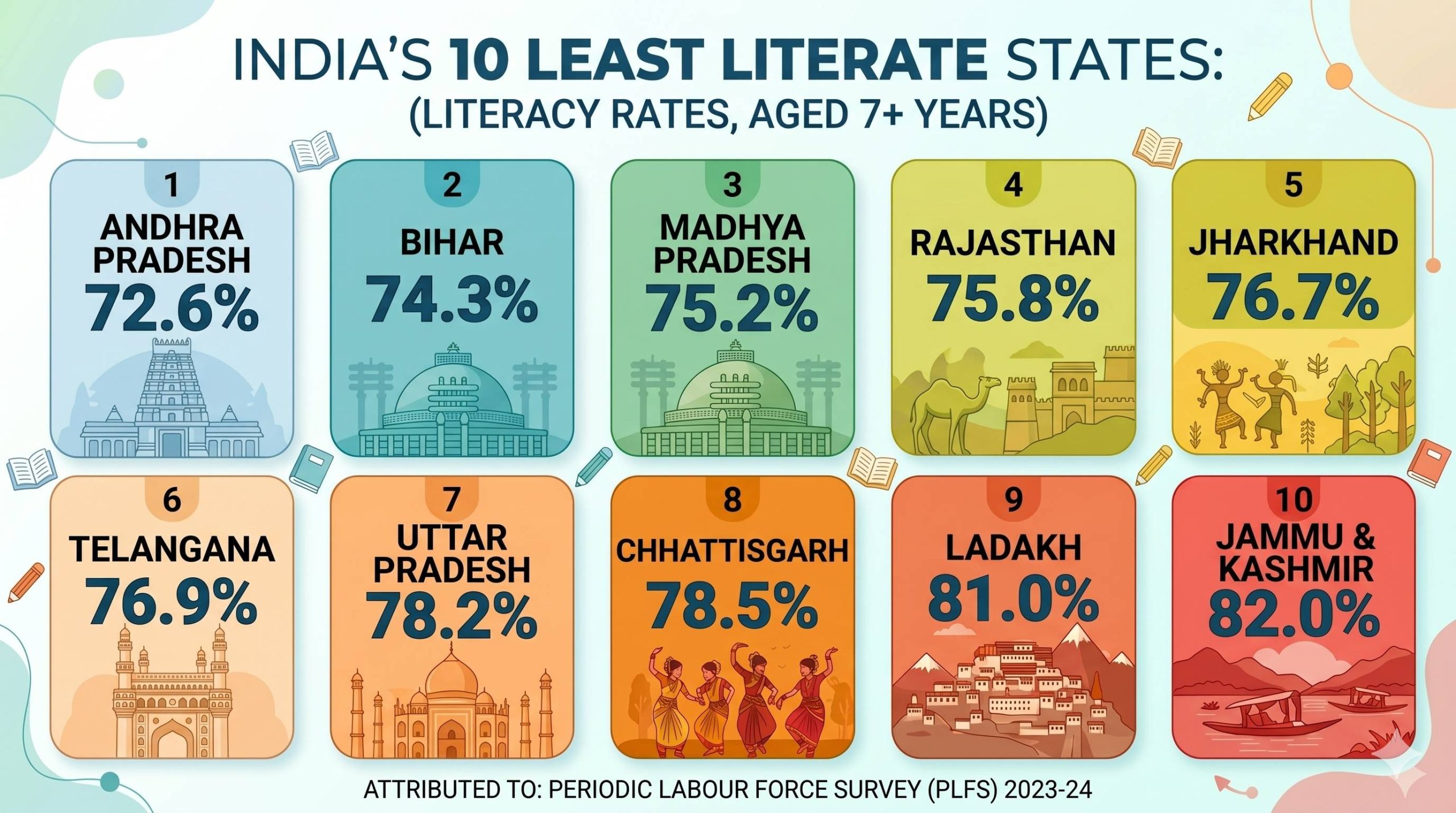
It is evidence of a long-term policy failure that successive governments have failed to address. The bifurcation of Andhra Pradesh also exposed structural realities that were previously concealed by the higher literacy levels of Hyderabad and surrounding urban regions.
While literacy in undivided Andhra Pradesh was below the national average, it was never among the worst in the country.
The post-bifurcation years have revealed the depth of educational deprivation across large parts of present-day Andhra Pradesh.
Successive governments share responsibility for this situation. Every administration has promised educational reform. Every government has launched schemes, welfare programmes and ambitious development plans.
Yet literacy has rarely occupied the centre of the policy agenda. The current government has launched the Akshara Andhra programme with the objective of making 81 lakh non-literate adults literate over the next four years.
This is a welcome initiative and deserves support. If implemented effectively, it could significantly improve literacy outcomes.
However, the programme must be accompanied by deeper structural reforms. The literacy crisis also raises important questions about political priorities.
Nara Lokesh has emerged as one of the most visible ministers in Andhra Pradesh and is widely associated with information technology, artificial intelligence, digital governance and investment promotion.
These initiatives may contribute to future economic growth. However, Andhra Pradesh continues to remain India’s least literate State.
This raises a legitimate question. If literacy is the foundation upon which every technological and economic ambition rests, why has it not received the same political attention as investment summits, technology initiatives and publicity campaigns?
An Education Minister’s performance cannot be measured merely through visibility, branding exercises or announcements. It must ultimately be judged by literacy levels, learning outcomes, teacher availability and school retention. On these indicators, Andhra Pradesh continues to face a serious crisis.
Welfare schemes such as Talliki Vandanam may reduce the financial burden on families and encourage enrolment. However, welfare alone cannot substitute for quality classrooms, trained teachers, improved learning outcomes and sustained literacy acquisition.
Educational transformation requires long-term institutional commitment rather than periodic announcements. The path forward is clear. Andhra Pradesh must treat literacy as a mission rather than a department. Teacher vacancies must be filled as a priority. Single-teacher schools must be eliminated.
Special literacy programmes should target tribal and remote regions. School dropout tracking systems should be strengthened. Government schools must be revitalised through sustained investment in quality rather than merely infrastructure.
Community organisations, volunteers and self-help groups should be integrated into literacy campaigns.
Most importantly, public discourse must shift from celebrating toppers to ensuring that every child can read, write and learn.
Andhra Pradesh aspires to become a hub for artificial intelligence, data centres, green energy and global investment. These ambitions are welcome and necessary. But no knowledge economy can be built on a weak literacy foundation.
A State that remains India’s least literate cannot sustainably lead India’s technological future. Before building AI hubs, Andhra Pradesh must first ensure that every citizen possesses the most basic tool of human development: literacy. Until that happens, the State’s development story will remain incomplete.



