
Published Aug 10, 2026 | 7:00 AM ⚊ Updated Aug 10, 2026 | 7:00 AM

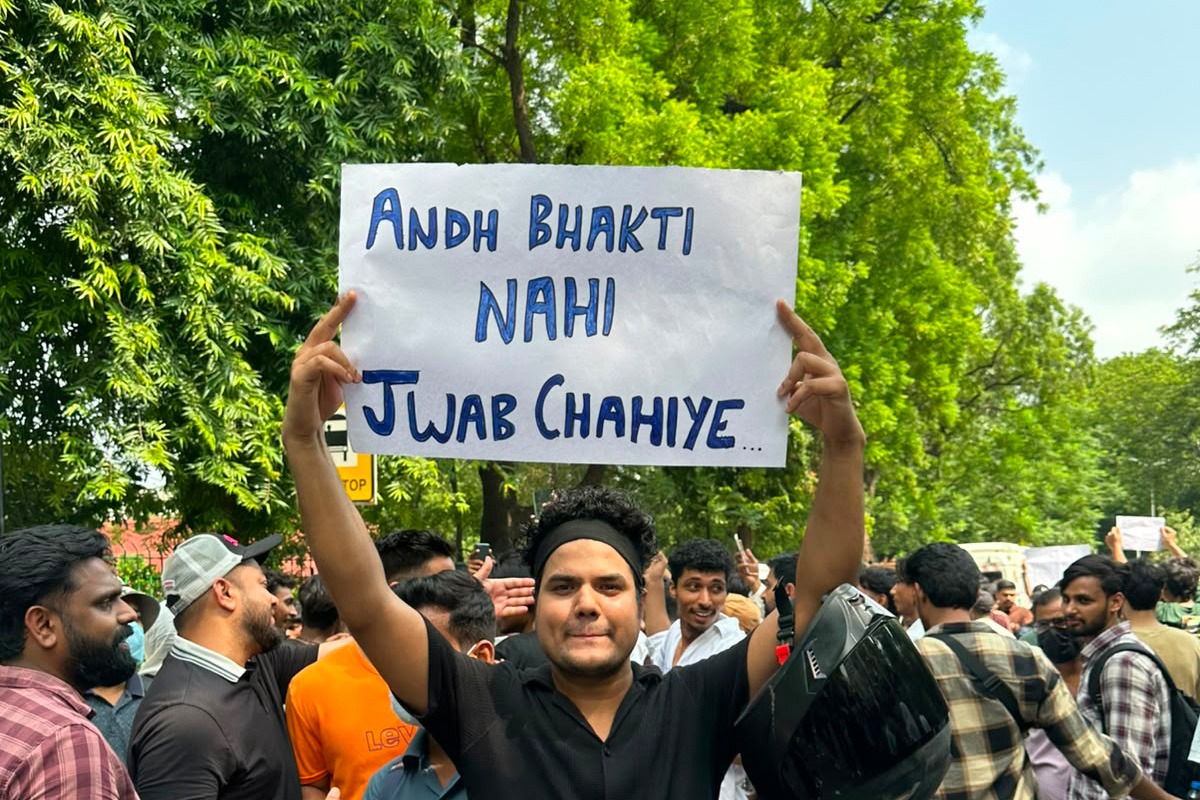
A poster that says it all from Jantar Mantar. (Photo | Likhitha Nair)

Synopsis: Youngsters have found their voice. The Cockroach Janta Party plans to be a nationwide pressure group raising everyday concerns of citizens. Political alternatives like Prashant Kishor are also finding favour. Change, my friend, is blowing in the wind.
“The earth itself seems to be in the throes of labour,” wrote the revolutionary Telugu poet Sri Sri while describing moments of profound historical change. His words resonate with the political mood unfolding in India today.
A series of recent developments suggests that the country’s political landscape may be entering a period of transition. New voices are emerging, fresh ideas are finding expression, and demands for greater accountability are growing louder across institutions. Whether these developments will culminate in a more responsive democracy remains uncertain, but they unmistakably signal a shift in India’s political discourse.
For over a decade, the National Democratic Alliance (NDA), led by the Bharatiya Janata Party (BJP), has dominated national politics. Even after securing a third consecutive term, however, governance is no longer insulated from public scrutiny. Every major policy and legislative initiative is increasingly subjected to public examination. While the ruling party has weakened several opposition parties through defections and political realignments, the anti-incumbency sentiment has simultaneously found expression through issue-based protests, youth-led campaigns and electoral setbacks in recent by-elections.
An equally significant signal has come from within the broader ideological ecosystem associated with the ruling establishment. The Rashtriya Swayamsevak Sangh (RSS) chief Mohan Bhagwat recently observed that protest should not automatically be equated with anti-national activity. Politics, he argued, extends beyond winning elections and running governments. He also described Generation Z and Generation Alpha as more honest and rational than previous generations, reflecting an acknowledgement that younger Indians expect a different political culture.
That changing mood is visible in the emergence of new civic platforms. The recently formed Cockroach Janata Party (CJP) has announced that it will function not as another electoral party but as a nationwide pressure group. Its stated focus is educational reform, youth aspirations, institutional accountability and the everyday concerns of ordinary citizens. Representing a generation that constitutes nearly two-thirds of India’s population under the age of 35, such initiatives point towards a broader transformation in political participation.
The announcement follows the recent youth mobilisations at Jantar Mantar and the subsequent “Chalo Sansad” campaign that led to the resignation of Dharmendra Pradhan. They demonstrated that decentralised, issue-based movements can influence governments without being driven by established political parties. Whether this model expands to other public issues remains to be seen, but it has already compelled traditional political actors to rethink how citizens—particularly young voters—organise themselves.
The judiciary, too, appears to recognise this changing democratic landscape. The Supreme Court has stressed that maintaining law and order must not become a justification for excessive policing of protests. More importantly, it has underlined the need for institutional dialogue between governments and protesters, arguing that democratic governance requires narrowing the distance between the state and its citizens.
The larger message emerging from these developments is the growing demand for institutional accountability. Citizens increasingly seek reforms in education, healthcare, public administration and anti-corruption mechanisms. Many also argue that India’s legislative system requires structural changes. Public confidence weakens when elected representatives frequently shift loyalties, allowing governments to be formed or sustained without returning to the electorate.
Questions are also being asked about the media’s role and about transparency within the judiciary. Longstanding concerns regarding judicial appointments and accountability continue to attract attention. Recent parliamentary proceedings have intensified these debates, with important Bills reportedly being passed amid disruptions and limited discussion. Opposition members have criticised both the legislative process and the conduct of parliamentary proceedings, arguing that meaningful debate is increasingly being replaced by procedural expediency. Regardless of political affiliation, these concerns point towards a common demand: the need for stronger institutions, greater transparency and more accountable governance.
Meanwhile, political priorities appear increasingly disconnected from public priorities. Citizens consistently identify education, healthcare, employment, agriculture and economic opportunity as their foremost concerns, while politicians obsess over electoral calculations and partisan strategy. This disconnect partly explains why voters are becoming more receptive to alternatives.
The recent electoral success of Prashant Kishor’s Jan Suraaj initiative in Bihar reflects this shift. Opinion surveys have also suggested that even many NDA supporters believe India’s competitive examination system requires significant reform following the NEET controversy. Likewise, sections of the ruling alliance’s own support base have reportedly expressed discomfort with the handling of recent public protests. Such findings indicate that public opinion is becoming increasingly issue-driven rather than predictably partisan.
The renewed discussion surrounding the proposed Delimitation and Women’s Reservation legislation has generated further debate. Questions are being raised over whether the government intends to revise the earlier proposal or whether changing parliamentary arithmetic has altered the political calculations behind it. These discussions underline a larger reality: legislative initiatives today are judged not only on constitutional grounds but also on perceptions of democratic legitimacy.
India may well be entering a phase where political parties are no longer the sole drivers of democratic change. Civic movements, youth networks, public-interest campaigns and issue-based mobilisations are steadily reshaping the national conversation. Whether governments adapt to these changing expectations or continue to rely primarily on electoral majorities will determine the next chapter of Indian democracy. The winds of change are beginning to blow. The question now is whether India’s institutions will move with them—or be compelled to change by the people themselves.
Also Read:
In cold numbers: What brought the youth to Jantar Mantar and the streets of India
‘It’s the economy, stupid’: The making of India’s Gen Z discontent
(Edited by R Rajesh Kumar.)



