

Published Oct 01, 2026 | 8:00 PM ⚊ Updated Oct 01, 2026 | 8:00 PM

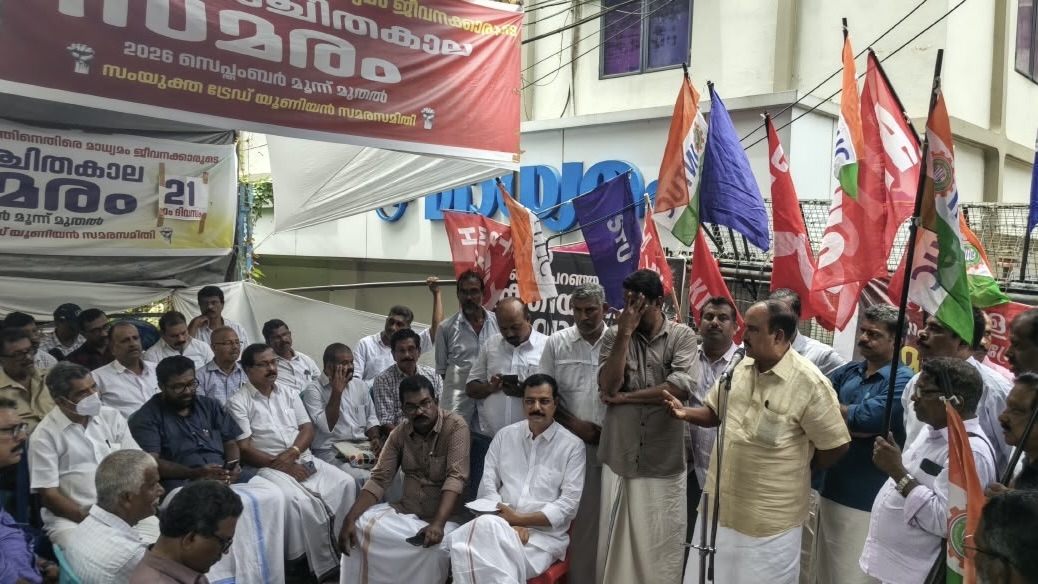
Protest in front of the Madhyamam office premises.

Synopsis: Employees of the Malayalam daily Madhyamam are protesting over eight months of salary arrears, contractualisation and job insecurity. They allege that the management is pressuring permanent staff to shift to contract employment or resign, while staff shortages are also affecting newsroom operations and the quality of journalism. Workers’ rights advocate Rejimon Kuttapan said the management’s withholding of earned wages amounted to deliberate “wage theft”.
In 2022, the Malayalam daily Madhyamam had roughly 900 staff members, including 202 permanent employees across its Keralam bureaus. Today, around 100 permanent employees are left, while its Thiruvananthapuram office has fewer than five.
In that time, delayed salaries have become routine. Salaries were initially delayed by a month or two, but the delays kept getting longer. As of 30 October, employees had gone without being paid for eight months, the longest stretch yet.
Madhyamam is the fourth-largest daily in Keralam by circulation, according to the Indian Readership Survey 2020.
It is published by Ideal Publications Trust, run by the Keralam unit of Jamaat-e-Islami Hind. Alongside nine editions across Keralam, it also has one each in Mangaluru and Bengaluru in Karnataka. Separately, its Persian Gulf edition, Gulf Madhyamam, has nine editions.
The management has maintained that it is cash-strapped because the Gulf edition has been suffering financial difficulties since Covid-19. Employees, however, say it should not matter, as Madhyamam Keralam has been posting healthy revenues on its own.
“Keralam Madhyamam also generates good revenue. In 2020-21 alone, an audit report showed revenue of ₹66 crore. This was disclosed by the management when the court intervened,” Nishad T, Chief Reporter of the Thiruvananthapuram bureau, told South First.
Instead, employees allege that the delayed salaries are a deliberate tactic by the management, with the long-term aim of forcing permanent employees to accept contractual employment.
Also Read: A cleaner sea, but at what cost? Keralam plans fishing-boat fuel switch, fishermen raise concerns
For the past month, hundreds of the paper’s employees, led by the Madhyamam Journalist Union and Madhyamam Employees Union, have been holding a day-and-night protest at the State Secretariat in Thiruvananthapuram. Nishad is among them.
Every working day, he remains at the picket line until around 4 pm before rushing back to the newsroom to complete his shift, which ends at around 2 am the next morning.
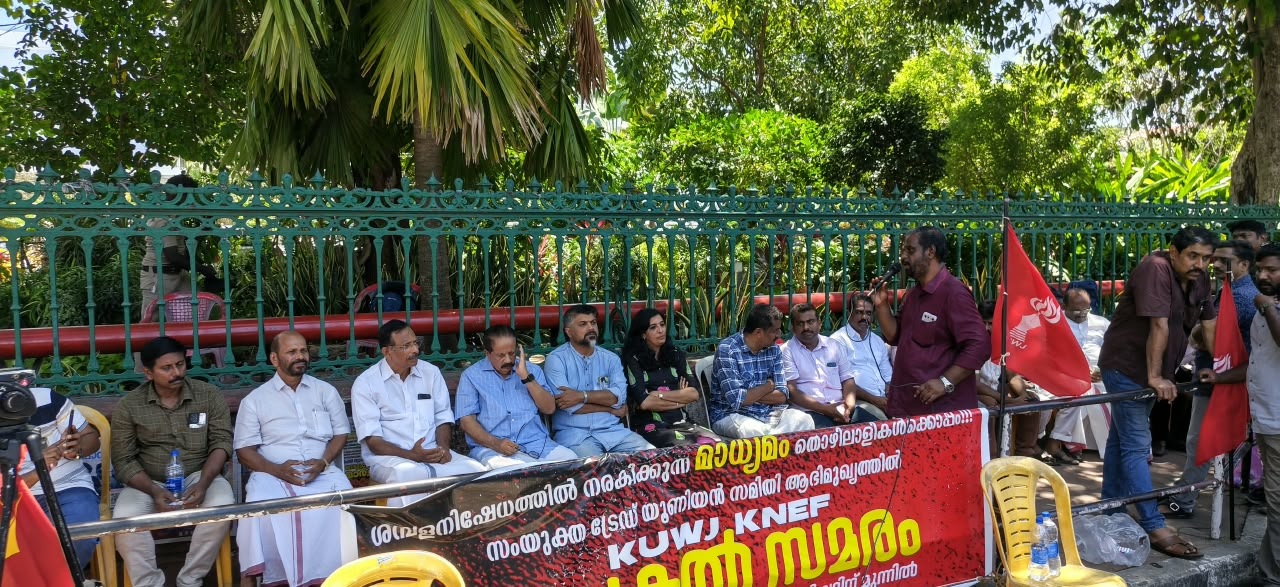
Madhyamam journalists protest in front of the Secretariat with KUWJ and KNEF support
The protests have received support from nearly every labour organisation and political party, including the CPI(M), Congress and their trade unions in the State.
“When an organisation wants its employees to shift to contract employment, it normally has to offer more money. This is happening in many news outlets. But here at Madhyamam, it is being used as a pressure tactic, and the management calls it a ‘package’,” Nishad told South First.
“September 30 is the deadline given by the management to either shift to contract employment or leave the job. Some unofficial discussions have taken place, but nothing more has happened.”
He alleged that the management had also used a “scare tactic” by suggesting that the paper would soon be shut down, forcing many to resign.
“Transfers are also being given as punishment. Many employees working in other districts are struggling with the financial burden of rent and other living expenses,” he added.
Nishad said the financial crisis and shortage of staff were also affecting the quality of journalism.
“In my bureau, when the Assembly is in session, the workload is hectic. The less-discussed side of this issue is the quality of journalism. Since getting the salary is still the priority, the quality of journalism is also being compromised, and we are sad about it. Years ago, PRD [Information & Public Relations Department] releases were limited, with fewer than 10 releases a day,” he said.
“Now, the PRD has a wide network and is sending out a large number of government releases. These are releases that the government wants to highlight and spread. With the limited workforce, we are forced to give those releases. Our own stories are limited because the workload and financial constraints are affecting us. We cannot go out and cover good stories. Now, one person has to handle the releases alone. Earlier, at least three own stories were filed from the Thiruvananthapuram bureau on a daily basis. Now there is no workforce. This is the same in all bureaus, including Kozhikode.”
Also Read: Kanthapuram and the myth of confining the Muslim woman to her home
Nishad said Madhyamam has long been the only news organisation that has effectively implemented the recommendations of the Majithia Wage Board, though not in name, and suggested that the management was now attempting to reverse it.
“After resigning and moving to contract employment, an employee’s service period is also affected, which can impact their pension. There is no job guarantee and no long-term contract,” he said.
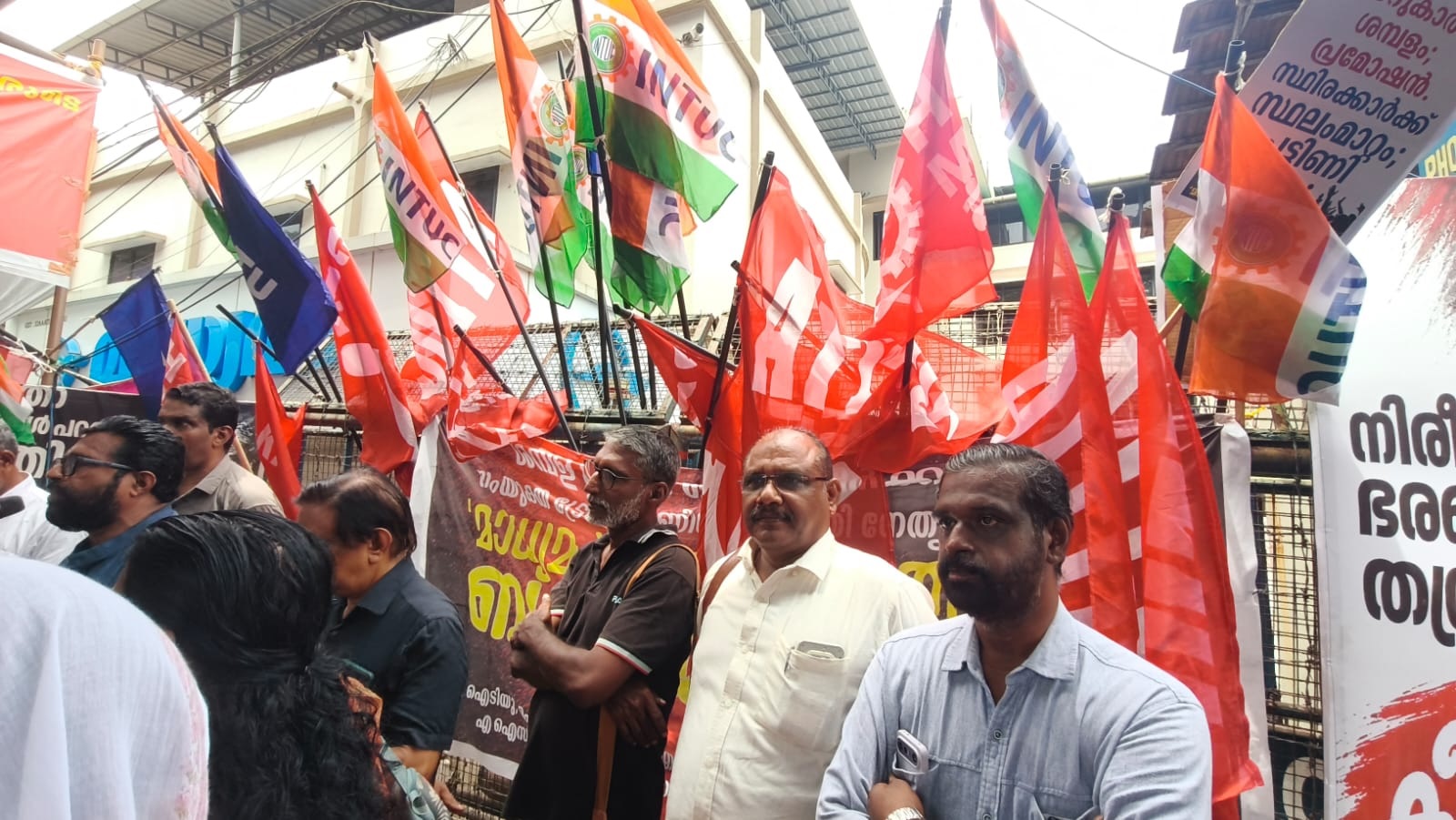
Madhyamam Journalists protest
“There are now five LLPs (Limited Liability Partnerships), through which the revenue of the mother company, Ideal Publications Trust, can be rerouted. So, on paper, the mother company’s revenue can be shown as lower. What is happening here is a clear violation of labour rights. By splitting employees, we lose our collective bargaining power as a union.”
He said the situation had made continuing in the job unsustainable for many employees.
“People who are living on this job cannot continue with this crisis. Many families are struggling. People who hold the journalist title mainly for its social dignity may continue because they are not interested in salary discussions, but that is not the situation for the majority.”
Another employee at the paper, who spoke to South First on condition of anonymity, said they had been forced to take up a second job to meet their daily expenses.
“I am working in another online media organisation as well to meet my day-to-day expenses, and no one knows that. For the past three months, I haven’t even been able to pay my rent. The journalist title carries a certain respect, and that is why my house owner still allows me to continue there. But what about my management? They did not value us even as human beings,” they said.
“We have no assurance and legal protection if we change to contract employment. Even senior journalists are being forced to shift to contract employment.”
Also Read: Manufacturing an accident: Keralam to bust repeat patterns behind fake insurance claims
Workers’ rights advocate Rejimon Kuttapan told South First that the Madhyamam management withholding salaries amounted to wage theft.
“Wage theft is theft, including in a newsroom. During COVID, workers’ rights advocates, myself among them, insisted on calling it wage theft. We stopped saying ‘non-payment’ or ‘delayed wages’ because those soft words let employers off the hook. Wages that are earned and withheld are stolen,” he said.
“During those years, when Gulf employers sent Indian migrants home with empty hands, I told their stories in prime-time debates on MediaOne, the channel from the same family as Madhyamam. That platform condemned wage theft abroad. The same family is now facing allegations of wage theft at home.”
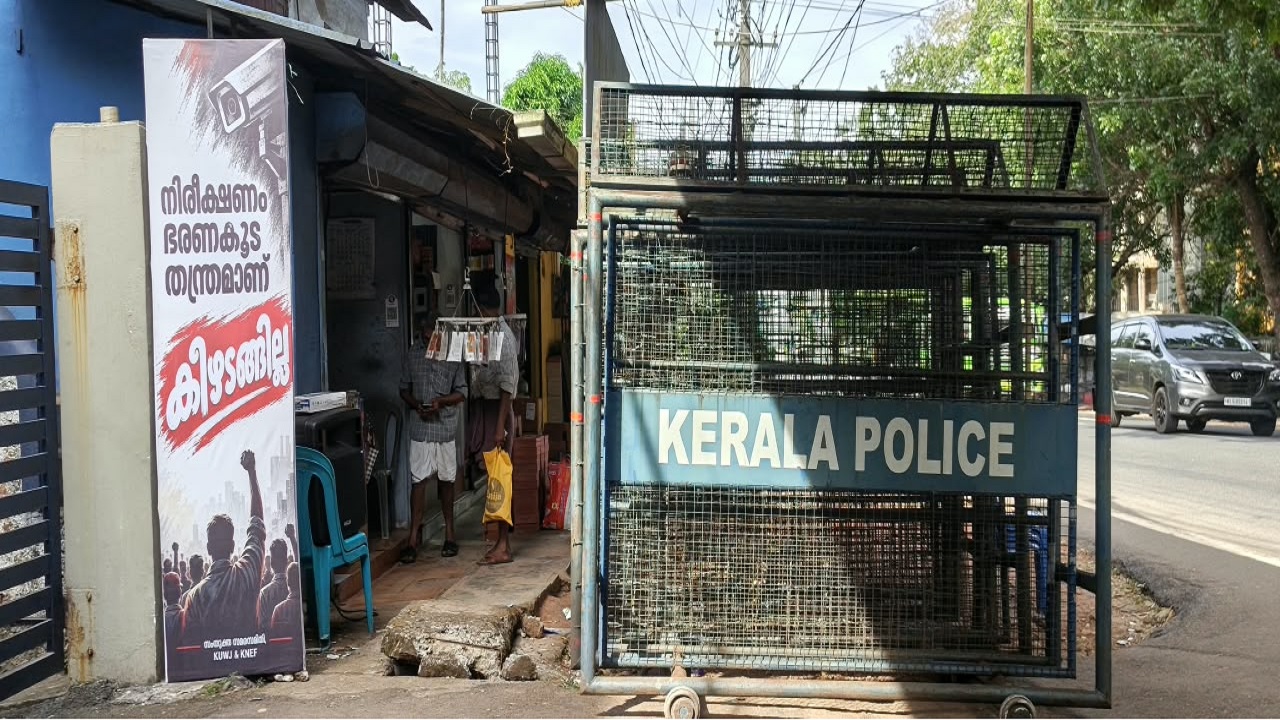
Police barricaded the area near the protest site of Madhyamam journalists
He noted that while the management had cited financial difficulties for not paying permanent employees through most of 2026, contract staff in the same newsroom had been paid every month.
“This is not a financial crisis. It is a political choice — starve permanent workers into resigning, then rehire them without security, without gratuity and without a voice. It is the same logic that is spreading contract work and weakening job security across India, now applied inside a newsroom,” he said.
“The Universal Declaration of Human Rights (Article 23) and the ICESCR (Article 7), which India has ratified, guarantee just and fair remuneration. ILO Conventions 95 and 173 require wages to be paid regularly and put workers first when an employer claims difficulty. The ILO treats withholding of wages as an indicator of forced labour.”
The UN Guiding Principles on Business and Human Rights make every enterprise responsible for respecting rights, whether it is a corporation, a trust or a newspaper, he noted.
“India’s Supreme Court, in PUDR v Union of India (1982), tied the denial of fair pay to forced labour under Article 23 of the Constitution. This is also a test for the Government of Keralam,” he said.
“A state that calls itself pro-worker cannot let a signed settlement become waste paper. I call on the government to enforce the February agreement, invoke its statutory recovery powers, audit Provident Fund remittances, and ensure that no worker is coerced into resignation or contract terms under economic duress.”
(Edited by Dese Gowda)



