

Published Sep 30, 2026 | 1:45 PM ⚊ Updated Sep 30, 2026 | 1:45 PM

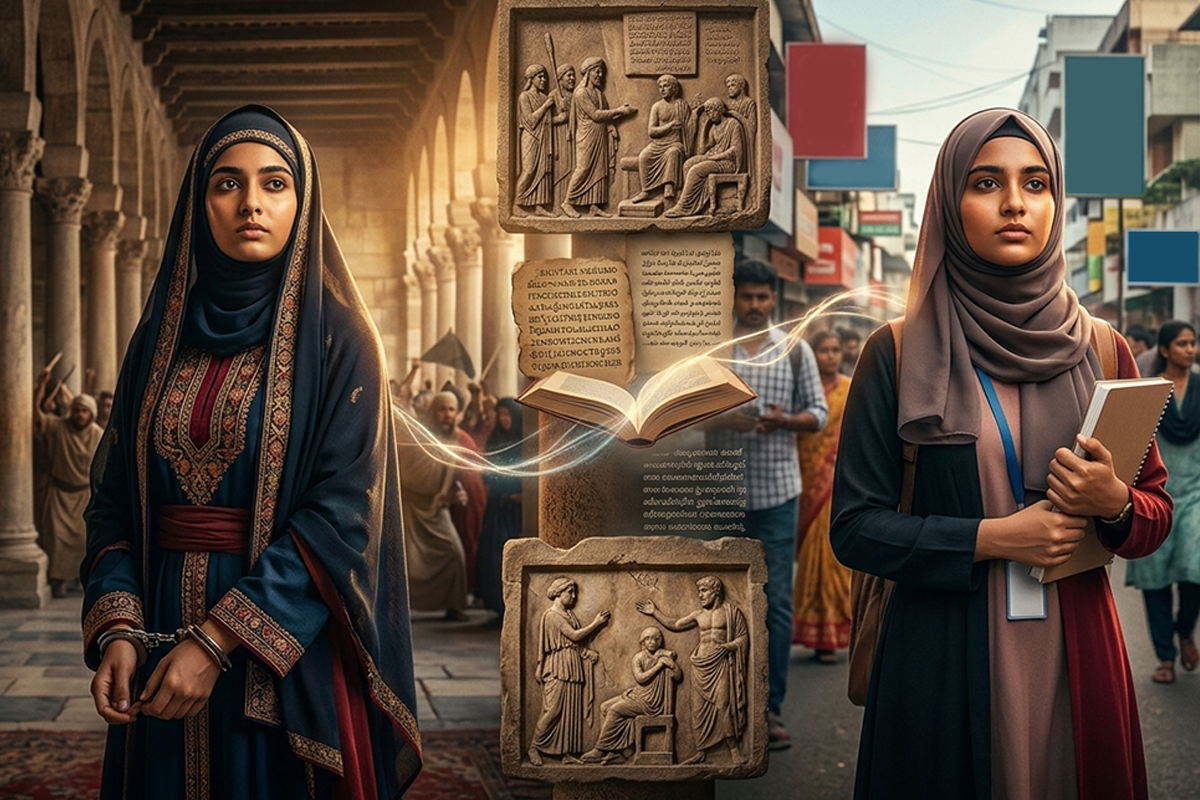
Image used for representational purpose. (AI generated image)

Synopsis: A conservative cleric’s call to confine women to private spaces has sparked a fierce debate over female autonomy, which exposes a glaring contradiction. History proves that Muslim women have always been formidable public leaders, stateswomen, and scholars.
When Sayyidah Zaynab, granddaughter of Prophet Muhammad, stood unshackled in the tyrannical court of Caliph Yazid in Damascus, her voice did not tremble.
Having witnessed the brutal massacre of her brother Imam Hussain and his family on the blood-soaked plains of Karbala, she did not retreat into secluded mourning or private silence. Instead, she faced absolute state power head-on, delivering searing, eloquent public indictments that dismantled the legitimacy of an empire and forever altered the political trajectory of Islamic history. Her courage was public, unapologetic, and monumental.
That historical legacy feels startlingly distant when looking at the modern, localised controversies sparked by prominent religious figures.
The recent debate in Keralam ignited sharply following an official circular issued by the Samastha Kerala Jamiyyathul Ulama faction led by the Grand Mufti of India, Kanthapuram AP Aboobacker Musliyar. The directive explicitly declared that it was “not permissible” for young women to be present among unrelated men on public roads and stages during religious celebrations, instructing madrasas and local mahal committees to bar women from public platforms.
Defending these restrictive edicts at an Islamic conference in Kochi, Kanthapuram doubled down on the stance, arguing that bringing women onto public platforms invites “great destruction” and asserting that they must remain confined to the private space of their homes.
Echoing archaic patriarchal anxieties, such edicts reduce women to domestic appendages—even comparing them to precious gold ornaments that must be locked away safely out of sight to preserve community purity.
This attempt to legislate women out of the public sphere evokes the timeless dilemma captured in Sophocles’ Antigone. Just as King Creon sought to enforce an edict that denied public dignity, burial, and voice to the fallen, instead demanding blind obedience to arbitrary state law, modern patriarchal gatekeepers seek to enforce a theological edict that buries half the community in enforced invisibility.
Like Antigone, who recognised that unwritten higher laws of justice supersede tyrannical decrees, modern Muslim women pushing back against these regressions are standing up for a moral truth: that human agency, dignity, and the right to inhabit the world cannot be legislated away by self-appointed custodians of morality.
Both Zaynab and Antigone — one forged in the dramatic imagination of classical Greece, the other in the harrowing crucible of early Islamic history — embody the archetype of the defiant female voice speaking truth to power. Antigone faced the stone walls of a tomb; Zaynab faced the golden halls of an absolute caliph. Both demonstrated that when the state or the pulpit attempts to crush the conscience, the human spirit revolts in defence of higher universal values.
The strictures laid down by the cleric did not pass quietly, triggering an immediate and fierce political pushback, particularly in Kerala.
Kerala Chief Minister VD Satheesan strongly rejected Kanthapuram’s stance, dismissing it as a regressive “19th-century mindset” entirely incompatible with a progressive, modern society.
Satheesan dismantled the cleric’s logic by pointing out that such restrictions stem from a fundamental misinterpretation of sacred texts. He noted that the architecture of early Islamic history is replete with women who commanded deep public and political presence, stating that figures like Khadija operated as master businesswomen, and Aisha historically participated in major public and military affairs.
This sharp political rebuttal underscored that forced confinement has zero grounding in the dynamic realities of early Islam, bringing to light a broader global friction: the ongoing battle between progressive constitutional democracy and insular clerical gatekeeping.
To argue that Islam mandates the permanent confinement of women is to profoundly sanitise Islamic history, whose foundational architecture was shaped not by figures hiding in the shadows, but by formidable public personages who commanded commerce, scholarship, governance, and theology.
History reveals titans like Khadija bint Khuwaylid, an independent merchant who managed vast trade caravans; Aisha bint Abi Bakr, a brilliant jurist and political leader who transmitted thousands of Hadiths; and Al-Shifa bint Abdullah, whom Caliph Umar appointed as a market inspector to oversee public administration in Medina.
The intellectual and institutional legacy continued with Rabia Basri, the foundational architect of divine love in Sufism; Fatima al-Fihri, who utilised her inheritance to establish the University of Al-Qarawiyyin in 859 CE; and Nafisa al-Kubra, whose grand study circles in Cairo attracted towering male scholars like Imam al-Shafi’i, who sat humbly as her students.
To further dismantle the myth that female political leadership is foreign to Islamic civilisation, history points to extraordinary sovereigns who wielded supreme authority with unmatched tactical and administrative brilliance.
In the thirteenth century, Shajar al-Durr rose to become the Sultana of Egypt in 1250 CE. During one of the most perilous moments of the medieval era — the Seventh Crusade — she stepped into the political vacuum following the death of her husband, astutely navigating military crisis, outmanoeuvring external invaders, and securing political stability when the state faced imminent collapse. Her deft governance proved that in moments of existential crisis, Islamic sovereignty found its saviour not in patriarchal complacency, but in female political genius.
Similarly, the annals of the Indian subcontinent showcase Razia Sultana (1205–1240 CE), the first and only female ruler of the Delhi Sultanate. Known for her razor-sharp administrative acumen and fearless leadership, Razia broke every convention of her era by riding into battle dressed as a warrior and demanding to be treated as a sovereign on her own terms.
Both Shajar al-Durr and Razia Sultana stand as undeniable historical testaments to the fact that leadership, command, and statecraft were never the exclusive domain of men in classical Muslim history.
Writing in her autobiography, Daughter of the East, former Pakistani Prime Minister Benazir Bhutto diagnosed this exact malaise. She argued that the systematic oppression of Muslim women has never stemmed from the core tenets of Islam itself, but rather from men’s interpretations of religion.
Bhutto detailed how political fundamentalism and patriarchal orthodoxy weaponised selective rules to strip women of agency and force them into seclusion under slogans like “Chadar aur Chaar diwari.” By stepping into the highest echelons of political leadership in a major Muslim-majority nation, Bhutto shattered the orthodox illusion that Muslim women are inherently meant to be silent, private, or submissive figures. She proved that the weaponisation of religion to suppress female autonomy is a political strategy of control, not an immutable divine mandate.
When traditionalists attempt to quarantine women inside domestic walls, they are inventing a cramped orthodoxy that directly contradicts authentic Islamic heritage. A modern society cannot progress by turning back the clock on half its population. The fierce backlash from young Muslim women, students, and professionals across the country proves that the script of forced confinement has expired.
Women are claiming their rightful spaces in universities, courtrooms, parliaments, and public squares. Zaynab and Antigone teach us that tyranny, whether backed by a crown or a clerical decree, ultimately fractures against the resilience of those who refuse to be silenced.
A Muslim woman is not merely a creature of the private shadows; she is, and has always been, a vital public personage. Ultimately, this ongoing struggle reminds us of a fundamental truth of civic and spiritual life too: religion is simply too important to be left to the clergy.
Also Read:
How Ayatollahs of Iran betrayed their revolution’s mentor
Law against black magic in the works, study probes what drives deadly superstition in Keralam
Where are our distinguished jurists?
(Faisal CK is Deputy Law Secretary to the Government of Keralam. Views are personal. Edited by R Rajesh Kumar.)



