

Published May 14, 2026 | 6:54 PM ⚊ Updated May 15, 2026 | 6:58 AM

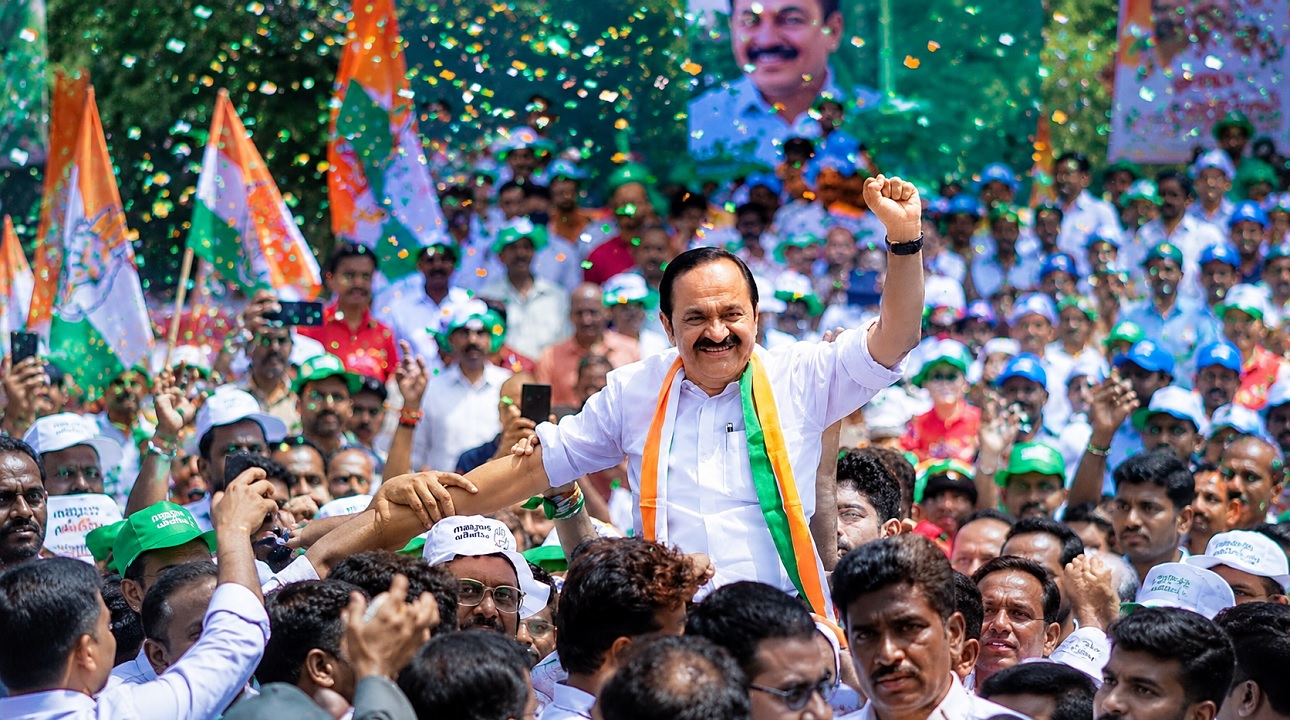

Synopsis: With VD Satheesan confirmed as the Congress party’s choice for Kerala Chief Minister, attention has now turned to cabinet formation, with negotiations expected to begin in earnest within the Congress and among UDF allies over ministerial berths and key portfolios. The IUML and Kerala Congress (Joseph) are expected to seek greater representation in the ministry, while the Congress must also balance internal factional interests within the party.
VD Satheesan’s confirmation as the Congress party’s pick for Chief Minister of Kerala may have ended weeks-long uncertainty over government formation in the state, but it is only the first step in a lengthy process, with negotiations over cabinet positions both within the party and among UDF allies now taking precedence.
Senior Congress leaders said discussions over cabinet allocation are expected to begin in earnest immediately after the leadership issue is formally put to rest with Satheesan’s election as leader of the Congress Legislature Party (CLP) on Thursday, 14 May.
The UDF secured a commanding mandate with 102 seats in the 140-member Assembly.
The Congress is the single largest party in the alliance with 63 seats, followed by the Indian Union Muslim League (IUML) with 22 seats. Kerala Congress (Joseph) has seven seats, while the Revolutionary Socialist Party (RSP) has three.
The Revolutionary Marxist Party, Kerala Congress (Jacob) and Communist Marxist Party (CMP) have one seat each. The coalition also includes four Independents.
As the second-largest constituent in the UDF, the IUML is expected to stake a claim for a larger share of cabinet berths, with the number likely to go up to five, along with key portfolios.
Likewise, Kerala Congress (Joseph), given its strong performance, is also expected to press for a larger share.
Within the Congress, the party will also have to contend with competing interests while accommodating allies of KC Venugopal and Ramesh Chennithala, Satheesan’s key rivals for the Chief Minister’s post, though neither is expected to join the cabinet.
Also Read: No ‘KC after OC’: Venugopal’s rise in Congress, and Satheesan’s win
South First understands that the Congress may look to the Oomen Chandy government of 2011 for direction and induct ministers in phases.
Initially, only four or five ministers are expected to take oath alongside VD Satheesan, with more names likely to be added later after consultations within the party and with allies.
A senior UDF leader told South First:
“Along with the CM-designate Satheesan, legislature party leaders of constituent parties in the UDF may also take oath. Portfolio allocation may happen later. Since the tentative date for swearing-in is 18 May, there are still a few days left. The UDF meeting scheduled at Cantonment House on 15 May could help arrive at some consensus.”
Unlike Chandy, who had six ministers sworn in alongside him initially before 13 more ministers were inducted a few days later, the two Pinarayi Vijayan ministries were inducted in one go in 2016 and 2021, with 18 and 21 ministers respectively.
At the same time, it remains unclear whether allies such as the IUML and RSP would be allocated the same portfolios they held previously.
During the 2011 UDF government, the IUML held four cabinet positions and controlled influential departments including Industries, IT, Trade and Commerce, Mining and Geology, Wakf and Haj Affairs, Public Works, Social Welfare, Panchayats, Education, Urban Development and Minority Welfare.
The RSP then handled Labour and Employment, while Kerala Congress (Joseph) was given Water Resources, Irrigation and Inland Navigation.
Kerala Congress (Joseph) handled Food, Civil Supplies and Registration.
Another factor that may shape cabinet formation is that several MLAs who served as ministers in the 2011 government have now returned to the Assembly, including PK Kunhalikutty, Manjalamkuzhi Ali, Shibu Baby John and Anoop Jacob.
Within the Congress, accommodating Venugopal and Chennithala loyalists is also expected to be a key factor.
MLAs close to both leaders are expected to seek significant cabinet representation and key portfolios.
While Venugopal continues to serve as an MP, indications from Chennithala are that he is unwilling to join the cabinet.
Also Read: The delay in choosing the Kerala CM caused irreparable damage: The takeaway for Congress
The CLP is set to formally elect Satheesan as its leader at a meeting on Thursday evening.
Soon after, Satheesan is scheduled to meet Kerala Governor Rajendra Viswanath Arlekar at Lok Bhavan at 7 pm to formally stake claim to form the government.
Under coalition arrangements, alliance partners generally submit letters extending support to the leader staking claim.
Once satisfied that the claimant commands majority support in the Assembly, the Governor formally invites the leader to form the government under Article 164 of the Constitution.
Under Article 164(1), the Governor appoints the Chief Minister, while other ministers are appointed on the advice of the Chief Minister.
When a party or alliance secures a clear majority, constitutional convention requires the Governor to invite the elected leader of that formation to form the government.
The swearing-in ceremony is likely to take place on Monday. The Governor first administers the oath of office and secrecy to the Chief Minister, followed by members of the Council of Ministers.
Portfolio allocation may either be announced immediately after the ceremony or finalised later.
The first Cabinet meeting traditionally takes place within hours, or at most a day, after the swearing-in.
Apart from its symbolic significance, the first Cabinet usually clears the proposal to summon the Assembly under Article 174 of the Constitution. The Cabinet also recommends the appointment of a Pro-tem Speaker.
The Governor then appoints the Pro-tem Speaker, usually the senior-most MLA in the Assembly, who administers the oath to newly elected legislators and presides over the election of the permanent Speaker.
Only after MLAs are sworn in on the Assembly floor can the House proceed to elect its Speaker.
Ministers who have already taken oath before the Governor must again take oath as MLAs inside the Assembly, since the two processes are constitutionally separate.
Once the Speaker is elected, the Pro-tem Speaker’s role automatically ends and the new government moves into full legislative functioning.
(Edited by Dese Gowda)



