

Published Jun 30, 2026 | 5:02 PM ⚊ Updated Jun 30, 2026 | 5:03 PM

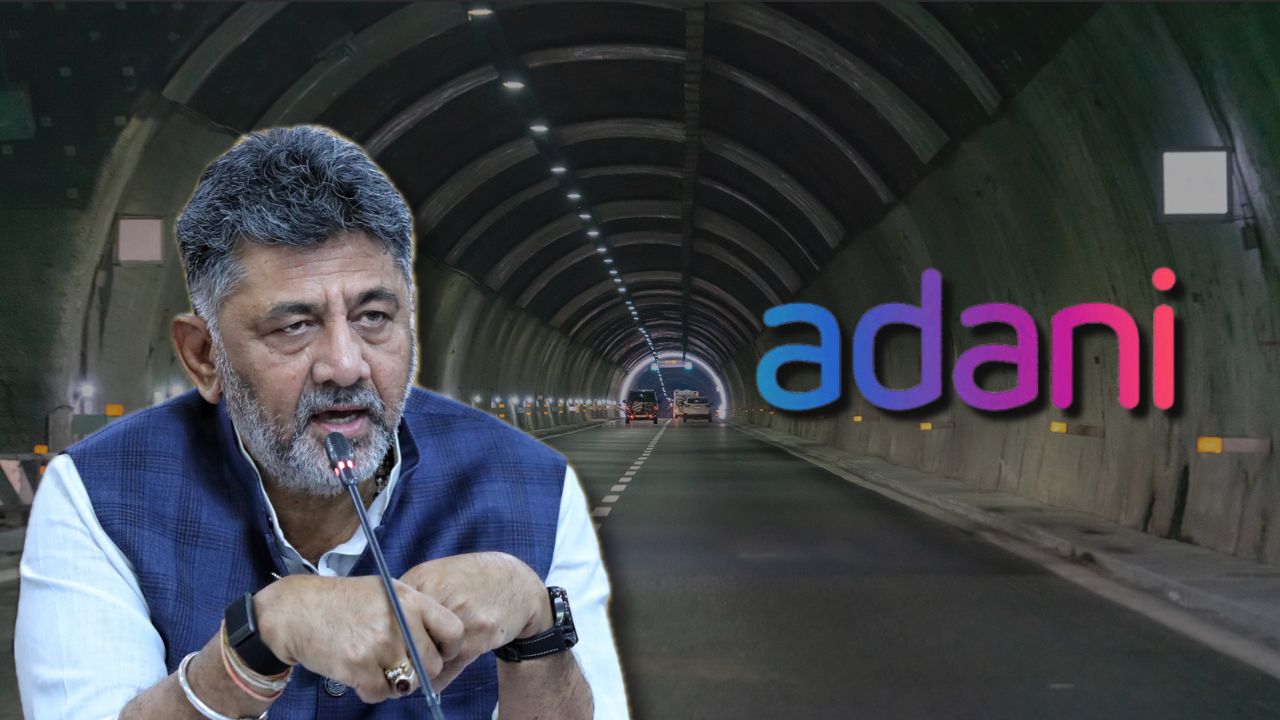
CM DK Shivakumar faces a political tightrope walk amid controversy and questions over whether the tunnel road is even the best solution.

Synopsis: Karnataka Chief Minister DK Shivakumar must decide whether to negotiate with Adani Enterprises, revise the government’s cost estimates or invite fresh bids after the company’s winning offer for Bengaluru’s tunnel road project came in more than 90 percent above the government’s Total Concession Value estimate. The decision has become politically sensitive, with the BJP accusing the Congress of protecting “corporate interests”, and, along with mobility experts, demanding that the project be scrapped.
Nationally, Leader of the Opposition in the Lok Sabha Rahul Gandhi and his party, the Congress, have taken it upon themselves to portray businessman Gautam Adani and PM Narendra Modi as the poster boys of crony capitalism.
Armed with photos of the duo aboard private jets, claims of personal ties and an unholy nexus, the Congress has minced no words in insisting that the BJP-led NDA government has bent rules, misused central agencies, extended undue favours and used every trick, even at the cost of public money, to enrich Adani’s business interests.
This politically uncompromising stance by the Congress has left Karnataka Chief Minister DK Shivakumar juggling a hot potato after Adani Enterprises emerged as the winning bidder for two packages of his brainchild: Bengaluru’s tunnel road project.
The BJP has now turned the tables, accusing the Congress of protecting “corporate interests” and demanding that the project be scrapped.
As things stand, Adani Enterprises submitted the lowest bid, yet its estimate is more than 90 percent higher than the government’s estimate of the Total Concession Value (TCV).
The contract has not yet been awarded. The Karnataka government now has a few options: negotiate and convince the bidder to lower its estimate, revise its own estimates, or scrap the current tender process altogether and invite fresh bids.
Each of these options comes with its own set of challenges.
As the proposal sits on Chief Minister DK Shivakumar’s table awaiting approval, he faces a political tightrope walk amid controversy and genuine questions over whether the tunnel road is even the best solution to Bengaluru’s urban mobility woes.
Also Read: Inside the 460-day protest against Bidadi AI township championed by CM DK Shivakumar
The project, a 16.75-km twin-tube tunnel corridor from Hebbal in north Bengaluru to Central Silk Board in southeast Bengaluru, is aimed at reducing travel time from the current 90-plus minutes to under 35 minutes.
Initiated by DK Shivakumar when he was Deputy Chief Minister and held the Bengaluru development portfolio soon after the Congress returned to power in 2023, the project was deemed by mobility experts to be a band-aid solution to Bengaluru’s traffic woes.
Now that the staggering gap between the government’s estimated cost and Adani’s bid has come to light, the matter has become more complicated.
Karnataka’s initial estimate for the project, split into two packages under a Build-Own-Operate-Transfer (BOOT) model, stood at approximately ₹14,000 crore (₹8,000 crore for construction and ₹6,000 crore for maintenance).
However, when the tenders were opened in December 2025, the estimate—including return on investment (RoI), risk insurance, financing costs and other components—was revised to ₹17,800 crore.
Adani Enterprises, Dilip Buildcon, Vishwa Samudra Engineering and Rail Vikas Nigam Limited (RVNL) bid for the project. Adani Enterprises’ bid was the lowest, but at ₹22,000 crore.
Sources in the Finance Department, the Chief Minister’s Office (CMO) and Bengaluru development agencies told South First why these gaps in estimation exist and what measures are being taken to address them.
The government acknowledges that some of its estimates may have been erroneous, while others may warrant debate.
Simply put, the difference in cost estimates is less about construction costs and more about maintenance, financing conditions and return-on-investment assumptions.
“The bidder’s [Adani Enterprises] estimates on cost of maintenance is more than double GoK’s estimates. One of the primary contributors to the largest estimate is Risk insurance that the bidder has to buy for financing of the project. Bidder’s estimate is around ₹1,000 crore over and above the government estimate,” a stakeholder from the government told South First.
The other component adding an additional ₹500 crore to the bidder’s estimate is the RoI. While the GoK estimates peg the RoI at 14 percent, the bidder has assumed a 16 percent return in line with industry standards.
“Some items like risk premium are justified and genuine, others like RoI, PCR rates, vehicular density, toll recovery period are debatable since there may be some gaps in our estimation but irrespective of project total cost, outgo from Karnataka government is capped at around 40 percent Viability Gap Funding (VGF) for construction cost. The total construction cost is pegged around ₹8000 crores,” the stakeholder added.
Under the tender conditions, the company awarded the contract will have 30 years to recover its investment, with a provision to extend the tenure by another 10 years if the investment is not fully recovered.
In short, if the company’s higher-than-government-estimate bid is approved, users of the tunnel road could end up paying toll for a longer period even though the Karnataka government’s outgo for the project would remain unchanged.
As part of the investment recovery, bidders are also allowed commercial development at five “golden exits”—prime real estate locations—along the route.
Also Read: Two investigations in US and India raise fresh Gautam Adani questions; Karnataka deal highlighted
Chief Minister DK Shivakumar is expected to take a call on Adani Enterprises’ bid for the project soon, but the next few weeks are likely to witness a series of negotiations with the firm.
A source within the CMO told South First that holding talks and bringing down the bidder’s estimate was the government’s first option, adding that the controversy surrounding the bid had become a political thorn.
“Adani [Enterprises] won the bid legitimately and government cannot indulge in favouritism or ill will irrespective of party’s stance. There are some estimation errors from our end bordering on unreal expectations but some estimates presented by the bidder are also inflated and based on data that is opaque. There will be multiple levels of negotiations to arrive at a common ground,” the source said, adding that the process could take weeks.
The other option before the government is to go back to the drawing board and revise its estimates, correcting errors and taking market conditions into account.
A third option, though one the government would rather avoid, is to scrap the current bidding process and invite fresh tenders.
Finance Department officials involved in the project are not too enthusiastic about that prospect for one specific reason.
“At the current government estimate, no firm will take up a Public-Private Partnership (PPP) project of this scale. We will then have to redesign the project and tender it package by package under an Engineering, Procurement and Construction (EPC) model,” the official said.
In the current situation, the GoK may have the option of capping its contribution to 40 percent VGF of the construction cost, irrespective of the TCV. But under an EPC model, the state’s share would rise exponentially.
For Bengaluru, already burdened by the fiscal cost of the Peripheral Ring Road, Metro rail and expressway construction, shouldering higher costs for another mobility project would be extremely challenging.
With controversy surrounding the project’s cost, opposition leaders and mobility experts urging that it be scrapped, the question now is whether DK Shivakumar’s push for his pet project will prevail, or whether the tunnel road will go into cold storage under the weight of negotiations and revisions.
(Edited by Dese Gowda)



