

Published Aug 11, 2026 | 7:34 PM ⚊ Updated Aug 11, 2026 | 7:34 PM

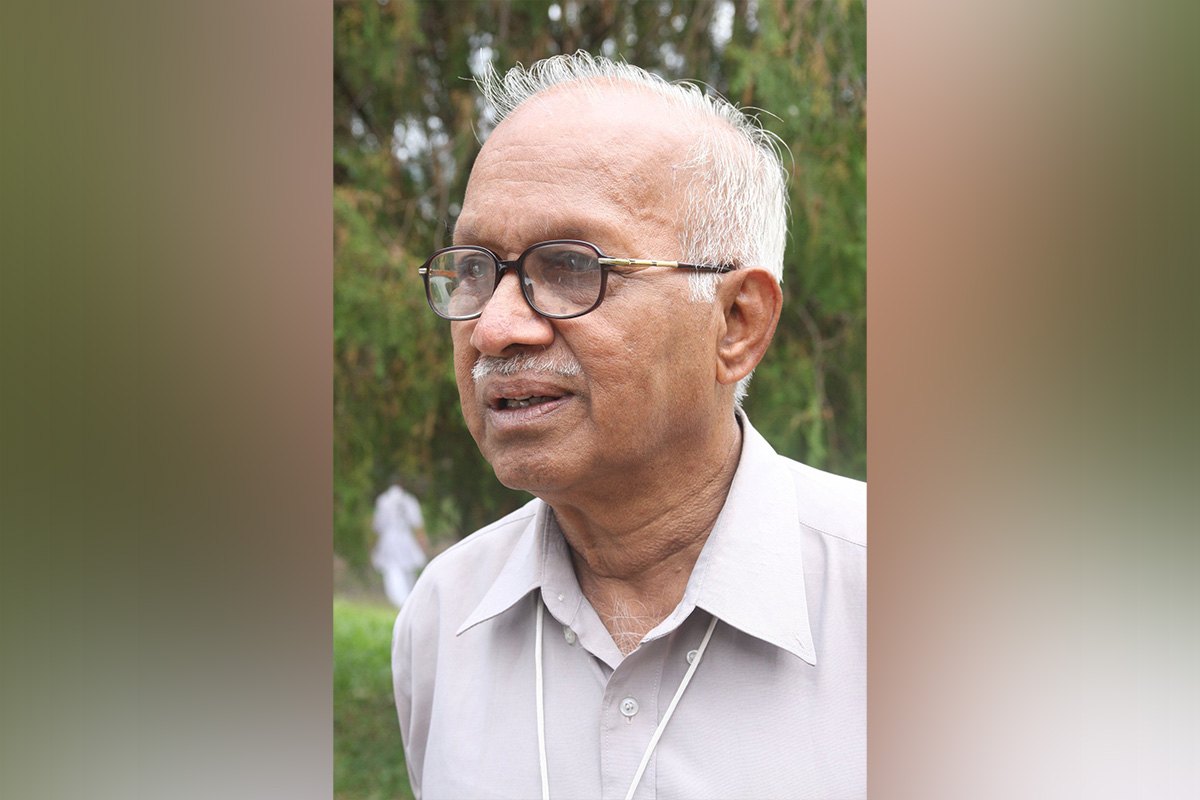
MP parameshwaran

Synopsis: M.P. Parameswaran, the nuclear scientist who walked away from a prestigious career at BARC to take science to ordinary people, is no more. A man who went on to become one of Kerala’s most influential voices in the popular science and literacy movements was also a Marxist thinker who later fell out with the CPI(M) over his ‘Fourth World’ theory. Parameswaran spent his life arguing for decentralised democracy, ecological balance and a society where science and knowledge served people rather than remaining confined to institutions.
Dr. M.P. Parameswaran, the nuclear scientist who walked away from a secure career at the Bhabha Atomic Research Centre to take science to ordinary people, and whose ideas later sparked one of the most intense ideological debates within Kerala’s Left, has died. He was 92.
Parameswaran died at his residence in Thrissur, leaving behind a life that moved across the worlds of science, Marxist thought, popular education, literature and social activism.
A scientist, writer, thinker and one of the principal architects of Kerala’s popular science movement, he remained deeply concerned with one question throughout his public life: What good is knowledge if it does not reach ordinary people?
Born on 18 January, 1935, into a conservative Namboothiri family in Thrissur district’s Kiralur, Parameswaran was initially known as M.P. Parameswaran Namboothiri.
He later dropped the caste suffix from his name while he was in college.
In an interview with Mathrubhumi weekly, he described the decision as a natural one rather than an act driven by any particular revolutionary purpose, saying that caste consciousness had never been central to his own thinking.
His early education was in Thrissur Namboothiri School, followed by studies at CMS High School and St Thomas College. He went on to study electrical engineering at Thiruvananthapuram Engineering College and later travelled to the Soviet Union, where he earned a doctorate in nuclear engineering from the Moscow Power Institute.
His years in Moscow left a lasting impression on him.
He experienced a standard of living that he felt was far ahead of ordinary Indians. He was also moved by the place knowledge occupied in everyday life. There, he observed that knowledge was not confined to classrooms or laboratories; it was woven into society.
That experience shaped the course of his life after his return.
Also Read: Kerala to Keralam: Amit Shah set to introduce name-change Bill in Parliament on Monday
Parameswaran joined the Bhabha Atomic Research Centre in 1957 and worked there as a scientist until 1975. But the laboratory increasingly seemed too narrow a space for the questions that concerned him.
He wanted ordinary people to understand that science was not merely a collection of formulas, machines and sophisticated technologies. It was present in the most familiar aspects of everyday life — in the way a household functioned, in agriculture, in health, in the environment and in the way nature itself operated.
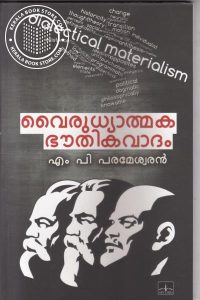
One of the works of M P Parameswaran
He eventually gave up his position at BARC in 1975 and devoted himself fully to the Kerala Sastra Sahitya Parishad (KSSP).
He never regarded the decision as a sacrifice.
For him, it was simply a transfer from one field of work to another — one that offered greater satisfaction.
KSSP, founded in 1962, had begun as a forum for popularising science and grew into one of Kerala’s most influential people’s movements.
Parameswaran was among its leading figures and played a major role in turning the organisation into a mass movement with a reach extending far beyond the scientific community.
His method was simple but powerful: science had to be brought down from its pedestal and connected to people’s lives.
He often asked what purpose science served if it neither benefited the masses nor encouraged them to think.
For Parameswaran, science was not synonymous with gadgets or technology. It was an understanding of how nature worked — and, equally, a way of thinking.
His vision was of a society capable of living in harmony with nature.
He also played a major role in the wider popular science and literacy movements and was associated with the formation of the All India People’s Science Network, helping carry the idea of people’s science beyond Kerala.
Also Read: In Kerala’s relief camps, caste proves harder to wash away: Inside flood-hit Pathanamthitta
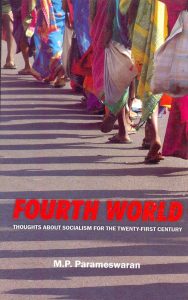
The book that triggered the debate
If Parameswaran’s work in science made him a household name among sections of Kerala’s progressive society, his political writings made him one of the most debated thinkers among the Left.
He had been a member of the Communist Party of India (Marxist) for 33 years.
But his advocacy of what came to be known as the Fourth World theory eventually brought that association to an end.
Parameswaran had been developing the idea since the 1990s, and his book ‘The Fourth World: Thoughts About Socialism for the Twenty First Century’ became the centre of a major theoretical debate within the CPM and the wider Left in Kerala.
At the heart of his argument was a question about the direction of both capitalism and conventional models of socialism. He believed the earth’s resources were finite and that a development model built around endlessly expanding production, consumption and material wants could not continue indefinitely.
His alternative placed greater emphasis on decentralised democracy, local economies, equitable distribution, environmental protection and smaller production units rooted in communities.
Parameswaran saw a possible meeting point between Karl Marx’s ideas on decentralisation and Mahatma Gandhi’s concept of Gram Swaraj. He envisaged a new kind of village as the foundation of a new social order — one in which economic activity was decentralised, power was pushed down to the grassroots and people’s well-being mattered more than the relentless pursuit of production.
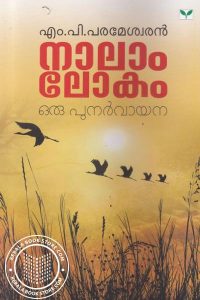
M P Parameswaran’s book on Fourth World
He warned that the coming generations could face an ecological and cultural crisis if development continued along the existing path. Natural disasters, environmental degradation and declining productivity, he argued, would become increasingly serious.
His central concern was not how much society could produce, but how people could live better.
The CPI(M), however, viewed the Fourth World formulation as a departure from Marxist-Leninist principles.
The dispute unfolded against the backdrop of wider organisational and ideological tensions within the party, including questions over Parameswaran’s association with institutions that received foreign assistance.
At that time, he was also labelled as ‘CIA Agent.’
In 2004, the party expelled him, bringing to an end his 33-year association with the CPI(M).
The expulsion did not end his engagement with the ideas that had shaped his life. Nor did it take him away from public activity.
He continued to work through the people’s science and literacy movements, writing, speaking and debating questions of democracy, development, ecology and socialism.
Also Read: Everyone wants a piece of Munnar: But can Kerala’s crown jewel carry the weight of its own success?
Parameswaran remained, in his own way, a Marxist thinker even after his break with the CPI(M).
The collapse of the Soviet bloc had strengthened his belief that democracy had to occupy a central place in any future socialist project. The Fourth World emerged from that continuing search for an alternative.
His argument was not simply a rejection of Marxism. Rather, he tried to reinterpret Marxist ideas in the light of ecological limits, decentralisation and the failures of highly centralised systems.
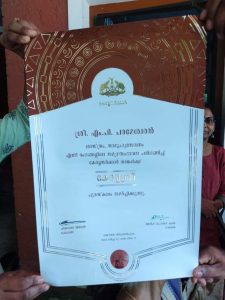
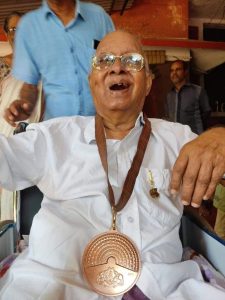
The Kerala Sree Award given to M P Parameswaran for his contributions in 2023
He argued that Marx and Engels themselves had envisaged a closer integration of agriculture and industry and a redistribution of populations away from heavily concentrated urban centres. The difficulty, he maintained, was that such a vision could not easily be realised through a centralised socialist state. The resulting concentration of population and economic activity in cities created its own instability.
His attempt to bring together Marx’s ideas of decentralisation with Gandhi’s Gram Swaraj therefore became an important part of his later political thought.
His autobiography, ‘Kaalaharanamillatha Swapnangal’ , chronicled much of this intellectual, organisational and personal journey — from the young engineer who travelled to Moscow, to the nuclear scientist at BARC, the people’s science activist, Marxist theorist and eventually the thinker who found himself outside the party he had served for decades.
Also Read: Kerala poll debacle makes CPI(M) rethink how it speaks, organises and fights
Parameswaran’s public life was marked by a striking disregard for status.
He had the qualifications for a distinguished scientific career and had already secured a place in one of India’s premier scientific institutions. Yet he chose to leave that path because he believed the larger task was to change the way society understood knowledge.
He brought complex scientific and Marxist ideas to ordinary people in language they could understand.
He saw no sharp boundary between science, politics and social life. Knowledge had to be democratic; scientific temper had to become part of everyday thinking; and development had to be judged by its impact on human beings and the natural world.
His influence therefore went well beyond the institutions with which he was formally associated.
For generations of activists, science communicators, literacy workers and Left thinkers, Parameswaran represented a rare combination of scientific training and an uncompromising commitment to social change.
He leaves behind books and theories, but perhaps his most enduring legacy is the question he repeatedly posed through his life and work: What is the use of science if it does not help people understand the world and change the way they live?
(Edited by Fayisa CA)



