

Published Jul 09, 2026 | 7:00 AM ⚊ Updated Jul 09, 2026 | 7:00 AM


Synopsis: It’s not just the football faithful, people looking to connect with others in real spaces also flocked to a community screen where the FIFA World Cup was being streamed in Kerala’s Kozhikode.
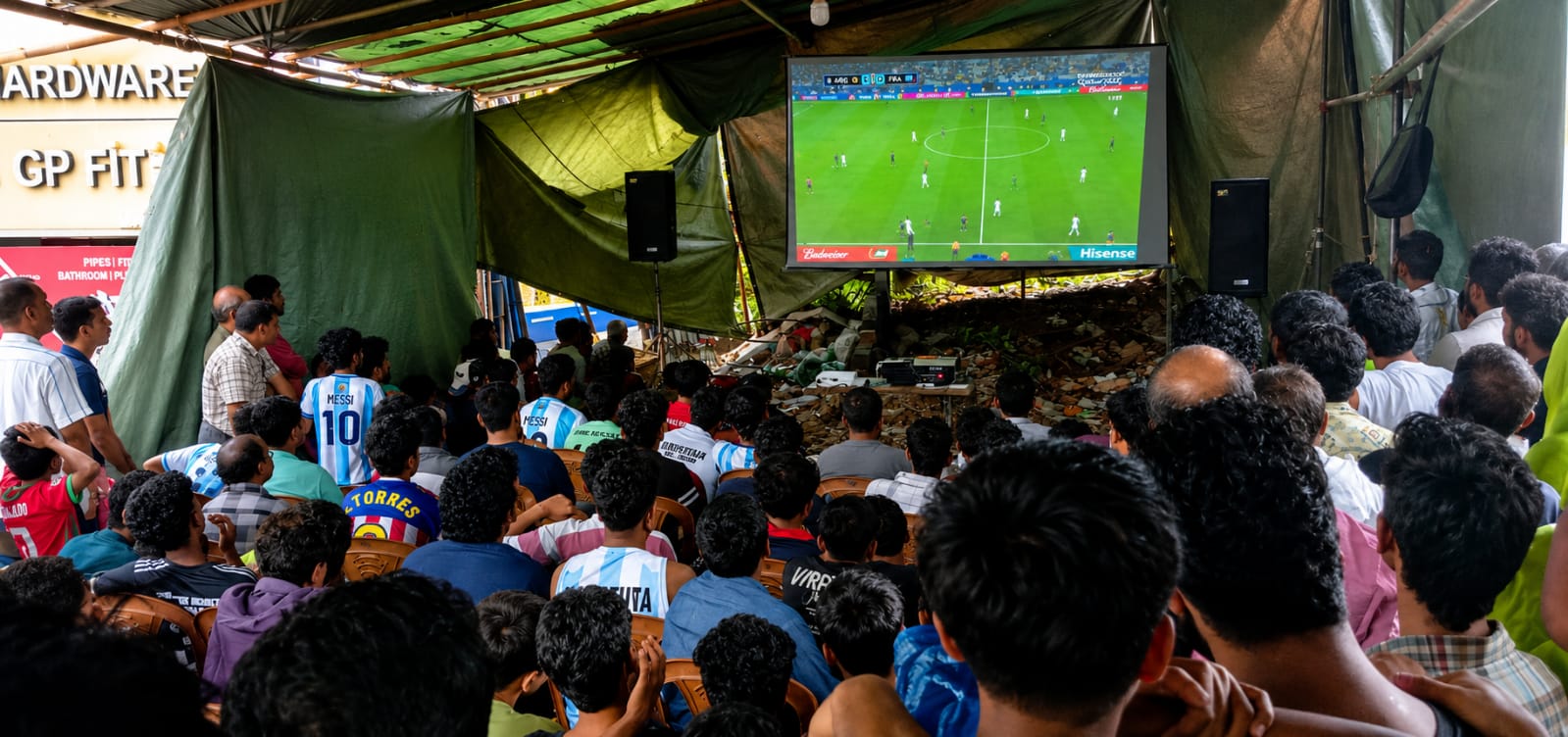
Muneer, an elderly man, sits outdoors after midnight learning football from teenagers as the 2026 FIFA World Cup plays on the screens.
“It is wonderful to sit with Gen Z while watching football,” he tells us, his eyes glued to the giant screen where Spain were building another attack against Portugal in a match they would go on to win. “They (the teens) know the names of almost every player. They understand the technical side of football much better than we do. This is more than football. It is a festival.”
Around him, teenagers interrupted the commentary to explain formations, identify players and debate tactical substitutions. Muneer listened, occasionally asking questions before turning back to the match. For him, the World Cup screening at Kunnathupalam in Olavanna Panchayat, Kozhikode was not simply an opportunity to watch football. It had become a space where generations met, conversations unfolded and learning happened collectively.
His experience presents an intriguing paradox. At a time when football can be streamed effortlessly on smartphones, smart televisions and personal devices, spectators in this small corner of Kozhikode continue to gather late into the night in front of a community screen. They come carrying phones that could individually broadcast every minute of the match, yet they choose to watch together.
What unfolds here is more than public sports viewing. It is a social ritual in which global media are woven into local community life.
For Habeeb, the gathering evoked memories of an earlier era of television.
“During the Doordarshan days, around a hundred houses might have had only one television,” he recalled. “We all gathered in that one house to watch. Now we have public screenings on a big screen. It is a special feeling.” His comparison illustrates both continuity and change. Although technology has shifted from television scarcity to digital abundance, the desire for collective spectatorship has endured.
Habeeb also highlighted another dimension of community viewing. “People who know the technical side of football explain what is happening during the match. That increases our interest.”
Also Read | ‘The day humans became angels’: Walking through Kadalundi 25 years after the rail disaster
The screening thus becomes more than a venue for watching a game. It becomes a site where football knowledge is shared informally through conversation, allowing experienced viewers to interpret tactics, formations and decisions for others in real time.
The younger participants echoed the importance of atmosphere. “Spain is my team,” said Finooz. “It is a good vibe.”
Usman similarly remarked, “I love watching here in the community.”
Their comments were brief but revealing: the appeal lay not solely in sporting allegiance but in the social environment surrounding the match.
Perhaps the most explicit reflection came from Abhinav.
“At home we are alone,” he said. “Here, so many people support and tease each other. Even people who don’t understand football come just to experience the vibe. Only a few have real knowledge of the game.”
His observation challenges the assumption that community screenings are attended only by committed football followers. Participation appears to be driven equally by the pleasure of being part of a temporary public gathering.
These conversations at Kunnathupalam recall aspects of Bakhtin’s idea of the carnivalesque —moments when everyday social arrangements are temporarily reconfigured through collective participation.
At Kunnathupalam, conventional hierarchies appeared to soften. Younger spectators became teachers, older viewers became learners, and seasoned football followers explained tactics to those less familiar with the game. The roadside space, usually just another neighbourhood corner, was transformed into a festive public arena where conversation, humour, teasing and shared anticipation mattered as much as the action unfolding on the giant screen.
Also Read | Wood, water, and memory: Inside Beypore’s surviving dhow-building tradition
For Nigilesh PS, Assistant Professor in the Department of Sociology at Thunchath Ezhuthachan Malayalam University , these gatherings are far more than occasions to watch football.
“Football spectatorship in Malabar can be understood as a form of lived cosmopolitanism,” he observed. “Global sporting events are experienced through local cultural practices, creating a shared social space where differences of caste, religion, age and class temporarily recede. What emerges is a form of social egalitarianism, shaped through the collective experience of watching together.”
Taken together, these accounts suggest that the community screening functions as a social institution rather than merely a viewing venue. The football match becomes the occasion through which conversations are initiated, friendships are renewed, generations interact and collective emotions are expressed. In an age where media technologies increasingly enable solitary consumption, the public screening transforms a global sporting spectacle into a locally meaningful social ritual.
While these observations emerge from a single location (Olavanna Panchayat in Kozhikode) and cannot be generalised to every football screening in Kerala, they illuminate how mediated sporting events can strengthen everyday forms of sociality. The significance of the gathering lies not only in the ninety minutes played on the screen but also in the community temporarily assembled around it.
Also Read | Toilet, monument and a vanishing turtle: Walking through Kerala’s Blue-Flag-certified Kappad Beach
(Edited by R Rajesh Kumar.)



