

Published Nov 02, 2026 | 3:53 PM ⚊ Updated Nov 02, 2026 | 4:33 PM

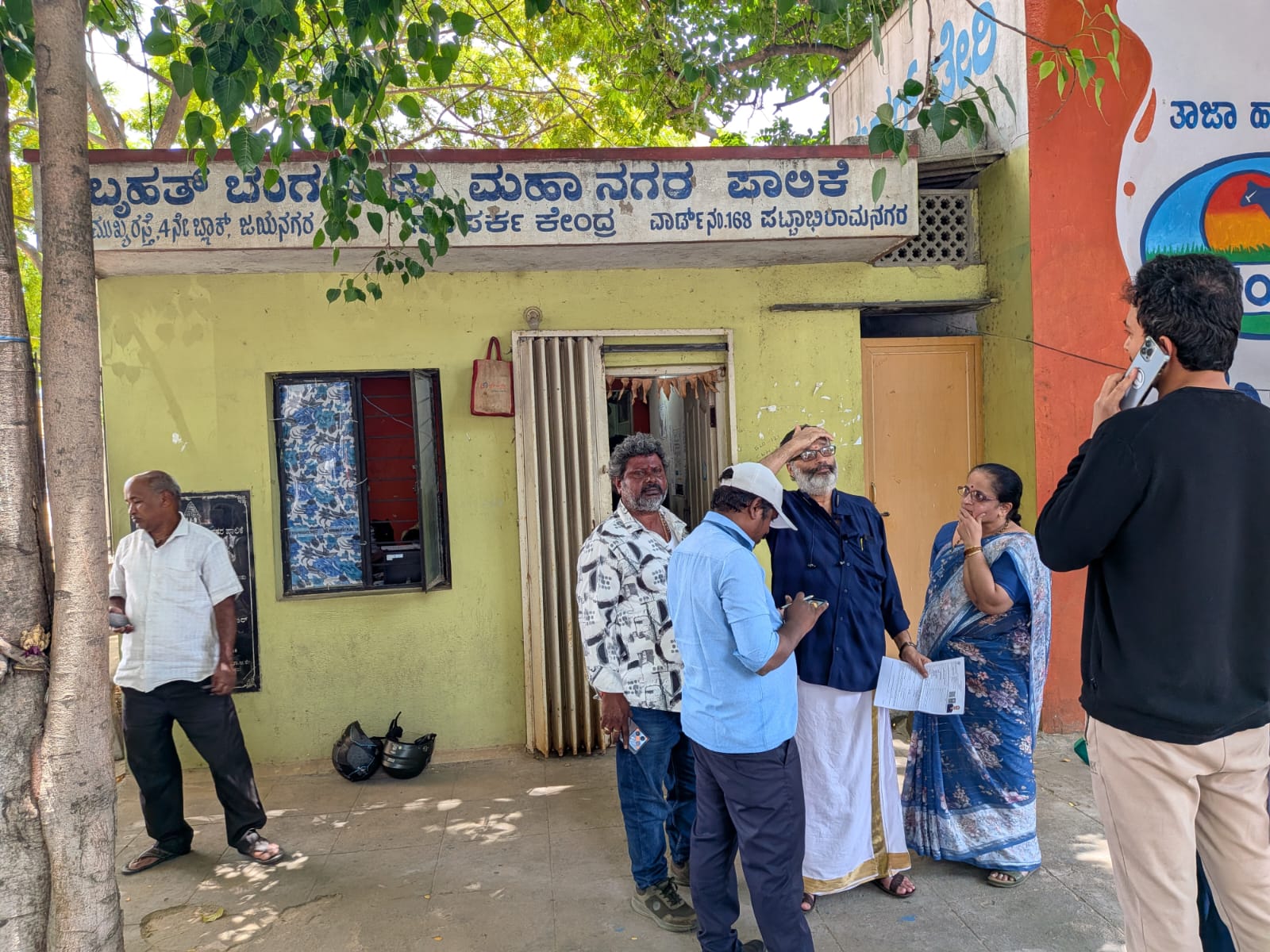
Voters at a facilitation centre in Bengaluru's Jayanagar.

Synopsis: Eighty-five per cent of the 1.08 crore electors marked for deletion during the Special Intensive Revision (SIR) of electoral rolls in Karnataka were classified under reasons other than death, with permanent shifting accounting for the largest share, an analysis of the list of absent, shifted, dead and duplicate (ASDD) electors published by the ECI has found. Non-death deletions exceeded the winning margin in 145 of the State’s 224 Assembly constituencies in the 2023 election, while Bengaluru Urban accounted for 44 percent of all deletions.
The Special Intensive Revision (SIR) of electoral rolls in Karnataka has marked 1,08,24,651 names for deletion, accounting for 20.4 percent of the 5.31 crore electors on the 2023 electoral roll.
Of those marked for deletion, 91,85,436 (85 percent) were classified under reasons other than death. These included permanent shifting, being untraceable or absent, already being enrolled elsewhere and refusing to submit the enumeration form, an analysis of the Election Commission of India’s (ECI) published list of absent, shifted, dead and duplicate (ASDD) electors by the Sabar Institute has found.
Assembly constituency-wise data show that Bengaluru Urban district recorded the highest number of deletions, while young women and third-gender electors were disproportionately affected. The number of deletions exceeded the winning margin in 145 of Karnataka’s 224 Assembly constituencies in the 2023 election.
The analysis examined the deletion data against the results of the 2023 and 2018 Assembly elections, Census 2011 data and official district income figures. It covered all 224 constituencies across 31 districts.
Non-death deletions exceeded the winning margin in 145 constituencies. The combined number of electors classified as untraceable or absent and those who refused to submit enumeration forms alone exceeded the winning margin in 40 constituencies.
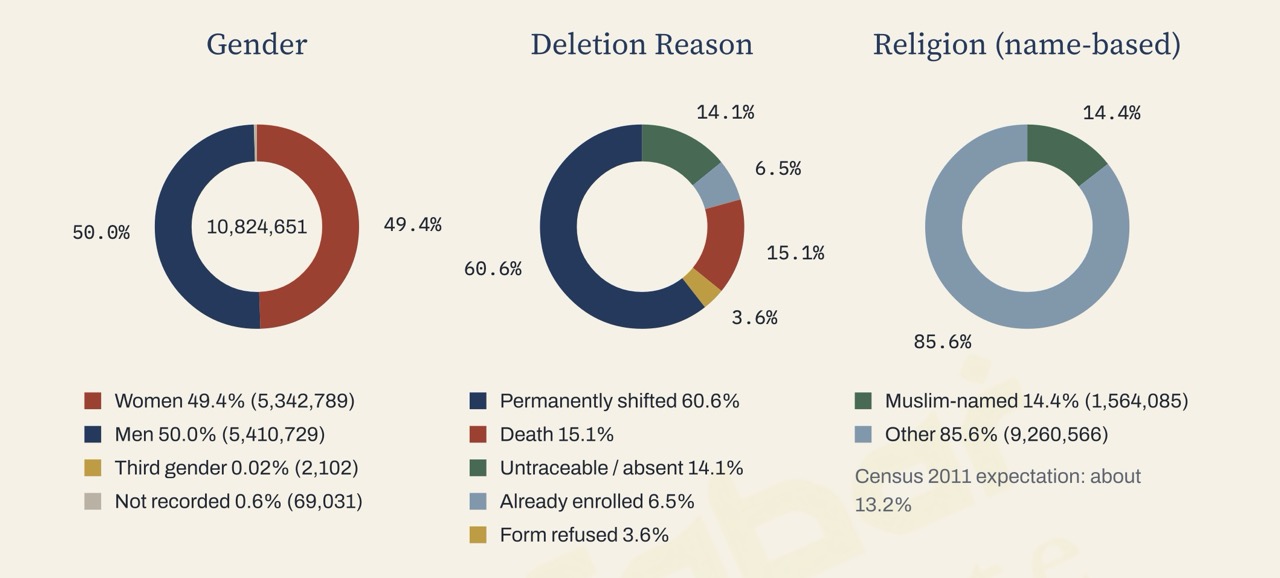
Deaths accounted for just 15.1 percent of the names marked for deletion. Permanent shifting was the largest category, accounting for 60.6 percent, followed by electors classified as untraceable or absent (14.1 percent), those already enrolled elsewhere (6.5 percent) and those who refused to submit the enumeration form (3.6 percent).
The age distribution also shows that 58 percent of those marked for deletion were below 45 years. The median age was 42.
Also Read: Karnataka’s voter roll needed cleaning, but it shouldn’t have lost 37 lakh real voters
Bengaluru Urban accounted for 47,14,339 of the 1.08 crore names marked for deletion, or 44 percent of the State’s total, despite having only 18 percent of its electors. The district’s 28 Assembly constituencies had 97,15,190 electors on the 2023 roll.
Of the 47,14,339 deletions in Bengaluru Urban, 43,95,484 were for reasons other than death.
In five Assembly constituencies, the number of names marked for deletion exceeded the number of votes cast in the 2023 election. The ratio was highest in Bommanahalli, at 1.24 times the votes polled. In C.V. Raman Nagar, Dasarahalli and B.T.M. Layout, it was 1.08 times, while in Vijay Nagar it was 1.03 times. Every Assembly constituency in Bengaluru Urban recorded deletions amounting to at least 36 percent of its 2023 electorate.
Outside Bengaluru Urban, Kalaburagi recorded the highest non-death deletion rate, at 20.3 percent, followed by Yadgir (16 percent), Raichur (15.9 percent), Ballari (15.8 percent) and Bidar (15.2 percent). All five districts are in the Kalyana Karnataka region, which has substantial seasonal migration.
The coastal districts recorded the lowest non-death deletion rates: Udupi (4 percent), Uttara Kannada (5.3 percent) and Dakshina Kannada (6.3 percent). The State-wide rate was 17.3 percent of the 2023 electorate.
The district-wise figures show the disparity in the number of deletions. After Bengaluru Urban, Mysuru recorded the highest number, at 5,57,254, followed by Kalaburagi (5,21,957) and Belagavi (5,13,373). Kodagu recorded the fewest, at 62,854.
The overall deletion rate was also highest in Bengaluru Urban, at 48.5 percent, followed by Kalaburagi (23.5 percent) and Mysuru (21 percent). Udupi recorded the lowest rate, at 6.1 percent.
Also Read: Behind Bengaluru’s 24 lakh SIR notices: Old rolls, shifting homes and a scramble for documents
A comparison of non-death deletions by the party that won each constituency in the 2023 Assembly election shows a higher rate in BJP-won seats across Karnataka, particularly in Bengaluru urban.
Across all 224 constituencies, non-death deletions accounted for 23.7 percent of the 2023 electorate in the 66 BJP-won seats, compared with 15 percent in the 135 Congress-won seats. The rate in the 19 JD(S)-won seats was 9.8 percent.
The BJP won 16 of Bengaluru Urban’s 28 constituencies. Outside the district, however, the rates were almost identical in BJP- and Congress-won seats: 11.4 percent in the 50 BJP constituencies and 11.2 percent in the 123 Congress constituencies. JD(S)-won constituencies recorded a rate of 9.8 percent.
After accounting for region, reservation status, urbanisation and electorate size, the difference between Congress- and BJP-won constituencies was 0.86 percentage points.
Young women were hit hardest.
Among living voters
aged 18 to 29, three women were deleted for every
two men; outside Bengaluru, nearly two for one.
The analysis found that turnout in the 2023 Assembly election was the strongest predictor of non-death deletions. It found a strong negative correlation between voter turnout and the deletion rate: each percentage-point decline in turnout corresponded to a 0.70 percentage-point increase in non-death deletions.
Constituencies in the lowest turnout fifth, where turnout ranged from 47.5 percent to 65.9 percent, recorded non-death deletions amounting to 38.6 percent of their 2023 electorate.
The rates were much lower in the higher-turnout groups. They stood at 14.2 percent in the second fifth, 9.6 percent in the middle fifth, 7.1 percent in the fourth and 7 percent in the highest turnout fifth, where turnout ranged from 84.2 percent to 91.9 percent.
Also Read: Is democracy banned in universities? How Jamia became ‘a police camp’ before sanity prevailed
Among electors aged 18 to 29 whose names were deleted for reasons other than death, 8,11,108 were women and 5,28,187 were men — a ratio of about three women for every two men.
The disparity was greater outside Bengaluru Urban, where 5,85,231 women and 3,11,592 men in this age group were marked for deletion. Women thus outnumbered men by nearly two to one.
The overall deletion rates were identical for women and men: 20.2 percent of each group’s electorate on the 2023 roll. But the gender composition of deletions differed sharply when deaths were excluded. Women accounted for 41.9 percent of electors deleted under the death category, but 51.1 percent of non-death deletions. Outside Bengaluru Urban, women made up 56 percent of non-death deletions, compared with 46 percent in Bengaluru Urban.
The disparity was particularly pronounced among younger electors classified as permanently shifted. In the 18-29 age group, 1.8 women were marked for deletion for every man.
The Sabar Institute says this pattern is consistent with women moving to their husbands’ homes after marriage and having to enrol at their new addresses, while their names are deleted from the electoral rolls at their parents’ addresses.
The age-wise breakdown of non-death deletions shows that women outnumbered men in the 18-29 and 30-39 age groups. Among electors aged 18 to 29, 8.1 lakh women and 5.3 lakh men were marked for deletion, a ratio of 1.54 women for every man. In the 30-39 age group, the figures were 14 lakh women and 11.5 lakh men, a ratio of 1.22.
The pattern was reversed among older electors, with men outnumbering women in every age group from 40 to 79. Among those aged 40 to 49, 11.8 lakh women and 13.2 lakh men were marked for deletion. In the 50-59 age group, the figures were 6.2 lakh women and 7.6 lakh men; in the 60-69 group, 3.5 lakh women and 4 lakh men; and in the 70-79 group, 2 lakh women and 2.2 lakh men. Among electors aged 80 and above, approximately one lakh women and one lakh men were deleted.
Also Read: Jayanagar: Legacy voter records a headache for some despite smooth SIR process
The Sabar Institute found that 2,102 of the 4,926 third-gender electors on the 2023 electoral roll were placed on the deletion list. Their deletion rate of 42.7 percent was more than twice the State-wide rate of 20.4 percent. By comparison, 20.2 percent of women and 20.2 percent of men on the 2023 roll were marked for deletion.
The deletion list included third-gender electors from 178 of the State’s 224 Assembly constituencies. Their median age was 36, compared with 44 for all electors marked for deletion. Nearly 63 percent were below 40 years of age.
Bengaluru Urban accounted for more than half of the deletions in this category, with 1,145 third-gender electors marked for removal.
The reasons recorded for deletion also differed from those for women and men. Permanent shifting accounted for 64.9 percent of third-gender deletions, compared with 60.6 percent among women and men. Another 18.6 percent were classified as absent, against 14.1 percent among women and men. Refusal to submit the enumeration form accounted for 5.8 percent, compared with 3.6 percent.
Only 5.4 percent of third-gender deletions were attributed to death, against 15.2 percent among women and men. The proportion classified as already enrolled elsewhere was 5.3 percent, compared with 6.6 percent.
The categories of absence and refusal rely substantially on the judgement of booth-level officers. Together, they accounted for 24 percent of third-gender deletions, compared with 18 percent among women and men.
Vijay Nagar in Bengaluru Urban recorded the highest number of third-gender deletions, at 151, or 7.2 percent of the State total. Krishnarajapuram followed with 127, Mahadevapura with 77, Byatarayanapura with 76 and C.V. Raman Nagar with 70.
The other constituencies among the 10 with the highest numbers were Bangalore South (63), Rajarajeshwarinagar (55), Nelamangala (55), Gulbarga Uttar (52) and Bommanahalli (49).
Also Read: Interview | ECI’s SIR ‘whodunnit’: Anjali Bhardwaj on collapse of accountability under BJP
Muslim-named electors accounted for 15,64,085, or 14.4 percent, of the 1,08,24,651 names on the deletion list. This was close to the 13.2 percent share that would be expected from their share of Karnataka’s population in the 2011 Census, assuming deletions were distributed evenly across religious communities.
The share of Muslim-named electors among those deleted was highest in Bidar, at 26 percent, followed by Kalaburagi (23.7 percent), Dakshina Kannada (22.2 percent), Davanagere (21.1 percent), Kolar and Dharwad (20.6 percent each), and Vijayapura (19.8 percent).
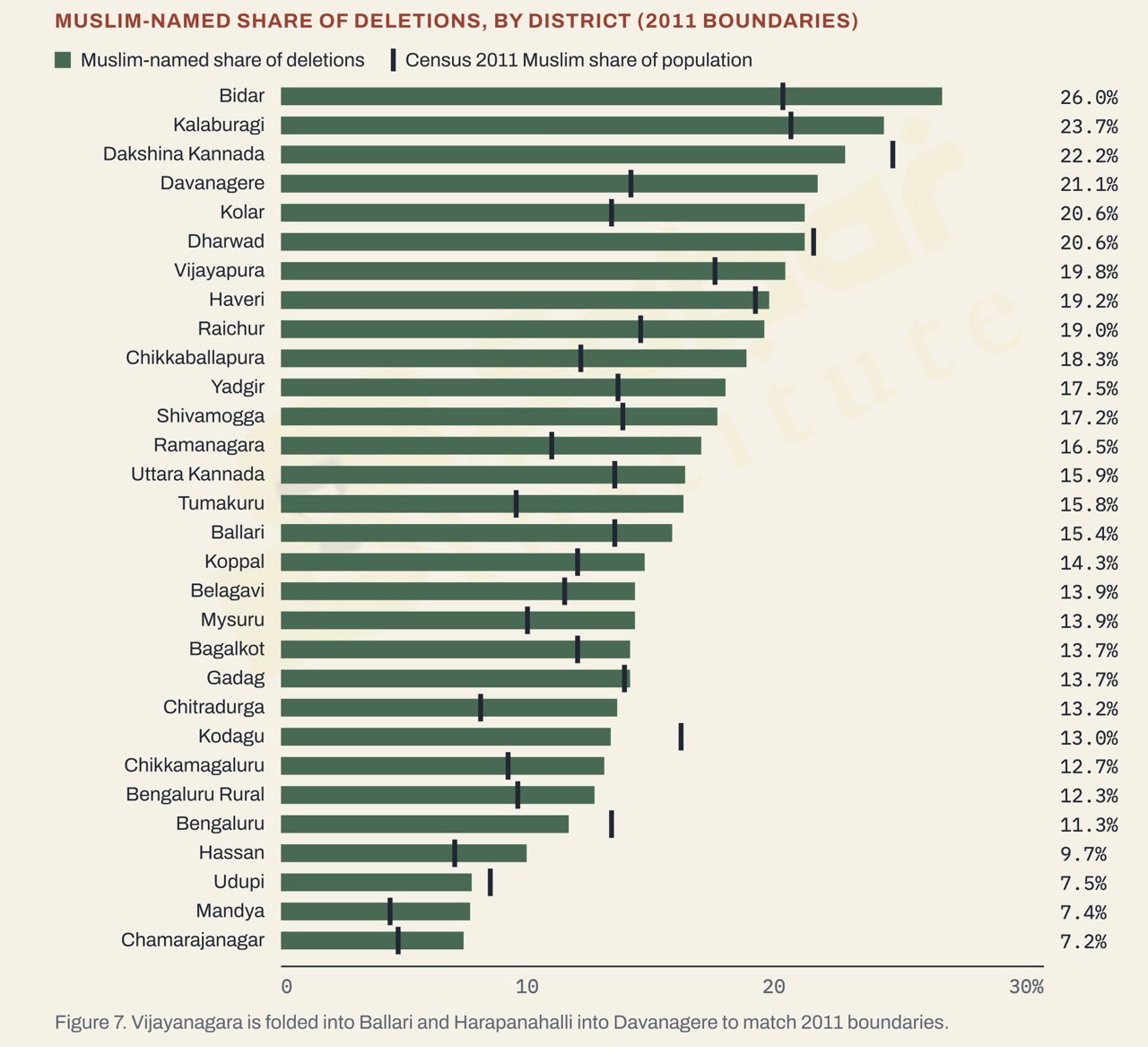
Muslim-named electors account for 14.4 per cent of the 10,824,651 deletions in Karnataka.
In southern Karnataka, the corresponding shares were lower: 7.2 percent in Chamarajanagar, 7.4 percent in Mandya, 7.5 percent in Udupi and 9.7 percent in Hassan.
The district-wise figures show that the share of Muslim-named electors among those deleted broadly tracked their share of the population in each district. In most districts, however, their share of deletions was a few percentage points higher than their share of the population in the 2011 Census. Bengaluru was an exception, with Muslim-named electors accounting for 11.3 percent of deletions.
The reasons recorded for deletion also differed between Muslim-named electors and others. Permanent shifting accounted for 56.9 percent of deletions among Muslim-named electors, compared with 61.2 percent among others.
The proportion classified as already enrolled elsewhere was higher among Muslim-named electors, at 9.2 percent, against 6.1 percent among others. Those classified as untraceable or absent accounted for 16.8 percent, compared with 13.6 percent. Refusal to submit the enumeration form accounted for 4.5 percent of deletions among Muslim-named electors and 3.4 percent among others.
Also Read: ECI extends SIR timeline in Telangana; final electoral rolls to be published on 30 November
The analysis found that non-death deletions were higher in districts with larger Scheduled Caste populations and lower per capita incomes.
The correlation between a district’s Scheduled Caste population share and its deletion rate was 0.41. The correlation between per capita income and the deletion rate was negative, at −0.56, indicating higher deletion rates in poorer districts.
Kalaburagi, the poorest district in the comparison, recorded non-death deletions amounting to 20 percent of its 2023 electorate. In Udupi, the corresponding figure was 4 percent.
(Edited by Dese Gowda)



