
Published Oct 28, 2026 | 5:24 PM ⚊ Updated Oct 28, 2026 | 5:24 PM

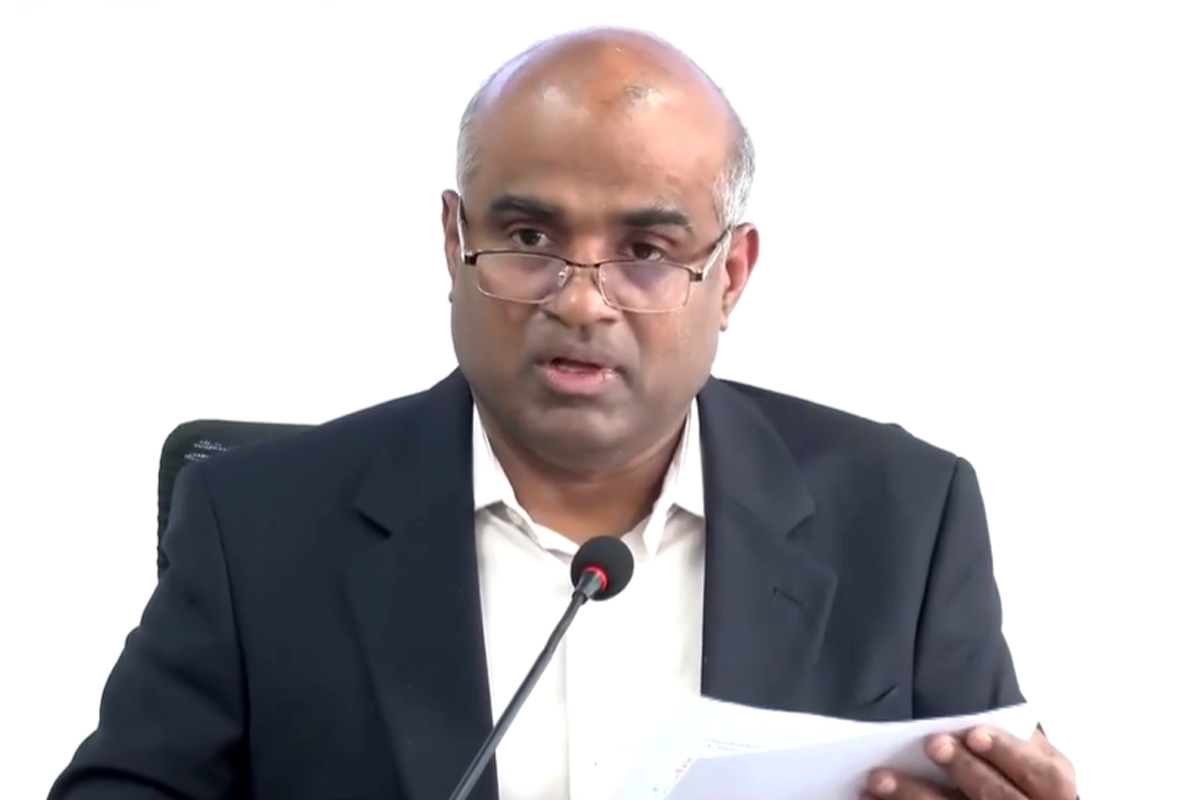
Karnataka Chief Electoral Officer V Anbukumar.

Synopsis: The Special Intensive Revision in Karnataka has removed one in five names from the electoral roll. Population data suggests that about only 62 lakh people should have been removed, instead of the nearly one crore who were. Here is a possible way to address the shortfall before the next election.
Karnataka’s Chief Electoral Officer published the final voter list on October 27, 2026, after the Special Intensive Revision (SIR). It contains 4.55 crore electors. On June 16, when the exercise began, there were 5.54 crore. In four months, the state’s electorate has shrunk by 99.32 lakh, nearly 18%. Deccan Herald reports that this is the highest percentage purge of any state so far.
How fair was it? Did Karnataka really have one crore ghost voters, or have lakhs of real citizens been quietly struck off?
The answer, when the numbers are laid against the State’s own population figures, is uncomfortable for both sides of the debate: can both sides be true? That is what this article examines with data and analysis.
The SIR is the Election Commission’s first nationwide, door-to-door re-verification of the electoral roll in more than two decades. It began in Bihar in June 2025, moved to 12 states and Union Territories in late 2025, where about 6.5 crore names were left off the draft rolls, and to 19 more states and UTs from May 2026. On 27 May 2026, the Supreme Court upheld the exercise as within the Commission’s mandate. For Karnataka, it was the first intensive revision since 2002.
Karnataka followed the SIR method used in states before it. A Booth Level Officer brings an enumeration form to every elector on the roll. The elector signs it and links himself or herself, or a parent, to the 2002 roll. If the form does not come back, the name does not go into the draft roll. People left out may later apply as new voters. On paper, almost everything looks simple and rational, but if the street protests and the debate in the media are any indication, it appears SIR has touched the very nerve centre of Indian Democracy. When confidence in a process is riddled with so much controversy, almost every outcome of that will look suspicious. But an independent examination of the facts is essential. That is what is being attempted here.
Of the 5.54 crore names in Karnataka, 1.08 crore did not make it into the draft roll published on August 24.
The officers recorded 65.5 lakh of them as “permanently shifted”, 19 lakh as “absent”, 16.4 lakh as dead and 7.1 lakh as duplicates. During the claims period, 10 lakh names were added back and 1.9 lakh more were removed. Of the 43.8 lakh electors who returned a form but were served a notice, only 61,960 were finally found ineligible.
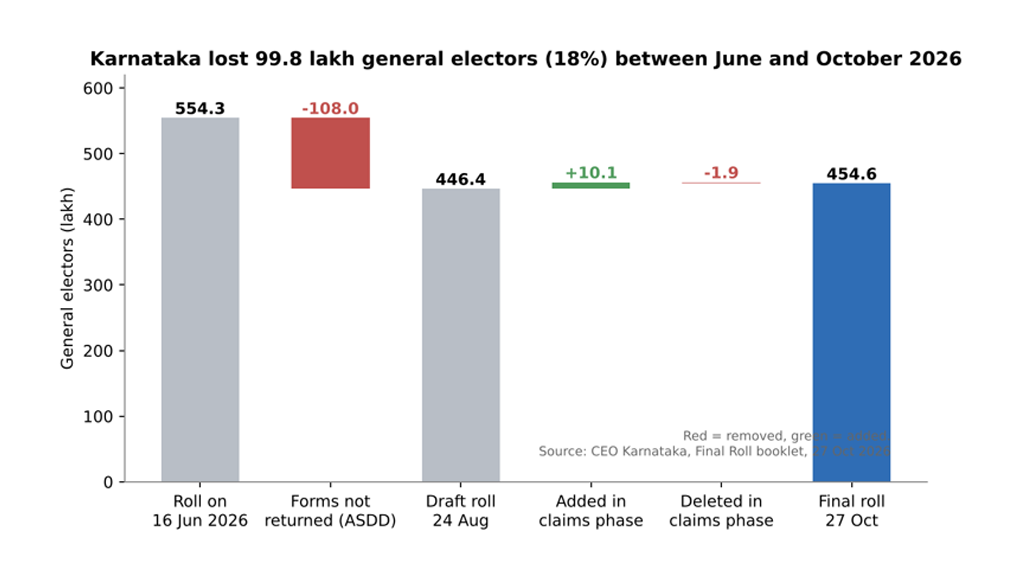
From 554 lakh to 455 lakh general electors. Source: CEO Karnataka.
What the chart says: almost the whole fall came in one step, when 108 lakh people whose forms did not come back were dropped. Three in four of them were not proven dead or ineligible; the officer simply did not find them at home. Only a tenth of that number returned in the claims period.
Population changes slowly, which makes it the best test of a voter list.
The Union government’s own projections put Karnataka’s population in 2026 at about 6.9 crore, of whom 75% are adults. The CEO’s booklet uses almost the same figure, 6.88 crore. That means about 5.17 crore adults. This is the fact; then the number of voters should match this fact.
Before the SIR, the roll had 5.54 crore names, about 107% of all adults. In the 2024 Lok Sabha election, it was 108%, the highest among India’s ten largest states.
A roll cannot list more voters than there are adults. Either the population figure is not correct, or the voter list is not. One has to be corrected; in this case, the voter list. At least 37 lakh names, and realistically closer to 62 lakh, belonged to people who had died, moved away for good, or were counted twice. Removing them is not controversial. It is overdue.
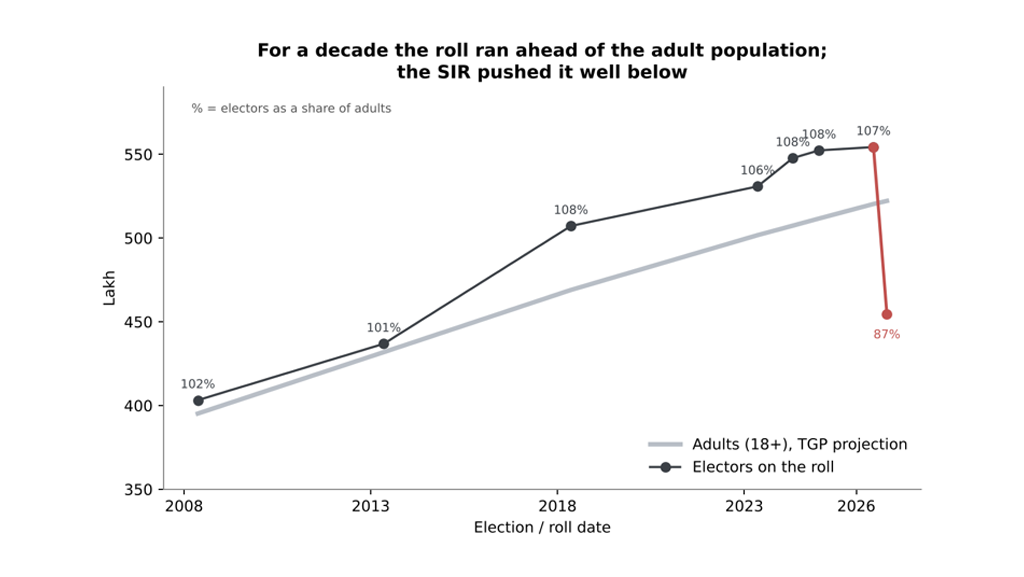
Electors on the roll against adults in Karnataka, 2008–2026. Sources: ECI; CEO Karnataka; MoHFW projections.
What the chart says: for a decade, the roll (dark line) ran ahead of the number of adults (grey line), an impossible position for a clean list. The SIR (red) did not bring the roll back to the adult line. It drove it far below, to 87% of adults, the lowest in the whole series.
It is highly unlikely that every adult living will enrol as a voter. Some never register, some are abroad, some have moved to other places, etc. So, the adult population figure should ideally be more than the voter list. So a well-kept roll should cover about 95% of adults. For Karnataka, that is about 4.91 crore electors. The final roll has 4.55 crore, a shortfall of 36 lakh.
Three facts make the shortfall hard to explain away.
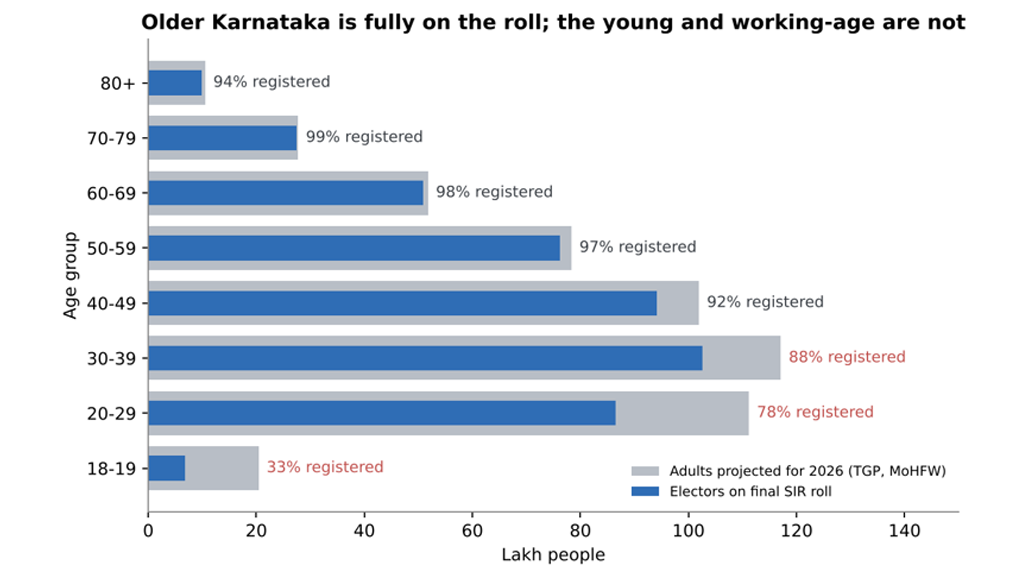
Electors on the final roll compared with adults of the same age. Sources: CEO Karnataka; MoHFW projections.
What the chart says: Where people are settled, older and at home, the roll and the population match almost exactly. The gap opens among people of working age, the very people most likely to move for jobs, rent their homes and be out when an officer knocks.
Bengaluru’s 28 constituencies lost 39% of their 2023 electorate. Other city seats such as those in Mysuru, Hubballi-Dharwad and Mangaluru lost 19%. Rural and small-town seats lost 7%. In Bengaluru alone, 24 lakh people, 42% of the draft roll, were served notices.
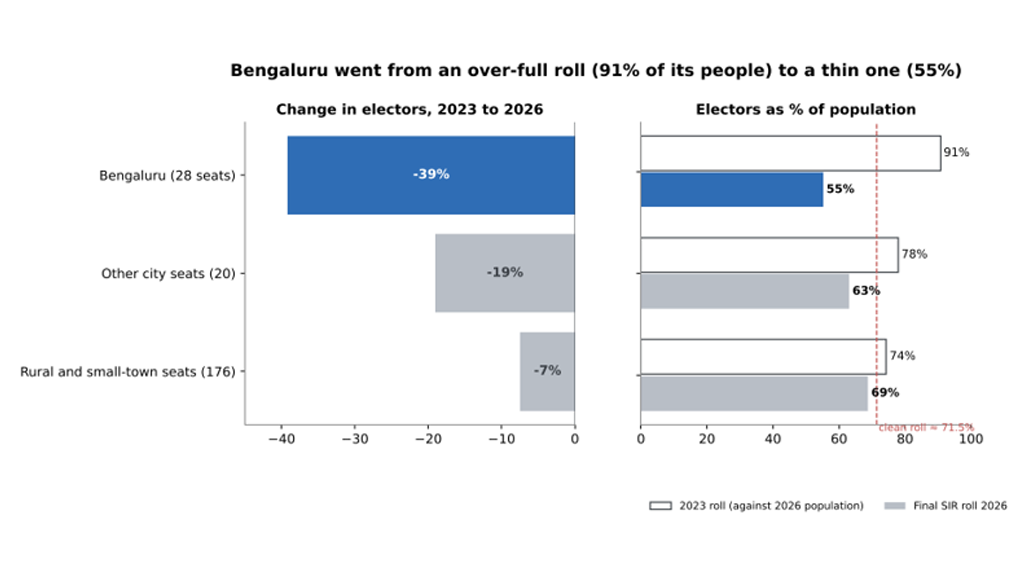
What the chart says: Bengaluru started with the worst roll. In 2023, its electors equalled 91% of its entire population, children included. It needed the deepest clean-up. But it now stands at 55%, far below the roughly 71.5% a clean roll implies, while rural Karnataka, at 69%, is close to it.
The reasons are not mysterious. A rule that removes anyone whose form does not come back falls hardest on city life:
| The bottom line
4.91 crore: the number of electors Karnataka should have, based on its official population of 6.88 crore, an adult share of 75%, and 95% registration. About 37 lakh: the number of genuine voters who are likely missing from the final roll (4.91 crore minus 4.55 crore). Even on the most cautious assumption, 90% registration, 11 lakh are missing. About half of the gap is in Bengaluru. |
Put plainly: of the 99 lakh names removed, about 62 lakh were surplus and needed to go. About 37 lakh were eligible citizens who should still be on the list.
The Chief Electoral Officer has urged voters to check their names and apply with Form 6 if they are missing. That alone will not close a 37-lakh gap; it leaves the burden on the very people the process missed.
Earlier, Chief Minister DK Shivakumar had demanded a fresh SIR. A full redo is not necessary. A targeted correction is.
Done well, this would restore most of the 37 lakh and bring the roll to about 4.9 crore: below the bloated 5.54 crore of June, but a true reflection of Karnataka’s adults.
No one should defend a roll with dead people, duplicates and voters who left years ago.
The SIR is necessary, but SIR should not be used as a tool to remove the legitimate voters from the list. That seems to be the issue, real or not, causing all this mistrust. ECI’s main job is to create and nurture the people’s trust in the electoral system. That is the reason it is independent of the government.
The SIR seem to have dented that trust, and the ECI should do everything it can, even if it means going the extra mile to reach out to voters. Except that it doesn’t appear to be doing so and instead is doing everything it can to erode the trust. That is not good for Indian democracy and for the ECI itself. Removing the dead and the ineligible is not in dispute. Removing eligible citizens is. It seems to be the core issue here in the SIR process.
If the roll is left as it is, the next elections in Karnataka will be fought on a list that leaves out about one in every fourteen eligible adults, and far more than that among the young and in Bengaluru.
An election held on such a roll may be legally valid. But it will not reflect the spirit of a democracy that promises every adult citizen a vote. The data to fix it exists. What is needed now is the will to use it.
Also Read:
Behind Bengaluru’s 24 lakh SIR notices: Old rolls, shifting homes and a scramble for documents
Karnataka SIR: Voters still at home despite Form 7 claims they had ‘permanently shifted’
(The author is a scientist and policy analyst. The figures in this article are from an independent analysis of the Chief Electoral Officer’s final-roll data, the 2023 Assembly election data and the Union government’s population projections. The author can be reached at gujjab2@gmail.com.)
(Edited by R Rajesh Kumar.)



