

Published Sep 11, 2026 | 9:00 AM ⚊ Updated Sep 15, 2026 | 11:47 AM

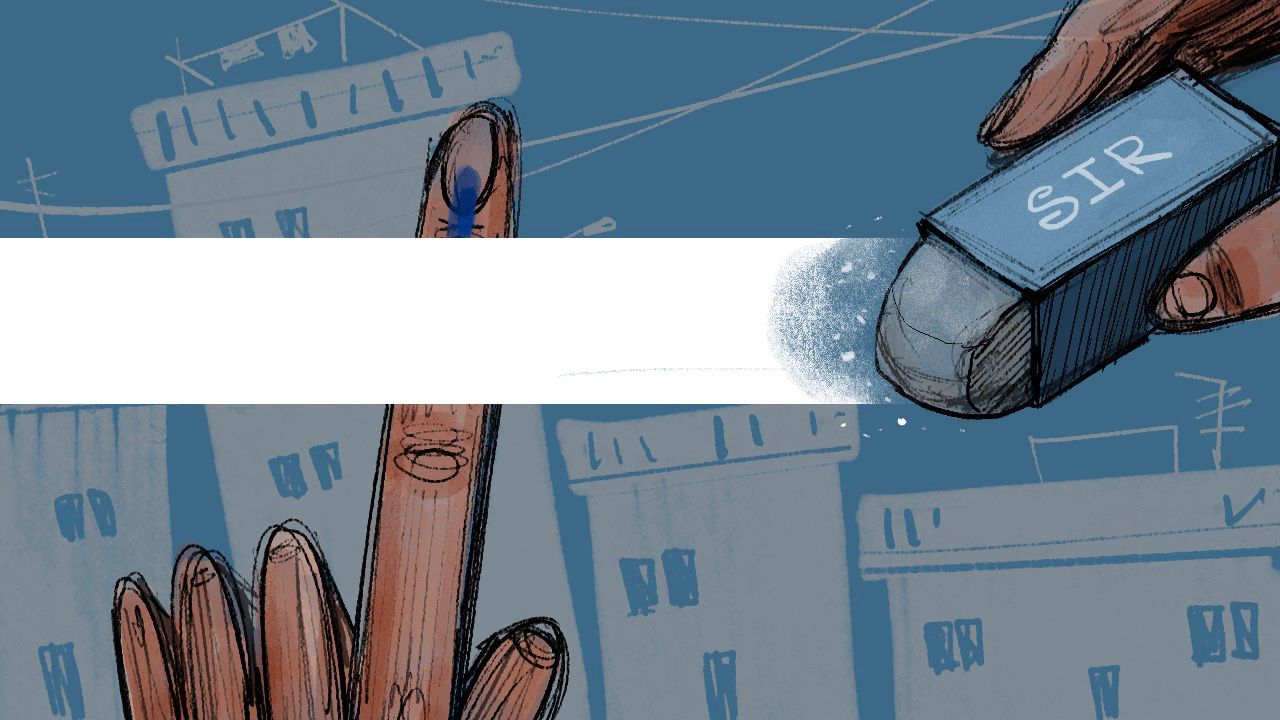
According to data from the Bengaluru District Election Office, more than 24 lakh notices have been issued so far.

Synopsis: As Bengaluru’s Special Intensive Revision pushes lakhs of voters into the notice and hearing process, ground reporting from Ejipura and Basavanagudi shows how old electoral records, changed addresses, name mismatches and missing family documents are making verification difficult — particularly for elderly voters and those without decades-old records.
Mary, a domestic worker from Bengaluru, reached the Special Intensive Revision (SIR) hearing centre in Ejipura on Thursday, September 10, with the documents she thought would be enough to register her as a voter: her ration card, Aadhaar card, voter ID and several photocopies.
But officials wanted older records, including documents linked to her parents who died several years ago.
Mary has little formal education and therefore does not have Class 10 certificates. Her parents died when she was young, leaving her without older family documents, while her voter ID was issued only around 2006.
“We are not educated. We only have a ration card, Aadhaar card and voter ID. They are asking for my mother’s or father’s documents… they died when we were young,” Mary said.
She waited at the centre from 8 am, missing a day of work, while her son skipped classes to accompany her. Mary also spent around Rs 300 from her hard-earned money on photocopies, only for officials to deem them unnecessary.
Mary’s experience illustrates one of the central challenges emerging from the Election Commission of India (ECI)’s controversial SIR exercise in Bengaluru: the difficulty of linking present-day voters to electoral records from more than two decades ago.
According to data from the Bengaluru District Election Office, more than 24 lakh notices have been issued so far during the SIR process. Of these, 17.81 lakh relate to voters who could not be mapped to earlier electoral rolls, while another 6.24 lakh entries were flagged for discrepancies involving details such as names, ages and family information.
The claims-and-objections process is scheduled to continue until October 22, before publication of the final electoral roll. Notices will be distributed to voters whose names did not appear on the draft electoral roll.
Around 2.68 lakh hearings had been completed as of September 9.
Also Read: ‘The police kept saying I was Bangladeshi’: Inside Bengaluru’s migrant verification drive
Sharadha, a BLO from Shakambari Nagar ward, said officials were trained to compare electors with the 2002 electoral roll after enumeration forms were submitted.
Where a link could not be established, voters could be categorised as having “no linkage” or “no mapping”.
She said BLOs sometimes spent one-and-a-half to two hours at a single household searching for old electoral details such as part numbers, serial numbers and polling-booth information in an attempt to establish the linkage before issuing a notice.
Shifting residence is one of the recurring difficulties, she said.
A voter who lived in one constituency in 2002 but has since shifted elsewhere may be harder to trace in the older electoral records. Missing parental information can create another problem. If the older record of the head of a family cannot be traced, establishing the linkage of children or grandchildren can also become difficult. This is known as “no-mapping”
Jyothi R another BLO from Basavanagudi described how relatively small differences between old and present records could result in logical discrepancies.
She cited examples such as “PG Ranga Rao” appearing differently between English and Kannada records. Where it is spelled P “J” in Kannada and P “G” in English. She also cited an example where “Venkateshamurthy” was recorded as “Venkatesha” in the 2002 roll.
For such cases, she said voters may be asked to produce older supporting records such as SSLC certificates and transfer certificates.
She said Aadhaar and PAN are generally not relied upon for establishing an old electoral linkage because they are more recent documents.
Even elderly voters are not necessarily exempt from the problem. According to the BLO, voters aged 55, 60 and even 70 had fallen into the “No Linkage” category when their details could not be traced in the 2002 roll.
For elderly voters who had not attended school and therefore did not possess educational certificates, she said government pension sanction or order copies could be used as supporting documents.
Also Read: SIR of electoral rolls: Here’s how you can join voter list update
Residents of Basavanagudi have also experienced trouble with the SIR process due to the mapping difficulties.
Guruprasad N, a resident of Padmanabhanagar said his 80-year-old mother was served a notice to appear for hearing at the SIR centre. He said applications for himself, his wife and his mother had been submitted together. He and his wife did not receive notices, but his mother did.
The family had earlier lived in Hanumanthnagar before shifting to Padmanabhanagar.
He believed that the change of residence was behind the need for additional verification. At the hearing, the family was asked to resubmit documents, including Aadhaar and bank or other government-issued proof. They were told that the verification process could not be completed from home because they had shifted residence.
For another resident, Prasanna Kumar, the issue was particularly difficult because his daughter, who works as a doctor in Tumakuru, could not attend the hearing as she was unable to get leave. She was nevertheless asked to appear in person for the hearing.
An AERO working in Basavanagudi pointed to another reason why a current voter may not map neatly onto the old electoral roll.
She said some voters now living around Bank Colony had been enrolled under the erstwhile Uttarahalli Assembly constituency in the 2002 electoral roll. Uttarahalli was abolished and its boundaries reorganised during the 2008 delimitation exercise. According to the AERO, officials were unable to map some of these voters because the relevant older electoral roll was not readily available for matching, even though several had voter IDs and had voted earlier.
“I come from Srinivasanagar, and three out of five members of my family have faced this issue because their details could not be mapped to the 2002 electoral roll,” she said.
At the Ejipura centre, an elderly woman, Rajalakshmi Narayanan described a different difficulty: repeated visits and uncertainty over whom to approach.
She had been standing in a long queue from the morning before being directed to another room. There, she learnt that the official handling her case was on leave.
“My BLO herself had called me and told me to come today and she is not present today,” she said.
She had brought documents including her passport and Aadhaar card, but said she was later asked to get a bank document stamped and return again the following day.
“Going and coming back tomorrow is so difficult,” she said, adding that officials had advised her to return around noon when the crowd would be less.
BLOs said that once a voter remains unmapped or a discrepancy requires further verification, notices are delivered to the voter’s residence and the delivery is then recorded on the BLO application. The notice contains information about the venue,date and the expected documents. There is a 7-day gap between the notice and hearing. If the person is unable to attend, the date is shifted.
The documents required depend on the voter’s date of birth.
According to the SIR guidelines, those born in India before July 1, 1987, must submit a document establishing their own date and/or place of birth.
Those born between July 1, 1987 and December 2, 2004, must submit such a document for themselves as well as for either their father or mother.
Those born after December 2, 2004, must submit documents establishing the date and/or place of birth of themselves and both parents.
Sharadha said around 200 notices had been issued in her part of Shakambari Nagar ward, with roughly 15 hearings scheduled each day. She estimated that a hearing centre could handle around 80 to 150 cases a day, depending on the number of BLOs and cases assigned.
An individual hearing, she said, could take around half an hour, as officials must verify documents, obtain signatures, record attendance, and upload information to the application.
At the hearing, documents are checked and a proforma order form is filled before the case is processed by the AERO.
Also Read: 100 days of Shivakumar rule: Siddaramaiah invited to inaugurate event as BJP prepares ‘chargesheet’
At the Ejipura centre, Mary eventually received help and expected her case to be resolved that day.
But proving her identity meant gathering her documents and spending hours at the hearing centre — getting caught in government machinery and losing a day’s work which she could ill afford.
Her difficulty was not that she lacked identification. It was that the documents she possessed did not necessarily establish what the SIR process was seeking: a link between her present enrollment and an older electoral record.
Across Bengaluru, 17.81 lakh voters categorised as ‘unmapped’ are facing the challenge of proving their voter identity by linking their current records to a document from two decades ago.
(Edited by Fayisa CA)



