
Published Oct 23, 2026 | 5:00 PM ⚊ Updated Oct 23, 2026 | 5:00 PM

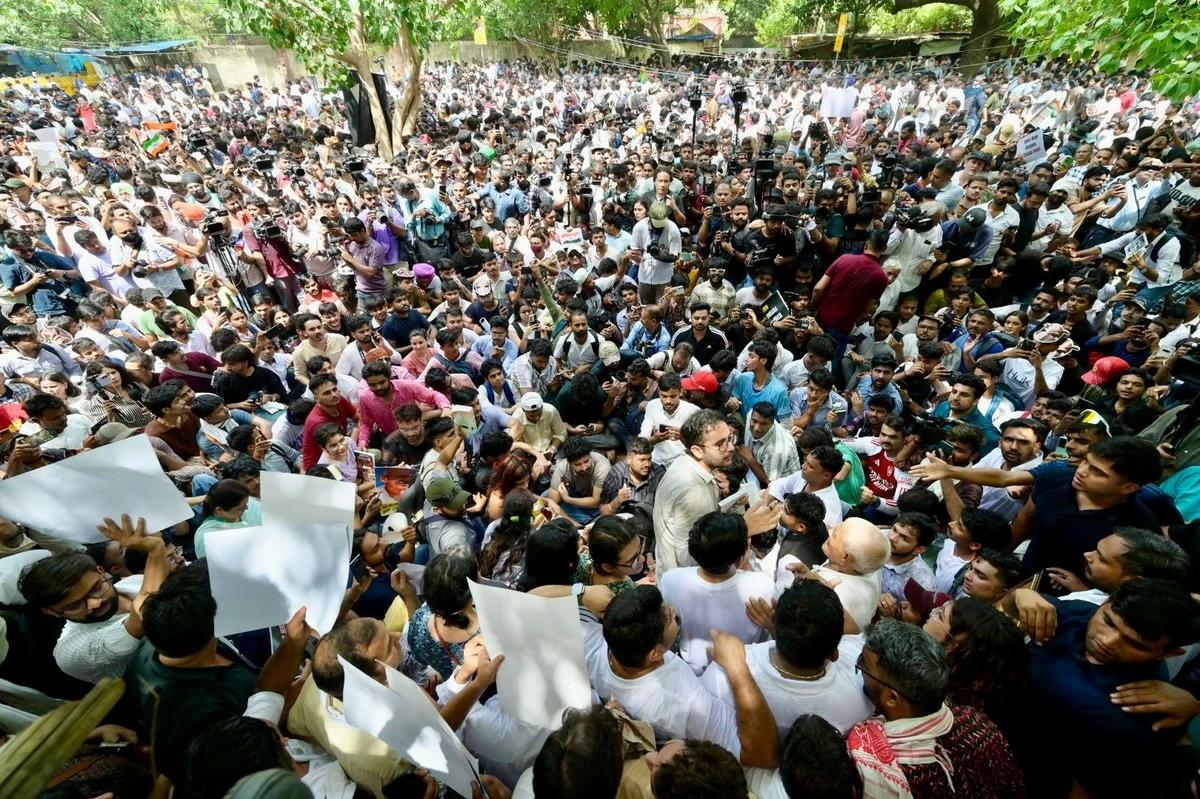
Ashutosh Ranka at the centre, surrounded by hundreds of youngsters during Jantar Mantar 1.0.

There was a time when a young Indian heading to a protest carried a placard, a bottle of water, perhaps a revolutionary poem tucked into a backpack, and enough courage to challenge the establishment.
Today, the sensible Gen Z protester might need a slightly different survival kit: a birth certificate, proof of citizenship, university records, and, if possible, a government officer willing to certify that the documents are genuine.
Welcome to the age when the right to raise a question may come with a preliminary examination of the questioner’s credentials.
Imagine a group of university students marching towards Jantar Mantar in Delhi, demanding accountability, justice and the resignation of a powerful public official. Their slogans are loud, their arguments sharp, and their placards beautifully designed. Suddenly, a helpful official interrupts the revolution.
“Before you proceed, please establish that you were born.”
The students stare in disbelief.
“Your birth certificate, please.”
One student produces a digital copy. Another frantically searches a government portal. A third calls home, asking a bewildered parent to locate a certificate issued nearly two decades ago. The fourth, who has come prepared with a placard demanding democratic accountability, discovers that the most urgent demand of the day is for a photocopy.
The protest is temporarily suspended. Not because the government has answered the questions, but because the protesters have not answered the paperwork.
For India’s Gen Z, the future may involve an unusual division of labour. One hand will hold the Constitution; the other, a folder of documents proving that its holder is entitled to invoke it.
The irony is difficult to miss. A generation raised on digital identities, online examinations, instant payments and biometric authentication may have to become a travelling archive of its own existence. Before asking the government to account for its actions, a young citizen may be expected to account for every detail of their birth.
And what about the university degree?
Here, the satire acquires an additional degree of academic distinction. If educational credentials are to be treated as the ultimate test of credibility, should not the same standard apply to everyone, from the student at the barricade to the person occupying the highest constitutional office?
India has witnessed recurring public debate over Prime Minister Narendra Modi’s university degrees, including questions raised about their disclosure and authenticity. The political and legal controversies surrounding those records have generated their own arguments. Yet the larger question remains delightfully uncomfortable: if a young citizen’s qualifications are considered relevant to the legitimacy of a political question, why should the educational credentials of powerful political leaders be beyond equivalent public scrutiny?
Of course, a degree is not a certificate of democratic virtue, just as the absence of a degree does not disqualify anyone from public life. A university certificate cannot guarantee wisdom, honesty or administrative competence. Nor should a student’s failure to carry a birth certificate turn a peaceful protest into an examination of citizenship.
Different standards of verification cannot become instruments of selective humiliation. If documents matter, they must matter consistently. If they do not determine the legitimacy of a person’s political voice, they should not suddenly become indispensable when that voice turns critical.
Gen Z has inherited a curious national contradiction.
It is told to innovate, question convention, think independently and lead India into the future. But when it questions authority at home, it may discover that independent thinking requires prior permission from the department of documentary evidence. Its citizenship, meanwhile, must never become a start-up awaiting regulatory clearance, nor should the young have to prove their past before being heard in the present.
Perhaps the next generation of protest placards should carry a footnote: Birth certificate available on request; degree certificate available for inspection; democratic rights applicable without prior appointment.
There is, however, a serious warning beneath the humour. Democracies do not become stronger by making citizens afraid to assemble, speak or question. Peaceful protest is not a privilege granted to the academically qualified or the administratively convenient. It is an essential means through which citizens hold power accountable.
So, Gen Z, pack your water bottles, charge your phones and carry your placards. Keeping important documents accessible is sensible in a country where bureaucratic surprises are hardly rare. But never mistake the paperwork for the purpose of the protest.
Your birth certificate may establish when you entered this world. Your university certificate may establish where you studied. Neither determines whether you have the right to question the people who govern it.
And if democracy ever demands that young Indians prove their existence before exercising their rights, perhaps those in power should first produce a certificate explaining when, exactly, they acquired ownership of the republic.
Also Read:
The flag, the book and the Mahatma: The youth have already won; now Modi must choose
When elves turn into imps: Who will watch the watchdogs?
Democracy’s shame: Delhi Police’s violence reverberates across India
(This piece follows the Delhi High Court’s observations on Saurav Das’ and Ashuthosh Ranka’s ages. Edited by R Rajesh Kumar.)



