
Published Oct 21, 2026 | 9:30 AM ⚊ Updated Oct 21, 2026 | 9:30 AM

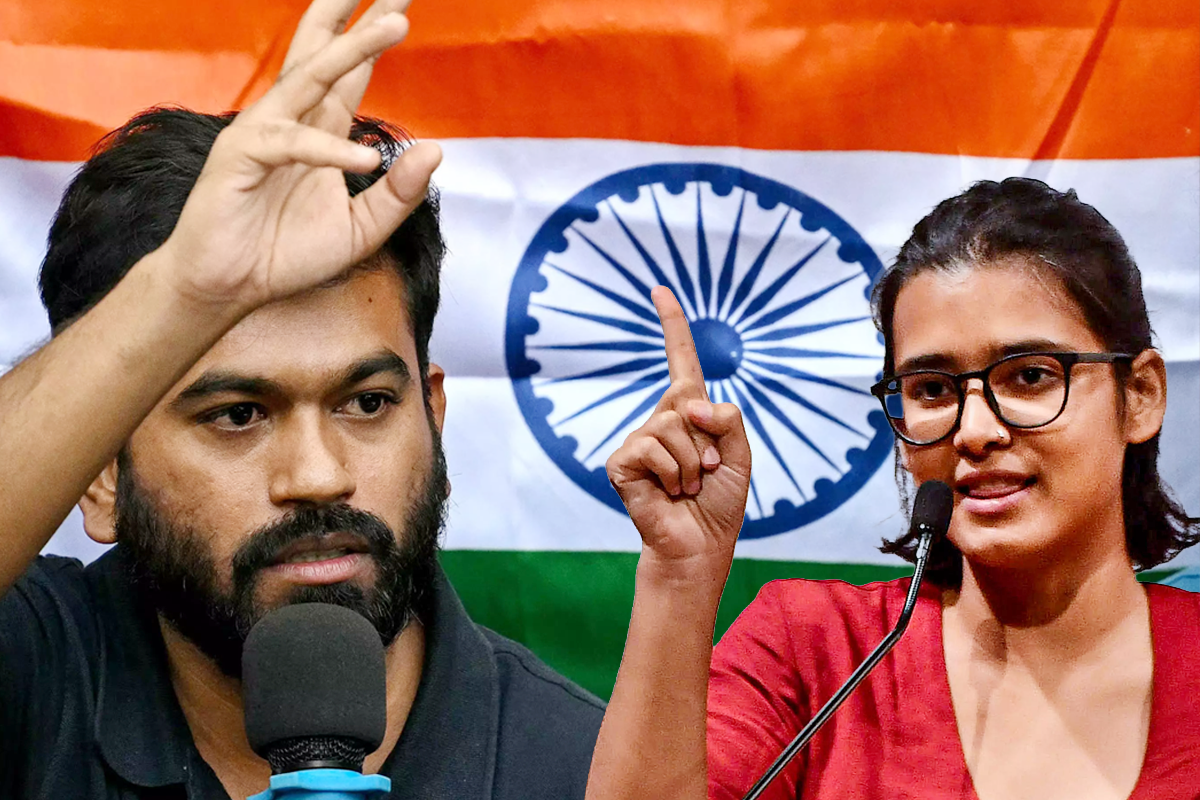
CJP founder Abhijeet Dipke and AISA leader Neha Bora.

Synopsis: Two weeks after the march of folly, the battle lines are drawn. The youth carry the Constitution, the Mahatma and the Tiranga; the government carries barricades. Only one side can win, and in an important sense the youth have already won. What they do with that victory will decide whether the nation wins too.
On 6 October, an article in these pages compared Indira Gandhi in 1975 with Narendra Modi in 2026. Both, at the peak of their power, refused a simple retreat when the legitimacy of the electoral mandate was questioned. The article ventured an unsolicited suggestion: that the Chief Election Commissioner (CEC), Gyanesh Kumar, would have to go before the end of October, or else the government would have to impose some form of Emergency.
Two weeks is a short time. But events have moved faster than most expected, and almost entirely in one direction. The record matters more than any opinion, so it is worth recalling first.
2 October, Gandhi Jayanti: The Cockroach Janta Party (CJP) began its nationwide protest from Mumbai, after Abhijeet Dipke had set a deadline for the CEC to resign. By most accounts, the turnout was large, though some of the usual media called it a flop.
10–11 October: Delhi was placed under lockdown to stop a protest at Jantar Mantar. Dipke and other leaders were detained at the airport, and about 600 people were arrested in Mumbai. According to Reuters, 45 metro stations and markets were shut and mobile internet suspended. A court ordered their release the next day.
12–14 October: The Home Ministry denotified Jantar Mantar as a protest site. CJP members entered it at dawn the next day with the national flag, and two leaders, Saurav Das and Ashutosh Ranka, were sent to Tihar Jail for five days, with their judicial custody subsequently extended by another two days.
15 October: The Election Commission ordered a Special Summary Revision, not a new SIR, in 17 states and Union Territories, and agreed for the first time to give parties machine-readable rolls.
16–17 October: Central Park in Connaught Place was closed for “administrative reasons”. Dipke was detained for the second time in a week, along with student leader Neha Bora. The BBC filmed a policeman slapping a detained protester inside a bus. Yet thousands still gathered, waving the flag. Both leaders were released the next day, Dipke after accepting conditions that were not made public.
18–19 October: Protests continued almost daily. On 19 October, a court extended the detention of Das and Ranka by two more days at the police’s request. The CJP’s legal head, Ratna Singh, called it “an absolute mockery of the judicial system”. The Election Commission, for its part, said the deleted names included 28 million dead, 63 million who had moved and 30 million who could not be traced, and that anyone wrongly removed could re-enrol.
That is the record. Now to what it means.
Of all the images of the past fortnight, one will stay with the nation. A government serving out its third term at the Centre shut down a public park in the capital because young people wanted to wave the national flag in it.
Dipke had called it “Lehra Do Tiranga”, wave the tricolour. When Das and Ranka went to Tihar, the CJP founder wrote: “Imagine being jailed in your own country for waving your own national flag.” When the police took Dipke away later, the CJP posted: “This government is so scared of the youth waving the national flag.”
Look at the symbols the youth have chosen.
The book: the Constitution, which every citizen is told to revere and which this government itself has made the subject of a national day. When Dipke first spoke at Jantar Mantar, and when he first stepped off the plane in Delhi, he was holding a copy of it.
The man: Mahatma Gandhi. The nationwide protest began on his birthday, and its method is his method: peaceful, disciplined, ready to court arrest. On the stage during the protest in Mumbai, almost every leader wore a white T-shirt carrying the iconic image of Gandhi on the march.
The flag: the Tiranga, which the ruling party has made the centrepiece of its own campaigns. When Dipke was detained the second time in Delhi, he was holding it.
So, all three — the book, the Mahatma and the flag — were present each time the youth were taken into custody. The message was that all three were being taken into custody with them. That is exactly what the youth wanted to convey to the nation, and they succeeded.
The government cannot arrest the Constitution, call Gandhi an anti-national, or ban the flag. So it does something far more damaging to itself: it arrests those who carry them. Every photograph of a policeman dragging a young man holding the Tiranga needs no caption.
This is why the youth have already won. It does not depend on the size of the crowds, or even on whether they stay in jail. For a satyagrahi, Gandhi taught, jail is not defeat but part of the method. Those who went to jail in 1975 came out to form a government in 1977.
The movement has had a clear purpose from the first day of its second round. On 24 September, CJP co-convener Saurav Das set out three demands:
Gyanesh Kumar must go and face criminal proceedings. “Answer who gave him orders,” Das said.
The SIR must stop. “Immediately put on hold all upcoming polls. Freeze the SIR process.” The rolls should be restored to their January 2025 state, and an independent inquiry set up.
The 2023 law must go. “Repeal the 2023 law on the appointments of EC officials,” and replace it with one framed with civil society.
One may agree or disagree with each of them, but no one can call them vague, or negotiable. “Even if Gyanesh Kumar resigns, we will not bow down,” Das told The Week. The third demand matters most. The 2023 law replaced the Chief Justice of India on the selection committee with a Union minister chosen by the Prime Minister. The youth have understood that the problem is not one man, but the process that produces such men.
For twelve years, a well-oiled propaganda machine has had a ready answer for anyone who criticised the policies of the Prime Minister: Pakistani agent, foreign-funded, desh drohi, urban Naxal, anti-national. It worked for a long time. Not anymore.
The machine has certainly tried. BJP president Nitin Nabin spoke of a “virus and cockroach” gang out to divide the country, and accused the Opposition of acting at the behest of foreign powers. Union Minister HD Kumaraswamy alleged that the Karnataka government was funding the CJP. The familiar “foreign hand” allegation, ironically made famous by Indira Gandhi, has returned too.
None of it has stuck. How do you call a young man an anti-national when he is arrested for carrying the national flag? How do you call a movement foreign-funded when its weapons are a satirical name, a phone and a Tiranga bought for fifty rupees? The youth have given the machine nothing to work with: no violence, no foreign platform, no slogan that can be twisted.
These labels have become a joke. When everyone who disagrees is a traitor, the word loses its meaning. A propaganda machine is powerful only as long as people believe it describes reality. Once they begin to laugh at it, and the very name “Cockroach Janta Party” is that laughter, it has lost its main weapon.
There is, however, one label the machine has not given up on.
Neha Bora has been among the bravest faces of this movement: a 23-day hunger strike in July that ended with the Education Minister’s resignation, and detention after detention in October. She is also president of the All India Students’ Association, the student organisation of the CPI(ML) Liberation. The BJP has noticed; its Karnataka president has already questioned Rahul Gandhi over his links with her.
Her courage is not in question. But a fair question will come, and will be asked unfairly: for her organisation, is the Constitution an end in itself, or a means to other goals?
This matters because the real strength of the CJP is its acceptability across the political spectrum, particularly among a middle class that has stood with the BJP not for its governance but for reasons of religion and identity. Once the movement is seen as a vehicle of the traditional left, the CEC will take a back seat in their minds, and the debate will turn into Left versus Right once again. That is what the BJP is hoping for.
Both the Left and the BJP are watching, each calculating how the CJP’s popularity can be used against the other. At some point, Neha Bora may have to choose between her ideology and the CJP’s idealism. That day has not come; for now they can work together for free and fair elections. But the CJP’s leadership must keep that line clear.
Whether the CEC resigns or not is, in a strange way, no longer the issue. Gyanesh Kumar has lost his credibility, and it is impossible for him to conduct an election the country will accept.
His own two colleagues, according to The Indian Express, questioned many of the revisions in a SIR process that removed roughly 13 crore names. He has not commented while the capital is locked down in his name. His Commission’s quiet shift to a summary revision in 17 states looks like a retreat, whatever the Commission says.
An election is not only counted; it must be believed. A referee whom one side of the field no longer trusts cannot blow the whistle, however legal his appointment.
The Prime Minister appears to be moving towards a showdown. Each step, from shutting the metro to jailing young people for carrying the flag, has closed one more door of retreat. The youth have just as decisively chosen theirs: they return to the street after every detention.
When one side has staked its authority on keeping one official, and the other has staked its moral case on removing him, one side has to win, and the other has to lose, completely. Either Modi wins and the nation loses; or the nation wins, the CEC goes first, and the question then turns to those who protected him.
If the government does not retreat, it has to resort to repression daily: closing Delhi, and later other cities; detentions every evening; protest sites denotified one by one. Das warned that the Prime Minister “will soon denotify democracy”. Dipke replied that Jantar Mantar is not a location but a spirit of resistance. Close one site, and the spirit moves to the next.
Meanwhile, a second process is under way that the police cannot stop. Every day, more people and journalists are putting evidence about the rolls into the public domain, just as The Indian Express did. A Maharashtra plea claims 40.6% of voters were missing in parts of Pune; Opposition leaders have asked the Court for an independent audit of deletions.
The Supreme Court upheld the legality of the SIR in May. That settled the law, not the facts on the ground. And the Court now appears to be looking at the facts. On 5 October, it issued notice on petitions challenging decisions allegedly taken unilaterally by the CEC.
Justice Joymalya Bagchi observed that the immunity the 2023 law gives election commissioners is “perhaps only for the President. It does not apply even to judges.”
When it came to West Bengal, the petitioners’ counsel told the Court that 93% of the appeals decided by tribunals so far had been allowed; in other words, most of the deleted voters who appealed were wrongly struck off. The Maharashtra plea comes up on 26 October.
The SIR may be legal; how it has been carried out is now under the Court’s scrutiny. Sensing the mood of the nation, the Court may become more assertive, examining not only the implementation but its consequences, including the sanctity of recent elections, particularly in West Bengal. That may produce some very uncomfortable decisions. It is exactly what the government hoped to avoid by doubling down on the protests rather than letting the CEC go.
As repression rises and evidence mounts, the conscientious sections within the BJP and the RSS — and there are many — will begin to distance themselves. First they will fall silent; some appear to have done so already. Silence inside a disciplined organisation is the first sign of doubt.
Very soon, the BJP and the RSS will have to choose. This is no longer a fight between the Opposition and the government, but between the youth of the nation and Narendra Modi.
On one side: save the organisations and lose one official. On the other: back the Prime Minister fully, and impose some form of Emergency, declared or not.
Short detentions do not work; every time the young leaders come out, they go straight back to the street, because they have nothing to lose. Only long detentions, the suspension of civil rights and the jailing of opposition parties would hold them. That is what an Emergency is, whatever name it is given.
The RSS backed the SIR as a way to ensure “free and fair” elections. Many of its leaders went to jail in 1975; they know what an Emergency does to the party that imposes it.
As things stand, Gyanesh Kumar’s position is indefensible, and his continuing in office while the country keeps some semblance of a functioning democracy is hardly possible. Either he goes, or civil rights go.
And after that, ruling India would become impossible. The British learnt that India cannot be ruled by force alone; Indira Gandhi learnt it in nineteen months.
There is one more thing those in power seem to have misjudged.
The people of India, above all the poorest of the poor, are deeply aware of the vote and its power. For many, the voter ID is the one document that says the state recognises them as a citizen and an equal.
India may be the only democracy where people associate the vote with being alive. To have one’s name removed from the roll is, in the mind of the ordinary citizen, close to being declared dead.
It was these people who answered the Emergency. In March 1977, the poorest of the poor, many unable to read a newspaper, voted Indira Gandhi out of power. She was defeated personally, in Rae Bareli, by Raj Narain, a man who had spent the Emergency in jail.
India’s middle class and elites, by contrast, have historically made their peace with power, and sometimes profited from it. The voters stood by democracy then, and they will again. For them, having a vote is being alive, and being alive means being able to check those who hold power.
This is why the SIR has touched a nerve far beyond those whose names were deleted. If a neighbour can be struck off today, anyone can be struck off tomorrow. No government, however powerful, can do two things in India: suspend the Constitution, and delete the people from the voter list.
The irony of the present moment is that the government now appears to need both. To keep the deletions, it must silence the protests; to silence the protests, it must suspend the Constitution.
The youth have won the argument, but they can still lose the country. Two traps lie ahead.
The first is laid by sections of the Left and their intellectuals, who want to read this as the long-awaited fight against fascism, and a chance to finish the RSS and the BJP for good. Until a few months ago, many of them had run out of ideas and action; the CJP has given them oxygen.
The second is laid by self-appointed nationalists, some of them holders of foreign passports questioning the patriotism of Indians from abroad, and by sections of the ruling establishment, who want it to be a fight between patriots and desh drohis. It is neither.
The moment it becomes Left versus right, Modi will know exactly how to deal with it. So far, the CJP has kept away from both traps.
There is good reason to believe that many in the RSS and the BJP cadre want free and fair elections, know the SIR has gone wrong, and privately wish Gyanesh Kumar would go. They hold back only because saying so might help the Left or Rahul Gandhi.
The CJP should reach out to them and make clear it is not here to finish them. The Congress and the Left, for their part, should remember that it was their own failures that brought the BJP to power, and that they share the blame for the damage to democratic institutions.
Most Indians want something simpler: a stronger democracy, functioning institutions and better governance. Indians are, and will always be, religious and spiritual; that does not make them BJP supporters.
It was the Left that pushed many of them there by ignoring their sentiments. Equally, removing genuine illegal migrants from the rolls is not an attack on any religion; the problem is that extremist and corrupt elements use such pretexts to polarise.
The political elites of Left and Right have both failed. They divided the people and their hearts, and many secured their children’s futures abroad. That door is closing, and the burden of their failure has fallen on the youth who stay.
The CJP’s task is to find the middle path between them, and to unite Indians around a common minimum agenda that people across the spectrum can sign: a law on conflicts of interest, real accountability for constitutional office-holders, and an independent process for appointing them. It should start building that agenda now, for the day after Gyanesh Kumar’s exit. That exit is certain. The only question is when.
On 26 November, the country will mark Constitution Day. The government will speak of the Constitution with reverence, as it does every year. The youth will be carrying the same book, the same flag and the same Mahatma, some of them perhaps from inside a police bus. The people will be watching, and they will know which of the two is telling the truth.
Note: The Election Commission and the BJP deny any wrongdoing; the BJP attributes its electoral dominance to the Prime Minister’s popularity and economic growth.
(The author is a scientist and policy analyst who has worked with several international agencies. Views are personal. Edited by R Rajesh Kumar.)



