

Published Jun 17, 2026 | 4:00 PM ⚊ Updated Jul 03, 2026 | 9:30 AM

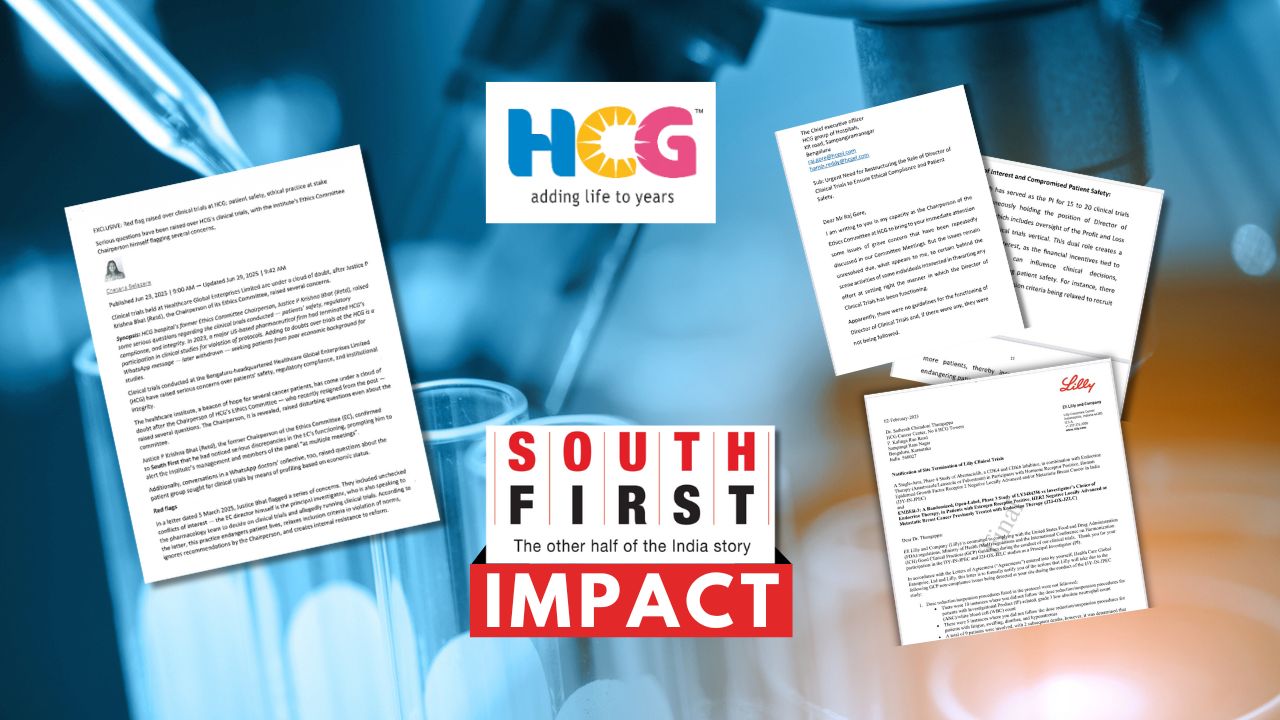
The order effectively bars HCG Bangalore from taking up new clinical trials for the next two years.

Synopsis: Nearly a year after South First first reported serious irregularities at HCG Bangalore’s Ethics Committee, the CDSCO has suspended the committee for 24 months, preventing it from approving or overseeing new clinical trials. The action follows an investigation launched after South First’s reporting, which found multiple violations, including delayed reporting of deaths and serious adverse events, unverified compensation payments, conflicts of interest, and gaps in drug accountability and trial documentation.
Nearly a year after South First first reported serious irregularities in the functioning of the Ethics Committee (EC) at Healthcare Global Enterprises Limited (HCG), one of India’s largest cancer hospital chains, the Central Drugs Standard Control Organisation (CDSCO), India’s apex drug regulator has suspended the committee’s registration for 24 months.
The suspension order, dated 12 June 2026, was issued by Dr Rajeev Singh Raghuvanshi, Drugs Controller General of India (DCGI) and Central Licensing Authority, under Rule 14.3(iv) of the New Drugs and Clinical Trials Rules (NDCTR), 2019.
The order, a copy of which is with South First, is addressed to the Member Secretary and Chairperson of HCG-Bangalore Institute of Oncology, HCG Towers, P Kalinga Rao Road, Sampangiram Nagar, Bengaluru.
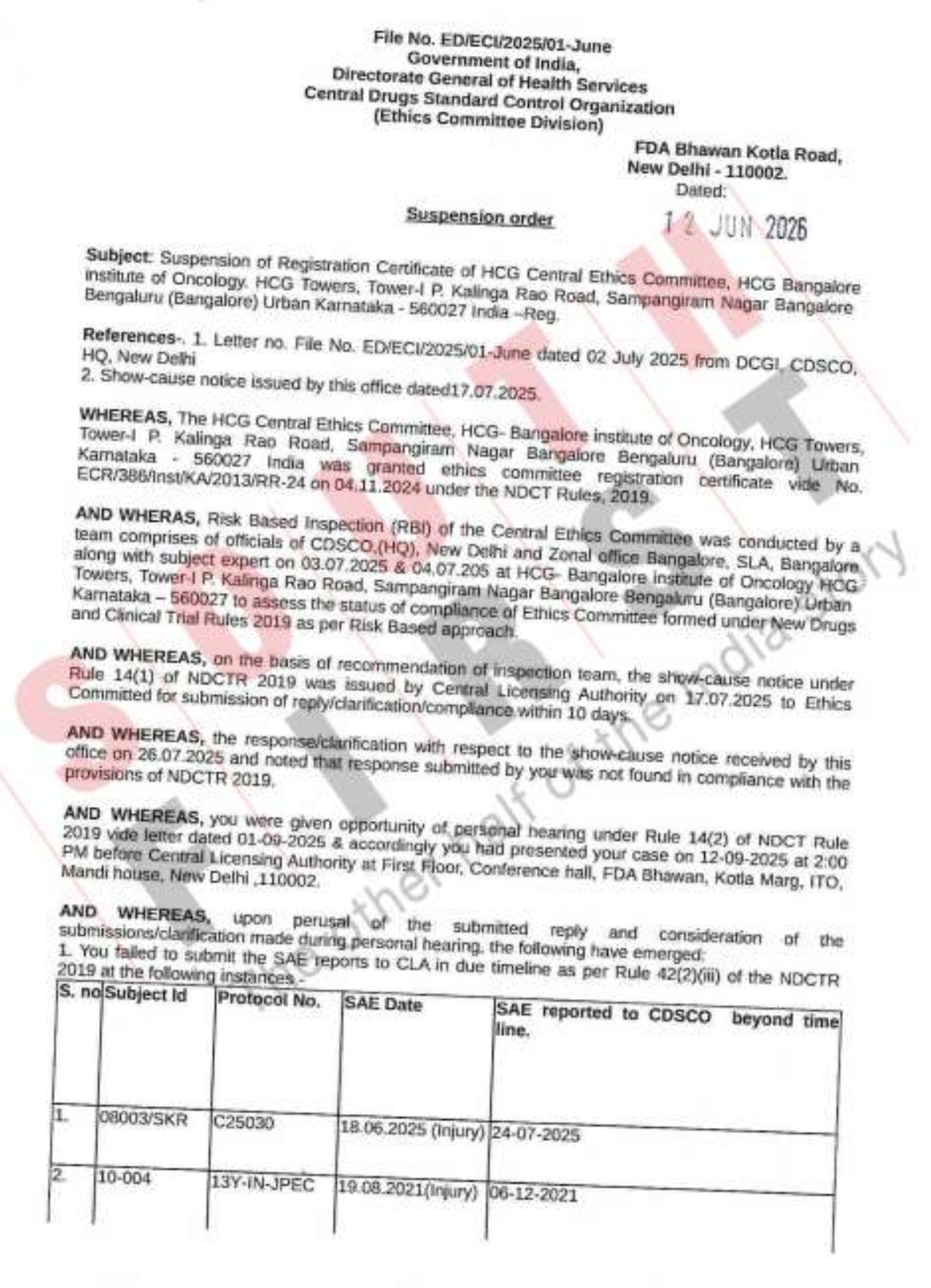
A copy of the suspension order.
Anju Kushwaha, Assistant Drugs Controller (India), CDSCO Bengaluru Zone, confirmed to South First that an email regarding the suspension of the EC had been received and that further action would be taken in consultation with the Deputy Drugs Controller (India), CDSCO Zonal Office, Bengaluru.
“We had conducted an on-site investigation and have now received the email regarding the suspension of the EC for 24 months. Our DDC is on leave, and we will take action as per the order in consultation with our officer,” Kushwaha said.
South First has sought comment from HCG’s Chairperson and Member Secretary. Their responses are awaited.
Also Read: Doctor’s prescription now mandatory for cough syrups as Centre ends OTC exemption
The order effectively bars HCG-Bangalore from taking up new clinical trials for the next two years. However, ongoing trials must continue to be monitored, with monthly safety reports submitted to the CDSCO Zonal Office in Bengaluru.
During the 24-month suspension period, HCG’s Ethics Committee cannot oversee or approve any clinical trial or bioavailability-bioequivalence (BA-BE) study at the site.
The Ethics Committee has, however, been directed to:
South First published an exclusive report on 29 June 2025 revealing that Justice P Krishna Bhat (Retd), then Chairperson of HCG’s Ethics Committee, had flagged serious concerns over conflicts of interest, patient safety violations and regulatory non-compliance.
Days after the report was published, the Karnataka government, under an initiative led by then Health Minister Dinesh Gundu Rao, launched an inquiry, and the DCGI ordered a probe.
On 3 and 4 July 2025, a Risk-Based Inspection (RBI) was conducted at HCG Bangalore Institute of Oncology by a joint team comprising officials from CDSCO Headquarters, CDSCO Zonal Office, Bengaluru, the State Licensing Authority (SLA), Bengaluru, and subject experts.
They found violations beyond procedural lapses.
By the time inspectors arrived, HCG’s Ethics Committee had effectively ceased to function. All members had resigned between 13 and 17 June 2025.
On 17 July 2025, the DCGI issued show-cause notices, copies of which are with South First, to the HCG Ethics Committee and separately to eight pharmaceutical companies and contract research organisations (CROs) whose clinical trials were underway at the site.
Each was asked to explain its position within 10 days.
Eli Lilly, as previously reported by South First in June 2025, had terminated HCG’s participation in two clinical trials in February 2023, citing serious Good Clinical Practice (GCP) non-compliance.
HCG submitted its response on 26 July 2025, but it was found to be non-compliant with the provisions of the NDCTR, 2019.
A personal hearing was granted on 12 September 2025. Even after the hearing, the Central Licensing Authority concluded that the Ethics Committee had failed to discharge its responsibilities and had violated Chapter III of the NDCTR, 2019.
The 24-month suspension followed.
Also Read: Beauty or medicine? What India’s injectable boom reveals about consumers’ understanding
The suspension order states that the inspection team found multiple instances in which participants died during clinical trials, Serious Adverse Events (SAEs) were reported, and compensation was recommended by the Ethics Committee (EC).
However, there was no evidence that any compensation had actually been paid.
In a study under Protocol No. 13Y-IN-JPEC, two participants died: Subject No. 10-004 and Subject No. 10-023.
The EC recommended compensation of ₹19,49,079 for Subject No. 10-004 and ₹4,00,000 for Subject No. 10-023. However, the order noted that neither the EC nor the clinical trial coordinator could confirm whether these amounts had been paid to the families.
In another study (Protocol No. SB27-3004), a participant’s death was reported on 17 September 2024. The EC recommended compensation of ₹4,85,089 for the family. Again, no payment records were available.
The inspection also reportedly revealed systemic failures in reporting Serious Adverse Events (SAEs) and deaths to the DCGI within the mandated timelines, with delays stretching to more than a year in some cases.
In one case under Protocol No. BAY1841788/21140, an SAE occurred on 14 December 2022, but was intimated to the DCGI only on 10 June 2024, 18 months later.
In another case under Protocol No. D910VC0001, an SAE that occurred on 1 March 2023 was reported more than a year later.
A second SAE under the same protocol occurred on 6 June 2023 and was reported only on 17 September 2024.
The inspection found that nine SAEs and deaths, including cases involving neutropenic sepsis with multi-organ dysfunction, respiratory failure and leukopenia, had either been reported well beyond the stipulated timelines or had not been reported at all to the Central Licensing Authority as of the date of the order.
Also Read: FSSAI orders food businesses to replace rusted knives, blades to curb contamination
South First’s exclusive report, along with other irregularities, flagged an alleged conflict of interest involving a senior doctor who was simultaneously serving as a member of the Ethics Committee (EC) and as Principal Investigator (PI) in multiple clinical trials.
The CDSCO inspection later confirmed and documented these concerns in detail.
Dr Govind Babu, a member of HCG’s Ethics Committee, was also the Principal Investigator in at least two ongoing clinical trials reviewed by the same EC.
He reportedly attended EC meetings, signed attendance sheets as a clinician, and declared “no conflict of interest”, including in meetings where protocols for trials in which he was the PI were being reviewed.
The inspection found that he did not voluntarily recuse himself from the review process, as required under Rule 7(11) of the New Drugs and Clinical Trials Rules, 2019.
In one instance, the inspection team found that two separate sets of minutes had been prepared for the same meeting, with the same date, time and quorum, without any explanation for why two versions existed.
In one version, Dr Govind Babu’s conflict of interest for a specific protocol was recorded as “No”. During that same meeting, two protocols for trials in which he was the PI were reviewed, but he stepped aside for only one of them.
The inspection also raised questions about the sheer volume of clinical trials being managed by a single Principal Investigator.
At HCG Cancer Centre, a 250-bed oncology hospital with more than 80 specialist doctors, Dr Sateesh CT was found to be the Principal Investigator (PI) in 42 of the 99 ongoing clinical trial studies and Co-Principal Investigator in 13 more. In effect, 55 of the 99 trials were under the supervision of a single doctor.
The inspection team also noted that staffing at the site was insufficient to maintain records, coordinate trials, dispense investigational products and follow up with patients.
Only 24 CRO agreements were available for 99 active trials, the inspection report said.
Also Read: Breastfeeding works in south India. So why are most toddlers still poorly fed?
Inspectors found significant discrepancies in the procurement and dispensing of investigational products, raising concerns about data integrity.
In the Nivolumab study (Protocol No. NIVO.22.001), the site received 130 vials of the investigational product but could produce delivery challans for only 100.
Of the remaining 67 unused vials, 47 were said to have been returned to the supplier and 20 transferred to another site, but no records were available for either transaction.
In another study involving Abemaciclib tablets (Protocol No. 13Y-IN-JPEC), 407 bottles were recorded as having been dispensed, but only 404 could be accounted for.
The investigator’s signature was also found to vary across pages of the same accountability log, which inspectors flagged as a potential data integrity issue.
In one case that the inspection team described as a protocol violation, a 37-year-old female participant in the Abemaciclib study (Subject No. 10-026) was administered the investigational product on 22 April 2022, at 8 pm, before her laboratory reports, which arrived the following day at 6.59 pm, were available.
The same pattern was observed across multiple treatment cycles for the same participant and was also found in other participants across different cycles.
Clinical trial protocols require all relevant test results to be available before a drug is administered.
(Edited by Dese Gowda)



