

Published Oct 12, 2026 | 7:00 AM ⚊ Updated Oct 12, 2026 | 7:00 AM

The phrase “freezing your eggs” can make the procedure sound simpler than it is.

Synopsis: Egg freezing is increasingly becoming a way for Indian women to buy time amid pressures around marriage, motherhood, careers and relationships. But doctors explain that freezing preserves the biological age of eggs, not the woman’s, and does not guarantee a baby. The story examines the science, costs, numbers, expectations and emotional pressures behind the decision.
The question arrives at weddings, festivals and Sunday phone calls.
‘When will she marry? When will she have a child?’
For some Indian women, the pressure has more to do with being told that the decision comes with a deadline. Egg freezing enters that conversation as a way to buy time, offering a woman what she fears she is losing: an option.
But what exactly does that option buy?
Egg freezing can preserve mature eggs at the biological age at which they were retrieved. It cannot stop the woman from ageing, remove the risks associated with a later pregnancy or guarantee that the frozen eggs will eventually result in a baby.
And once the eggs are frozen, the numbers begin to matter.
The family may be counting her age. The woman may be counting the years she has bought. The laboratory counts something else.
Dr Manasvi M, consultant psychiatrist at Maarga Mind Care in Bengaluru, says family expectations can make marriage and motherhood feel like milestones with an expiry date.
“Marriage and motherhood still come with a timeline here, and women hear about it constantly from family and relatives. For some unmarried women, freezing eggs is a way of buying time so they don’t feel forced into a rushed marriage or the wrong match. So it’s often as much about easing social pressure as it is about fertility,” Manasvi told South First.
Her patients rarely give one reason for considering egg freezing.
“It’s mostly a wish to not regret anything later and to keep her options open. Career, not having met the right person, family expectations and just not feeling ready all get mixed together, and the weight of each is different for every woman,” she said.
That makes the familiar description of egg freezing as a “career woman’s choice” incomplete.
“…it makes a complicated decision sound very simple. Many women I meet are dealing with a breakup, no partner, a medical issue or just don’t feel ready, and career is only one part of the picture. The label can also make women feel judged for putting their career first, when their reasons are usually far more personal,” Manasvi said.
Dr Samhitha Moturi, consultant in obstetrics, gynaecology and reproductive medicine at Prashanth Hospitals in Chennai, says families can also misunderstand a recommendation to freeze eggs.
“There is often a misconception that recommending egg freezing means telling their daughter not to get married or not to have children immediately. That is not the case,” Moturi told South First.
“Even after egg freezing, a woman can try to have children naturally. It is absolutely normal, and there have been quite a few patients who have conceived naturally after egg freezing,” she said.
The women arriving at Moturi’s clinic have also changed.
Her youngest patient was 22. She had gone to the doctor because of period pain, and a scan found endometriosis. Her AMH was low.
AMH, or Anti-Müllerian Hormone, is a blood test used as one indicator of ovarian reserve. It does not count the exact number of eggs a woman has left, but helps doctors assess ovarian reserve and anticipate how the ovaries may respond to fertility treatment.
“However, the scenario has completely changed. Today, we see a lot of younger women coming in, even in their early 20s, with poor ovarian reserve,” Moturi said.
She said the number of women opting for egg freezing has risen steeply as awareness has increased, although she declined to share centre-level figures.
Dr Radhika Potluri, regional medical head and fertility specialist at Oasis Fertility in Visakhapatnam, shared a centre-level picture. Over five years, 70% of egg-freezing cases at her centre were social or elective, among women aged 29 to 41, while 30% were for medical reasons, among women aged 25 to 27.
Also Read: Dry eyes aren’t just a screen-time problem. Here’s what else doctors want you to know
The phrase “freezing your eggs” can make the procedure sound simpler than it is.
For roughly nine to 12 days, a woman takes hormone injections to stimulate the ovaries to develop several follicles at once. A follicle is a small fluid-filled structure in the ovary where an egg develops.
Dr Krishna Chaitanya, scientific head and clinical embryologist at Oasis Fertility, told South First that doctors generally retrieve the eggs about 34 to 36 hours after a trigger injection.
The retrieval is usually performed under sedation or anaesthesia.
But the number seen on a scan is not necessarily the number that comes out of the procedure. Not every retrieved egg will be mature enough to freeze.
“In a cycle, broadly around 70–85% of retrieved oocytes may be mature, although this varies between individuals and cycles,” Potluri told South First.
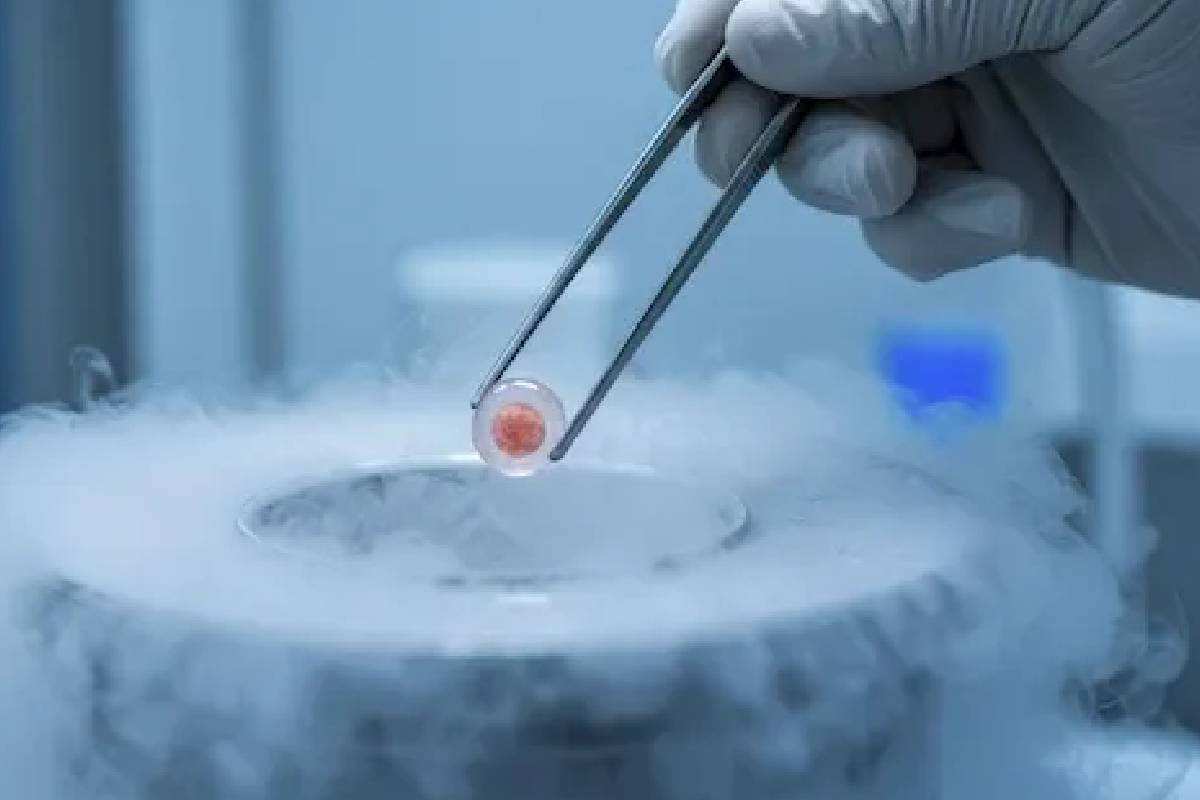
The mature eggs are then frozen using vitrification, a rapid freezing technique designed to minimise damage from ice crystals, and stored in liquid nitrogen at around minus 196°C.
That is when a woman may hear the most important number: perhaps eight, 10 or 15.
Also Read: No weight-loss drugs or bariatric surgery for under-10s, WHO says in first global obesity guidelines
Imagine a woman finishes one cycle and the clinic tells her that 10 mature eggs have been frozen.
It is easy to hear that as 10 future chances of having a child. It is not.
Years later, if she decides to use the eggs, they first have to survive warming. The surviving eggs are generally fertilised through ICSI, or intracytoplasmic sperm injection, in which a single sperm is injected directly into an egg.
Even then, not every fertilised egg develops into an embryo, and not every embryo transferred to the uterus results in a pregnancy or live birth.
“Attrition at each stage is biologically expected. Therefore, 10 or 15 cryopreserved oocytes do not represent 10 or 15 future pregnancies. The number of mature oocytes stored is a starting point, not a guarantee,” Chaitanya said.
“The important message is that 10 eggs do not mean 10 chances of a baby. They represent a pool of preserved reproductive potential, with some attrition expected at each stage of the process,” said Potluri.
The first hurdle is warming.
“With contemporary vitrification in experienced laboratories, post-warming survival of mature oocytes is commonly above 90%,” said Potluri.
The next step is fertilisation, followed by embryo development.
“There is around a 40–50% chance of the egg becoming an embryo, depending on the sperm quality as well. Once the embryos are formed, they can be transferred into the woman’s uterus after preparation,” said Moturi.
There is no magic number. Potluri pointed to modelling cited by the American Society for Reproductive Medicine suggesting that women aged 30–34 may need around 14 mature eggs for an estimated 70% chance of at least one live birth.
That does not mean a woman with 10 eggs has no chance. It means 10 mature eggs are below that particular modelled benchmark.
“Therefore, 10 mature oocytes at age 32 represent a reasonable opportunity, but are below this modelled estimate,” said Potluri.
Moturi said seven to 10 mature eggs can be a rough clinical estimate, while around 14 may be preferable, but stressed that there is no fixed number.
For women with lower ovarian reserve, reaching a higher number may require more than one stimulation cycle.
A woman may freeze her eggs at 30 and decide to use them at 38. The eggs remain biologically as old as they were when they were frozen, but the woman is still 38 when she becomes pregnant.
That distinction matters because egg freezing does not stop the rest of the reproductive clock.
“One of the biggest misconceptions about egg freezing is that it puts the biological clock on hold. It doesn’t,” said Potluri.
The procedure preserves the eggs at the age they were retrieved. But as the woman gets older, her overall health, fertility and the risks associated with pregnancy can change. Preserving younger eggs also does not remove the obstetric risks associated with being older when pregnancy eventually occurs.
“The oocytes retain the biological age at which they were cryopreserved, while maternal age at pregnancy can still influence obstetric risks,” said Potluri.
Also Read: Keralam’s cardiologists face a bigger question as CM questions ‘unnecessary’ angioplasty
“There is no single ideal age for egg freezing,” said Moturi.
A 25-year-old with normal fertility indicators may not need to freeze her eggs, while another woman of the same age with endometriosis and declining ovarian reserve may have a different discussion with her doctor.
For women over 35 who plan to continue postponing pregnancy, Moturi said the decision deserves particular consideration.
“That is definitely an age at which she needs to take a call,” she said.
Chaitanya also rejects the idea that egg freezing should be treated as something every woman needs.
“This should not be presented as something every woman must do, or as ‘fertility insurance.’ It is an optional, medically established fertility-preservation strategy that should follow individual counselling about age, ovarian reserve, expected oocyte yield, procedure, costs, limitations and future chances of success,” said Chaitanya.
The decision is not only biological. There is a price attached to keeping the option open.
Moturi estimates that one egg-freezing cycle can cost around ₹2.5 lakh to ₹3 lakh, although prices vary between centres.
At her clinic, storage renewal costs another ₹6,000 to ₹7,000 a year.
The initial payment is therefore only part of the calculation. A woman also needs to ask what is included in the cycle and what she may have to pay later for warming, ICSI, embryo culture and transfer.
Potluri and Chaitanya recommend asking for a written cost breakdown before starting treatment.
The experts also differ on insurance.
“It is actually surprising, but a lot of the patients I see have egg freezing covered under their insurance policies. A lot of the IT professionals I treat have egg freezing covered under their policies,” said Moturi.
“At present, there is no insurance coverage for egg freezing, which means women opting for social or elective freezing generally need to bear the expenses themselves. In our experience, women who come forward for social egg freezing are often from relatively affluent families and are in a position to plan for and manage the cost of the procedure,” said Potluri.
The difference may reflect individual employer benefits or policy terms, so women considering the procedure would need to check their own coverage rather than assume that egg freezing is routinely insured.
Also Read: South divide on early matrimony: From 40% child marriage in AP to 20% teen motherhood in Telangana
The emotional effect does not end when the laboratory confirms that the eggs have been stored.
“For a lot of women it’s about control. They feel they’ve done something instead of just waiting and worrying, and that brings real relief from the biological clock,” said Manasvi.
But relief can be followed by another set of questions.
“Honestly, it can do both. Most women feel calmer at first, and then questions creep in, like whether they froze enough eggs or whether they’ll ever get to use them. Some also feel pressure to make it count, which can nudge them into decisions about partners or timing before they’re ready,” she said.
Marketing can intensify that pressure.
“Celebrity stories and clinic ads tend to show egg freezing as quick, safe and almost a sure thing, and they rarely talk about the limits. That can leave women believing the eggs are a guarantee of a baby later, which they aren’t,” said Manasvi.
There is also an outcome that receives less attention: the eggs may never be used.
“A woman may later conceive naturally and never need to use her stored oocytes. Cryopreservation preserves an additional option,” said Chaitanya.
Women can therefore judge the decision differently.
“Some feel the money, time and effort were wasted, especially if they conceived naturally or decided not to have children. Others feel it was worth it because it gave them peace of mind and the freedom to choose without panic,” said Manasvi.
A failed attempt to use the frozen eggs can carry a different emotional weight.
“It can be different, because she may have trusted those eggs as her safety net. When that net doesn’t hold, the grief can be intense, along with a feeling of being let down and questions like ‘did I freeze too late?’ That said, some women find comfort in knowing they tried everything they could, and that eases the regret,” she said.
Manasvi believes counselling should be built into elective egg freezing.
“Clinics should talk openly about success rates, what the procedure can’t promise, the emotional and financial cost, and what she’d want to do with the eggs if she never uses them,” she said.
Clinics should also ask why the woman is making the decision.
“They should also gently ask why she’s doing it, to make sure the decision is truly hers and not coming mainly from family or social pressure,” said Manasvi.
Chaitanya recommends that women ask how age affects the eggs they freeze, what ovarian reserve tests can and cannot predict, how many mature eggs they might expect from one cycle and the laboratory’s warming survival rate.
They can also ask how the clinic measures success and check whether it is registered under the Assisted Reproductive Technology (Regulation) Act, 2021.
Ultimately, the experts agree on the basic limit of the procedure.
Egg freezing preserves a reproductive option. It does not guarantee the outcome.
“The purpose of awareness is not to persuade every woman to freeze oocytes; it is to ensure that women know the option exists early enough to make an informed choice,” said Chaitanya.
Manasvi brings the decision back to the woman who has to live with it.
“Egg freezing keeps a door open, but it isn’t a promise, and her worth doesn’t depend on how it turns out. I’d want her to do it for herself, with realistic expectations and people around her for support. And whatever happens, she should be kind to herself, because she made the best decision she could with what she knew at the time,” she said.
(Edited by Fayisa CA)



