

Published Oct 05, 2026 | 7:00 AM ⚊ Updated Oct 05, 2026 | 7:00 AM

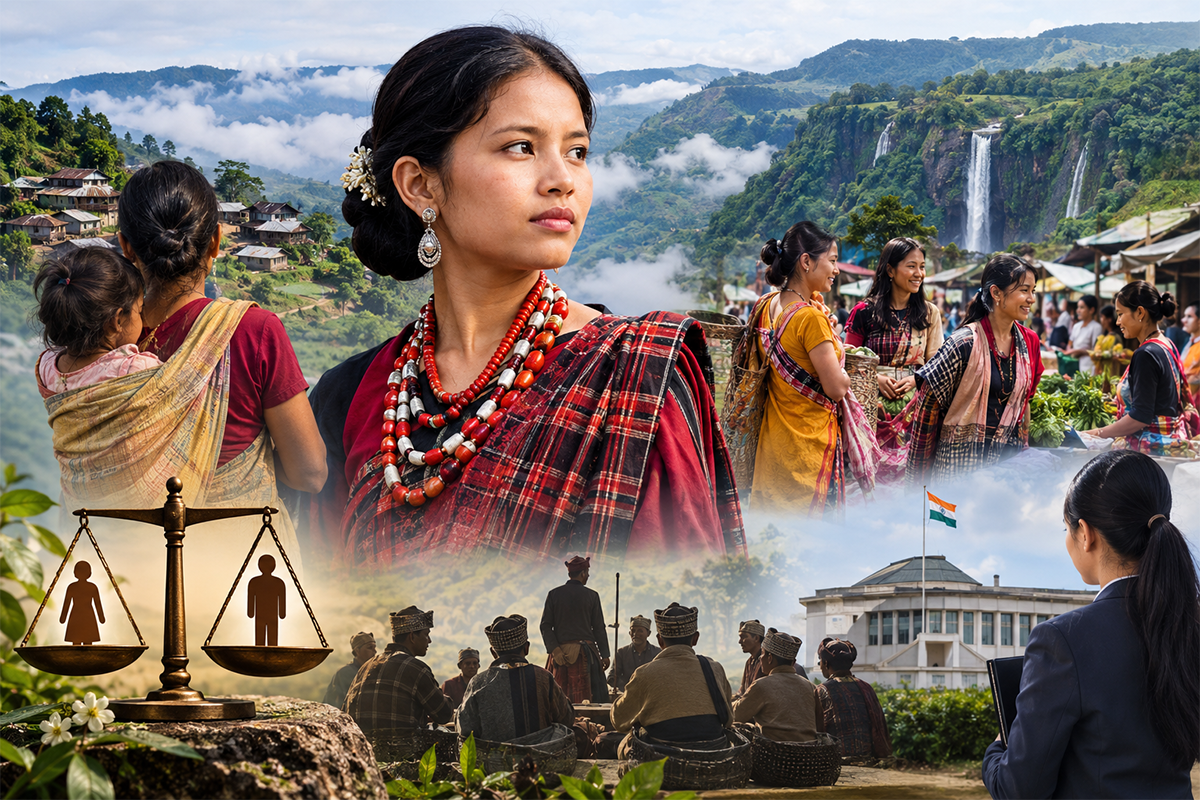
Image used for representational purpose. (AI generated)

Synopsis: Meghalaya’s matrilineal structure is enduring socio-economic, legal and cultural challenges, even as women remain at the centre of inheritance and family. But women’s visibility may not be a parameter of empowerment, with men continuing to outnumber women in politics and traditional governing structures.
Meghalaya, the abode of clouds. It was once known as the ‘Scotland of the East’.
After beginning life as two districts with limited autonomy within the state of Assam, it attained full statehood on January 21, 1972.
Meghalaya is also renowned for its matrilineal structure, unique in many ways. Being matrilineal means property rights and wealth traditionally pass from mother to daughter, most often the youngest daughter. The BBC, Al Jazeera and top international publications have run features on this aspect of Meghalaya’s society. But this system is now enduring momentous socio-economic, legal and cultural challenges.
While the Khasi, Jaintia and Garo communities continue to follow matriliny in principle, modernism, urban inputs, literacy, transmigration and changing gender roles are reformatting traditional belief systems. Some Khasi social organisations argue that matrilineal inheritance is detrimental to men because ancestral property passes on to daughters; in most cases, the youngest daughter or Ka Khadduh. These contrarians have sought reforms to cater to greater inheritance rights to men, while traditionalists argue that the existing nomenclature protects tribal indigeneity and family security.
Khasi historian Amena Nora Passah emphasises that ‘Meghalaya is a matrilineal society with patriarchal nuances’. Ironically, according to oral folklore, Khasis have patriarchal roots.
As warriors often fought with rival groups for land, men travelled to the plains for encounters. During those combats, some men were killed and some settled for a new life in the plains. When left without partners, Khasi women remarried or lived with other partners, and it was difficult to decipher a child’s paternity.
From its inception, the controversial Khasi Inheritance of Property Bill, 2021, providing equitable distribution of parental property among siblings, allowing parental choice through wills and excluding children who marry non-Khasis, has run into rough weather. A newly reconstituted review committee has been tasked with bringing the contentious bill out of legislative limbo in June 2026.
Despite its potential to reshape Khasi social fabric, the inheritance bill had been gathering dust since its introduction. Most critics feel the bill does not make it mandatory for all children to get a share of the parental property. It depends on the will of the parents to decide their genuine heir. The legislation, if passed, would change an age-old practice prevalent in Meghalaya and reshape a hitherto matrilineal society.
The Khasi Hills Autonomous District Council (KHADC) has been in the spotlight ever since questions on Khasi identity and clan lineage came into the limelight. With members debating the aftermath of families moving away from traditional practices like passing on the mother’s clan name, the future of matriliny in the state may run into rough weather.
The Khasi Social Custom of Lineage Act (1997) mandates that tribal identity and clan lineage depend on following mother-derived descent and prohibits adopting non-Khasi personal laws. The council seeks to restrict Scheduled Tribe certificates for individuals abandoning maternal surnames in favour of their father’s surname.
Walk in downtown Shillong, Tura or elsewhere; women are more evident than men thronging markets and carrying out sundry errands. But this visibility may not be a parameter of empowerment. Most vendors, homestay owners and waiters may be women, toiling tirelessly, but that does not signify matriarchy even in any subtle form.
Family planning and reproductive health are still taboo and not discussed often in rural Khasi households. Abortion is frowned upon, and so too is the use of contraception.
Since rural women are mostly semi-literate, they continue to raise children, sometimes at the cost of their health. Women who argue forthrightly and affirm their rights are termed ‘crowing hens’, pointing to intriguing questions being tossed or dabbling in worldly matters. In *Waiting for an Equal World: Gender in India’s North East*, noted columnist and editor Patricia Mukhim, who hails from the state, harps on women’s upbringing in Meghalaya’s matrilineal system as a facade behind which problems exist, belying gender equality.
The dominant feminine imagery takes a beating when the Socio-Economic Caste Census points to more than 70 per cent of rural Meghalaya as landless. It highlights dispossessed womenfolk since it is assumed that women own the land. On top of this, Maternal Mortality Rates are pretty high.
Community elders quote from folklore, suggesting a strong emphasis on the community’s foundational tradition of tracing descent through women. Figures such as Ka Li Dohkha, a mermaid who married a human, and Ka Pahsyntiew, daughter of U Lei Shyllong (the city’s deity), exemplify this tradition. According to legend, Ka Pahsyntiew emerged from a cave, was captured by a man who subsequently married her and gave birth to exceptionally beautiful children before disappearing. The tradition of reverence for women began when they were feted as progenitors of the race.
But later narratives suggest a more complex reality. Both Ka Li Dohkha and Ka Pahsyntiew returned to their original abodes – water and cave – after bearing children. Their retreats are interpreted as symbolic of discontent with their mortal existence and the treatment received after marriage and motherhood, hinting at an underlying tension between adulation of women as ancestors and their lived experience.
As more Khasis migrate to towns away from their textured, close-knit clans, there is a new responsibility on mothers. According to matrilineal tradition, men are not obliged to care for their children when they depart. This has led to a surge in women-centric households in Meghalaya. Earlier, the extended kin would support the lone mother, but now, owing to nuclear families, the mother has to rely on herself. A sort of men’s liberation faction, Syngkong Rympei Thymmai (Home Hearth Restructured), is also campaigning to end matrilineal inheritance, though their claimed motto is to bring men up to the level of women.
Despite playing a crucial role in inheritance and family, women find it difficult to make headway in politics. Men always outnumber women running for office and being elected as legislators. In Meghalaya’s 2023 legislative assembly polls, out of the 36 women candidates who were fielded, only three women were elected — a stark discrepancy that highlights structural obstacles.
Women are frequently excluded from pivotal positions in traditional governing structures like the Dorbar Shnong (Village Council) and Dorbar Kur (Clan Council), which are largely controlled by men. This imbalance is further entrenched by cultural norms that prevent women from pursuing political ambitions and political parties’ reluctance to recruit female candidates. Many tribal organisations support the continuation of matriliny because it preserves clan identity, customary laws and indigenous culture. Public debates continue over balancing traditional customs with issues such as surname, inheritance and tribal identity.
Of late, the Synjuk Ki Rangbah Kur Ka Bri U Hynñiewtrep, a body of traditional chiefs of Khasi-Jaintia Hills, condemned KHADC for eroding Khasi mores and resolved to revive clan institutions. It urged the Governor to withhold assent to the Land (Amendment) Bill 2026 and direct the council to withdraw a notification on fixation of land ceiling in Ri-Raid or community-owned tribal land.
In a marked shift, leaders of cooperatives or Synjuk, clan supremos, and scholars converged in a major assembly of the Tipkur Tipkha Movement, an initiative aimed at preserving Khasi-Jaintia identity. They warned that bypassing grassroots bodies would weaken democratic checks, create administrative chaos and undermine the spirit of the Sixth Schedule. These pointers clearly show how a deep-rooted matrilineal society may not be ready to introspect or shrug off the past.
With a continuing shift from joint to nuclear families in Meghalaya, the conflict between customary tribal laws and constitutional principles of gender equality remains a pressing issue. The road ahead lies not in fading away but in embracing contemporary socio-economic realities. The matrilineal society of Meghalaya is a distinctive socio-cultural institution that has preserved tribal identity for centuries through maternal descent and inheritance.
Meghalaya’s matrilineal ethos remains one of the world’s most distinctive kinship systems. However, urbanisation, globalisation, economic transformation and debates over gender parity are reformatting its practice. The central challenge for the new generation is to preserve the ethos of a matrilineal system while ensuring greater gender equality, inclusive governance and adaptation to contemporary social realities.
Also Read:
The Sea speaks Malayalam: The 122 words that sailed back with Vasco da Gama from Calicut
When a language fights to avoid being eaten: The Tulu lesson for India
Khichdi, khatta and kheema: The quiet trinity that once defined Hyderabadi mornings
(The writer is a commentator on society and politics. Edited by R Rajesh Kumar.)



