

Published Aug 24, 2026 | 8:02 PM ⚊ Updated Aug 24, 2026 | 8:02 PM

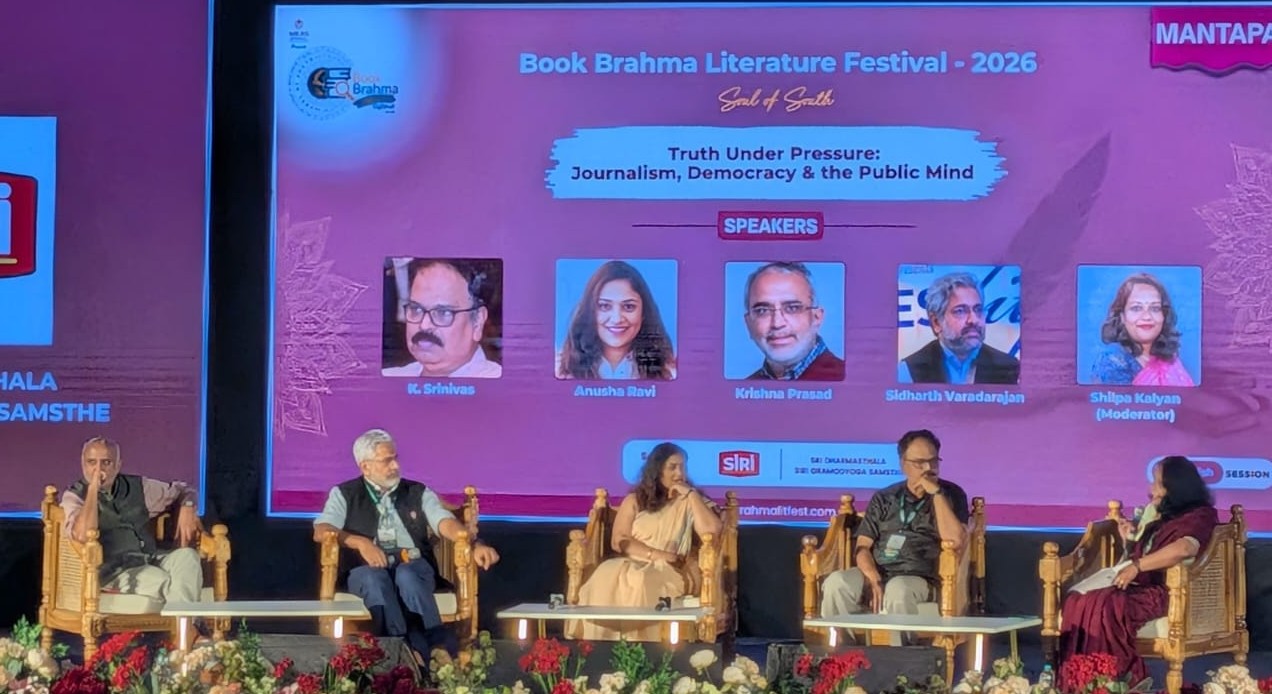
Krishna Prasad, Siddharath Varadarajan, Shilpa Kalyan, K Srinivas, and Anusha Ravi Sood at the panel discussion.

Synopsis: As journalism competes with social media, AI-generated content and shrinking attention spans, senior journalists at the Book Brahma Literature Festival argued that its biggest crisis is not technological but editorial — the erosion of independence, scrutiny and the willingness to question power.
Journalism cannot compete with entertainment, but it can survive the age of 30-second reels by remaining compelling without sacrificing its core values of honesty, fairness and accountability, senior journalists said at the Book Brahma Literature Festival in Bengaluru.
Speaking at a panel titled Truth Under Pressure: Journalism, Democracy and the Public Mind on the third and final day of the festival on 23 August, journalists Siddharth Varadarajan, Anusha Ravi Sood, Krishna Prasad and K Srinivas discussed how political and business pressures, the digital news cycle and changing audience habits are reshaping Indian journalism. Shilpa Kalyan moderated the discussion.
Siddharth Varadarajan, founding editor of The Wire, said journalism was gradually losing its willingness to question those in power.
“The honesty and fairness that has always been one of the cornerstones of journalism is sadly missing these days,” he said.
Also Read: Perumal Murugan on translation, power and expanding world of readers
Taking Prime Minister Narendra Modi as an example, Varadarajan said the Prime Minister’s statements were often reported at face value, without sufficient scrutiny or context.
Varadarajan cited the US case against Gautam Adani as an example of how news can be technically accurate but lack context.
“When the case was dismissed, some outlets reported it as a clean chit,” he said, pointing out that the charges were dismissed at the US Justice Department’s request without a trial or ruling on the merits of the allegations.
He attributed this partly to the speed of digital journalism. Unlike newspapers, which traditionally had more time to verify information before being pushed for publication, digital newsrooms and social media these days continuously share information and compete for clicks, engagement, and audience attention, which comes at the cost of fact-checking and verification.
But technology, he argued, was only part of the problem. Media organisations have also become increasingly risk-averse — aligning with political parties to avoid repercussions or protecting their own business and economic interests.
Also Read: A celebration of languages, literature and dialogue
Anusha Ravi Sood, the Editor of South First, said the medium may change, but journalism’s fundamental purpose does not.
At its core, she said, journalism remains about “asking questions, holding those in power accountable and bringing out stories that benefit the public”.
While newsrooms have become more culturally inclusive, she said the space within them to think, disagree and debate has shrunk, with younger journalists often expected to follow instructions rather than question editorial decisions. She highlighted her mixed experiences.
She also pointed to the continued underrepresentation of women in leadership positions, while noting that independent digital media had opened greater space for regional journalists and stories that might otherwise remain untold.
Group Editorial Officer, The Hindu. Krishna Prasad turned the criticism inward, arguing that editors themselves had lost their “spine” and the temerity to ask questions that could “rock the boat”.
Comparing Indian journalism with American outlets that routinely fact-check statements by US President Donald Trump, Prasad said claims by India’s political leadership were too often presented as truth without adequate interrogation.
“We are desperately short in serving our democracy,” he said, lamenting the decline of impactful journalism across both national and regional media.
Also Read: What does it mean to belong to a nation?
K Srinivas, who has worked in Telugu journalism for four decades, said regional newsrooms often struggle with financial constraints and limited editorial independence.
“What has to be done is already decided. Editors don’t have much say. Newspapers are aligned either with the TDP or YSRCP and work according to the mandate of the management,” he said.
Srinivas said regional journalists had greater freedom on social and non-political issues and could sometimes be more critical of national issues.
“We could be more liberal and thoughtful while questioning national issues, but we couldn’t do the same when it came to local issues,” he said, adding that independent journalists questioning local governments had faced threats and intimidation.
Also Read: Prose, politics and poise
The discussion eventually turned to perhaps journalism’s biggest contemporary challenge: how does a deeply reported 2,000-word story compete with a two-minute reel in today’s digital and social media age?
“Journalism can’t compete with entertainment,” Sood said.
But the panel argued that journalism does not necessarily have to.
Prasad invoked an old newsroom dictum: “make the important interesting”. Journalism, he said, has always needed to be “entertaining and compelling and magnetic”, something the profession has lost sight of.
A 2,000-word investigation, he argued, could be transformed into a two-minute video without editorial compromise. The challenge was not simply to shorten the information, but to do so without compromising editorial integrity.
News organisations have adapted well to changing times, Sood said, pointing to the digital evolution of outlets such as NDTV and the video stories and explainers of The Hindu and Deccan Herald.
Ultimately, the panel concurred, audiences too have a choice: consume a two-minute video without its full context, or spend the time required to understand the story behind it.
“Journalism is a biological necessity of humanity,” Prasad said, borrowing a phrase from Nobel laureate Gabriel García Márquez.
Pointing to journalism’s enduring presence in popular culture, he cited Citizen Kane, Satyajit Ray’s journalist Aditi Sengupta in Nayak, and Spider-Man’s Peter Parker.
Despite repeated “doomsday predictions”, he said journalism would always survive, regardless of changes in format or size.
(Edited by Majnu Babu).



