
Published Aug 24, 2026 | 5:20 PM ⚊ Updated Aug 24, 2026 | 5:20 PM

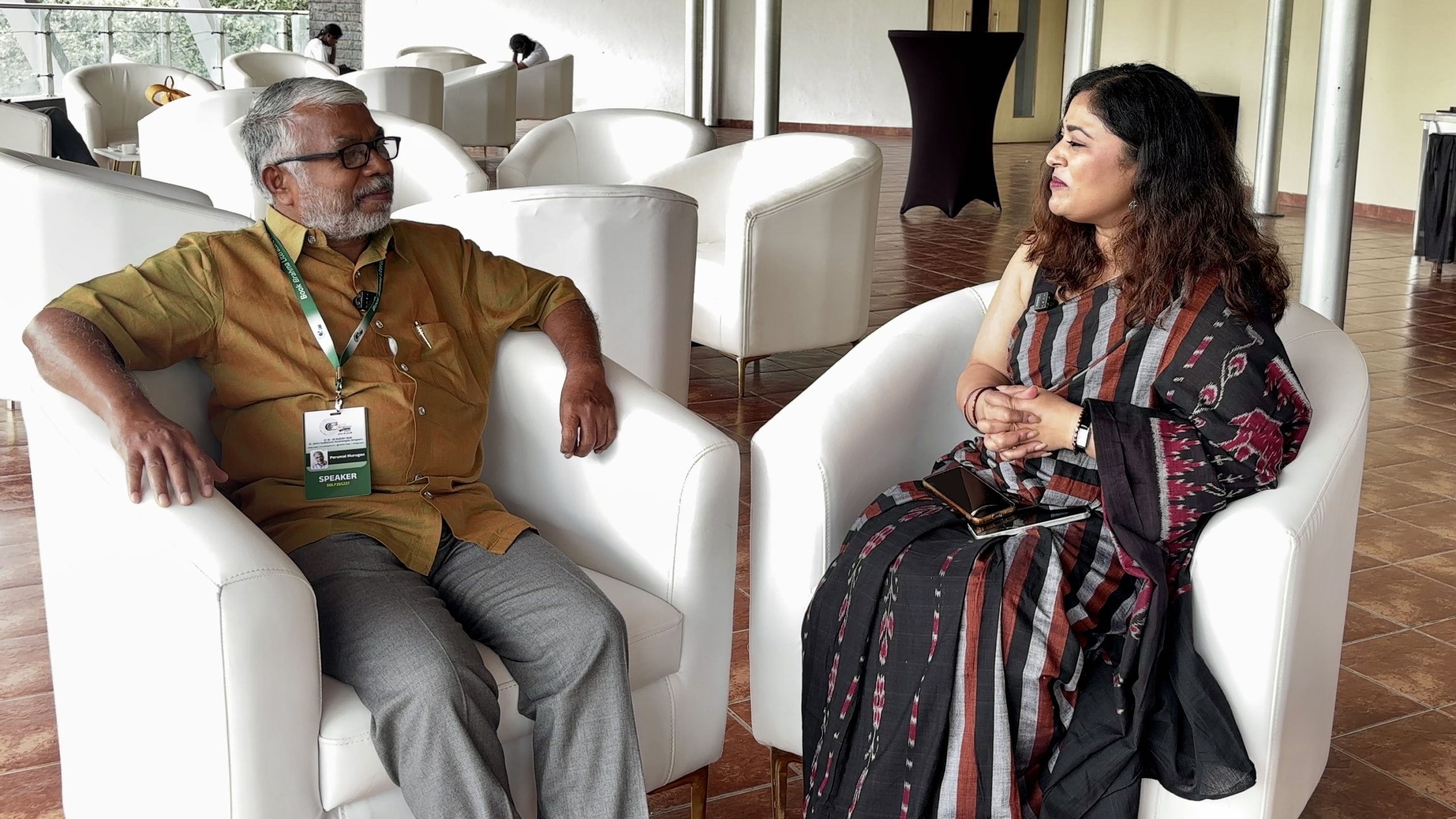
The acclaimed writer and poet is now read not just across India but across the globe.

Synopsis: On 13 January 2015, Perumal Murugan, the Tamil writer and literary chronicler, “died”. “Author Perumal Murugan has died. He is no god, so he is not going to resurrect himself. Nor does he believe in reincarnation. From now on, Pe. Murugan will survive merely as a teacher, as he has been,” he posted a self-scribbled “epitaph” on social media, after certain outfits raised a hue and cry over his novel, “Maadhorubhaagan” (Translated into English as “One Part Woman”). The death, as John Donne says, was “one short sleep.” The writer, Perumal Murugan, bounced back into literary life, stronger and sharper with “Poonachi: Or the Story of a Black Goat”, an allegorical, poignant novel that probed the societal hierarchies and raised existential questions. “They talk about the highs of toddy and liquor, but those are not highs at all. Real intoxication comes from talking. The moment it crosses a limit, we forget everything,” the novelist said in the 2016 work, “Poonachi.” And he did talk — about translations, writing by marginalised communities, education, and more in a freewheeling conversation with Anusha Ravi Sood.
Perumal Murugan, by his own account, never imagined or expected that one day he would be addressing readers who had discovered his work without reading it in Tamil.
The acclaimed writer and poet, whose works have brought to a wider audience an entire way of life and a culture that perhaps had not been part of the mainstream, is now read not just across India but across the globe, chiefly due to translations into English and other languages that have helped bridge the language barrier.
Even so, Murugan prefers Tamil when speaking in public. That did not stop a packed hall from crowding in to hear him at the recently concluded Book Brahma Literature Festival in Bengaluru, held over the previous weekend.
Murugan was on a panel with fellow writers and poets Benyamin, Salma and Imayam at a session on “The Art of Fiction: Stories That Define Our Times.”
Having started self-publishing his work in the late 1980s, Murugan says he has seen tremendous growth in the opportunities available to writers to publish their work and to readers to discover it. The result, he says, gives him “immense happiness”.
In a conversation with South First, Murugan offered insights into his world and his writing, exploring how his novels and characters open up entire worlds and why the very act of writing is political.
Edited excerpts:
Q: “You have come here to Bengaluru for the Book Brahma Literature Festival—whether it is your own session, or when others come and speak to you—they may or may not speak Tamil, but they have read your writings. When your words reach them, what does it mean to you as an author? Your writing is now accessible not only in Tamil but in other languages as well.”
Perumal Murugan: “I see this as one of the greatest opportunities that translation has given us. Especially now, in the 21st century, translation opportunities have increased tremendously. The facilities and resources available for translation have grown considerably.
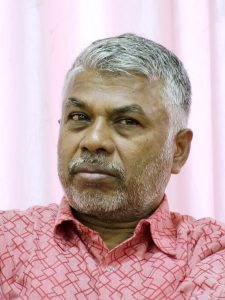
Perumal Murugan in 2019.
Because of this, even if we write in an Indian language—particularly a South Indian language that may be considered marginalised or overlooked—we now have the opportunity to have our work translated into English, other Indian languages, and foreign languages.
For a long time, our writers have been saying something very important: we translate and read all kinds of world literature in our languages. But only when we take our own literature into other languages will the world come to know the extent to which our literature can stand alongside world literature.
Earlier, however, the opportunities to do this were limited. The book market did not provide many such possibilities. But now, in the 21st century, these opportunities have increased significantly. That is the main reason.
As a result, there is now a great opportunity for people from different linguistic and cultural backgrounds to read our books. Through this, my books have reached many languages – through English as well as through other languages.
Because of that, the number of readers has grown enormously. And when I meet all these readers, it gives me immense happiness.”
Also Read: Revisiting Perumal Murugan’s magnum opus that sparked outrage
Q: “Did you ever imagine that people outside Tamil Nadu would read your books? When you write, do you ever think about things like, ‘Who is my target audience?’”
Perumal Murugan: “We never write with an audience in mind. If we wrote that way, I don’t think it would result in authentic or meaningful writing.
My general belief is that if we write truthfully about the landscape and environment in which we live, that itself can attain literary value. Because when we read world literature, that is what writers everywhere have done.
Whether we are reading literature from America, Russia, Latin America, or Africa, those writers did not write with the specific intention that their work should reach people in other parts of the world. They wrote about the lives they lived, the circumstances they lived in, and the culture that surrounded them.
When we read those works, we go beyond those particular backgrounds and settings, and the human relationships within them become important to us. Wherever those stories come from, we can recognise and connect with those human experiences.
So, in that sense, it is enough for us to write about our landscape and the life that exists naturally around us. There is no need to write while constantly thinking about readers – whether the work will be translated into another language, or whether it will reach people there. There is no need to write with those concerns in mind.”
Also Read: Legal and cultural battle over judging art in Perumal Murugan’s controversial novel
Q: “You said you write about the landscape and environment you live in. When you write about these things, are you simply writing about characters, or is there a political dimension to it? Or perhaps what we might call subaltern sentiments – things that are not part of the mainstream? Do you narrate your politics through your characters?”
Perumal Murugan: “The very moment we choose a character, there is already a politics involved in that choice. When we choose a subject for a novel or a short story, there is politics inherent in that choice itself.
Our choice reveals whether we stand with people who are vulnerable and oppressed, or against them. As a writer, I believe that in any situation, one must look at an issue from the perspective of those who are affected or harmed. That, in my understanding, is part of literary consciousness. And that is where politics begins for us.
Beyond that, the way you write, the incidents you choose, and the kind of language you use – all of these are political as well.
At a fundamental level, writing itself is a political act. The question is: which side are you on? Do you stand with power? Do you stand against power? Or do you stand with those who are affected and oppressed by power? All of these questions inevitably come into writing.”
Also Read: Perumal Murugan, God and the struggle for understanding the eternal quest
Q: “When you write, do you ever think about whether it is enough for a writer simply to have readers, or whether awards and prizes are also important? Do you think there is a disparity in how such awards are given? Are award ceremonies and prizes important? How important are they to a writer, in your view?”
Perumal Murugan: “If you ask whether awards are important to a writer, I would say they are not of overwhelming importance. But we do need certain markers through which a writer’s work can be recognised and acknowledged.
How do we recognise that? We meet readers at events, and they share their opinions with us. Those who have the opportunity may also write to us through email and other means. Writers today have access to these kinds of responses. But writers in earlier times did not have such facilities. They often did not even know who was reading their work, or what readers thought about it.
In such a situation, I see awards as one of the markers through which a writer’s work is recognised. Whether or not an award directly benefits the writer is another matter, but it can certainly be useful for readers.
For example, if a particular book has received an award, readers may become interested in reading it because of that recognition. That is why publishers often print on the cover of a book that it is an ‘award-winning book.’ Why? Because it serves as a marker – a way of bringing the book to the attention of readers.
So, from the perspective of both the writer and the reader, I think an award can serve as a sign of recognition for good writing.”
Also Read: Perumal Murugan’s cost of creativity and what it meant for artistic freedom
Q: There is often a sense that reading has declined owing to online platforms, Artificial Intelligence, and the internet. As a writer, do you feel that the number of people reading your books and stories is decreasing? Or do you see all this as part of modern technology – something that will eventually evolve and find its own place?”
Perumal Murugan: “I began writing in the late 1980s, and my first book (Eru Veyyil) came out in 1991. At that time, no publisher was willing to bring out the book. We didn’t know who the readers would be or how far the book would reach.
A few of us friends got together, with help from other friends, and printed the book ourselves. We created our own publishing house, gave it a name, and published it. We printed a thousand copies, hoping that government libraries might buy them. There were hardly any bookstores where we could sell the book. That was the situation then.
Now compare that with today. In these 30 or 35 years, there has been an enormous change. Even though modern technology and new devices have developed, I believe they have actually led to more readers.
Another important factor is that the number of people receiving an education in our society has increased greatly. Compare the number of educational institutions 30 years ago with the number we have today. Even if you look at Bengaluru alone, think about how many universities and colleges exist today – many of them did not exist 20 years ago.
What does that mean? It means that many more people are studying today. Earlier, a large section of the population did not have access to education. Today, far more people have opportunities to learn. Naturally, as the number of literate people and those receiving higher education increases, the number of people reading literature will also increase.
In fact, I believe the number of readers today is very large, and the habit of reading has also increased. Even if we have a phone in our hands, we read something every day – at least a few lines, a message, or some piece of information. In the past, a person could go through an entire day without reading anything. Today, that is almost impossible.
People read news, messages, online magazines – something or the other. So we should not think that reading is limited only to printed books. People read through all these new devices and platforms.
In Tamil alone, there are perhaps 20 or 30 online magazines, including many very good ones. They exist because readers support them.
So, I believe there are far more readers today. Book fairs are being held, and literary festivals such as Book Brahma are taking place. Look at the people who come to these events – there are a great many young people among them. That itself shows that they are reading.
So I look at all this with a great deal of hope and optimism. The number of readers is increasing, book sales are increasing, and literary gatherings are increasing. I see all of this as something very positive and encouraging.”
Also Read: Perumal Murugan’s transition from solitude to family life and its impact on his writing
Q: Is there a writer you particularly like, or a work of literature that is especially close to you?
Perumal Murugan: “There are many writers I like. If we take Tamil literature alone, I could easily name 40 or 50 writers. I admire the work of many writers.
Similarly, in Indian literature, translation has enabled us to read extensively in Tamil. For instance, many of the important works of Kannada writer SL Bhyrappa have been translated into Tamil. The works of Shivaram Karanth and UR Ananthamurthy have also been translated, and these are writers whose works we have read with great interest and affection.
Likewise, from Malayalam, there are writers such as Thakazhi Sivasankara Pillai and Vaikom Muhammad Basheer. Even the books of KR Meera, who is writing today, have been widely translated into Tamil. Translation has made it possible for us to read writers from many different languages.
A large number of translations from Bengali began appearing in Tamil as early as the 1940s and 1950s. Many works by Mahasweta Devi are available in Tamil, and she is one of my favourite writers. Tarashankar Bandyopadhyay’s Arogya Niketan is another work that has had a deep impact on me.
Then, of course, there are writers from world literature. Dostoevsky and Tolstoy’s works from Russia had already been translated into Tamil by the 1950s, so I had the opportunity to read them in Tamil even during my student days.
Today, translations are coming to us from many different languages – including smaller languages spoken by relatively small populations and from smaller countries. For example, Chinua Achebe’s novel Things Fall Apart is available in Tamil. That is the extent to which literature from around the world has become accessible to us.
So, there are a great many writers whose work I like and admire.”
Also Read: Who is more transparent about Dalit literature?
Q: As you yourself mentioned, you have been writing since the 1980s. Across India, writers from marginalised communities, backward communities, and Dalit communities have begun to emerge more prominently only in the past 20 or 30 years. What difference do you see between their writings and those of writers from dominant, elite, or privileged communities?”
Perumal Murugan: “Yes, there is a great deal of difference. If you ask why writers from the backward or Dalit communities have begun to emerge in larger numbers only in the past 20 or 30 years, the main reason is that education opportunities have become available to a much wider section of society only over the past 30 or 40 years.
Earlier, that was not the case. Only those with considerable means could pursue an education. Often, going to an educational institution meant moving away from one’s home, and ordinary people did not have the resources to relocate and study. These were some of the reasons.
After all, people need to become literate before they can become writers. Gradually, after Independence—particularly from the 1960s and 1970s onward, and even more so after the 1990s, with globalisation and other changes—education opportunities expanded significantly. People from all communities began to receive an education, and among them, those interested in writing began to emerge as writers.
That is why, over the past 20 or 30 years, we have seen many more people from these communities entering literature.
As for the difference between their writing and that of earlier writers, many of the writers who came before belonged to what we might call the dominant or higher castes. Naturally, they wrote about the lives they knew and inhabited. When they wrote about their world, it was often as though other sections of society did not exist.
Their works largely focused on their own families and their own experiences. Other communities would generally enter the narrative only when the subject was explicitly a social issue. Otherwise, there were countless stories centred on the problems of an ordinary middle-class or upper-middle-class family. The family’s relationship with the wider world—and the larger social realities beyond it—did not feature as prominently.
When writers from these previously underrepresented communities begin to emerge as representatives of their own experiences, these other realities enter literature.
Only after these writers began to write did we fully come to understand the many different social landscapes that exist within our society. That is a major transformation.
If you take a work by an earlier writer from the 1930s, 1940s, 1950s, or 1960s and read about a village, you might get the impression that only one or two castes lived in that village. But that is not how we see it today.
Now we are aware that a single village may be home to 10 or 15 different caste communities. Giving us that awareness is one of the great achievements of these writers.”
South First’s 10-part series on Perumal Murugan could be accessed here.
(Edited by Majnu Babu).



