

Published Aug 24, 2026 | 8:00 AM ⚊ Updated Aug 24, 2026 | 8:00 AM

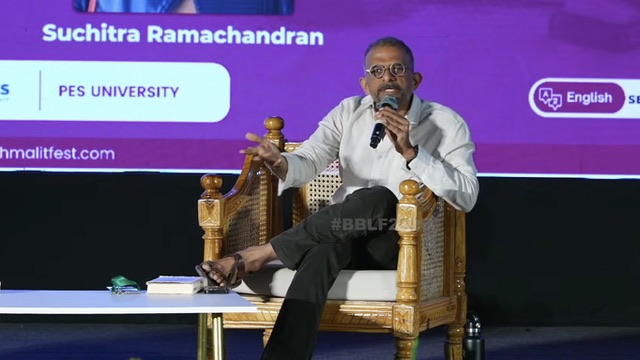
TM Krishna at the Book Brahma Literature Festival.

Synopsis: An instinctive remark describing the National Anthem as a protest song led Carnatic vocalist TM Krishna to examine his relationship with India and its national symbols in his book, We, the People of India: Decoding a Nation’s Symbols. Speaking at the Book Brahma Literature Festival, he discussed how that inquiry extends to the Constitution, citizenship and the relationship between a nation and the people from whom its symbols demand allegiance.
An instinctive remark at the Kerala Literature Festival in 2018 led acclaimed Carnatic vocalist TM Krishna to eventually examine his own relationship with India and its national symbols. The result is his book, We, the People of India: Decoding a Nation’s Symbols, published by Westland Books in January this year.
On the third and final day of the Book Brahma Literature Festival in Bengaluru on 23 August, Krishna detailed his exploration in conversation with Suchitra Ramachandran.
He recalled a conversation at the Kerala Literature Festival in Kozhikode in 2018, where he described the National Anthem as a protest song.
“While I instinctively made the remark, this led me to a deeper question as to what prompted me to make that remark [in the first place],” he said.
“There is no good answer to that question.”
The book comprises five independent essays examining the Indian flag, the National Anthem, the emblem, the motto and the Preamble.
Krishna said the essays explore the historical, cultural and philosophical roots of these symbols, while examining the political circumstances of the 20th century that shaped them and their meanings. They also examine the people who shaped the symbols, the choices they made and the reasons behind those choices.
According to Krishna, at the heart of his inquiry is the relationship between a nation and the symbols through which it represents itself.
“A nation-state is a construction done by a set of people,” he said, describing these symbols as a unifying force for India’s diverse population.
Also Read: ‘The Congress needs five or six Shivakumars’: Rasheed Kidwai on the Karnataka CM’s pan-India appeal
Another reason for writing the book, Krishna said, was his unease with contemporary India and the condition of its people.
For Krishna, the problem arises when national symbols demand subservience from citizens. He extends the same inquiry to the Constitution, which he described as more than a legal text.
“The Constitution is a cultural document, not a document of law,” he said, pointing to the foundation laid between 1947 and 1951, when India was battling abject poverty and regional and caste divisions.
Its makers, he argued, envisioned a future that went beyond the realities of their time. For him, the challenge was to turn that constitutional vision into the lived reality of India’s citizens.
The Preamble occupies a particularly important place in the book. Though it is not formally a national symbol, Krishna said he treats it as one, pointing to its emergence as a symbol of protest against the Citizenship Amendment Act.
The discussion then turned to ideas, vulnerability and the ability to change one’s ideals.
That willingness to question also informs Krishna’s approach to ideas. He said people are “too quick” these days to pick a side, and that discussions lose their nuance when ideas harden into fixed positions.
Pointing to the differing views of Gandhi and Tagore on the charkha and what it represented, Krishna said ideas, including nationalism, as reflected in Gandhi’s engagement with Ambedkar, must remain open to disagreement and change.
Changing one’s mind, in his view, does not necessarily mean abandoning conviction. What matters is whether the process through which one’s thinking evolves is marked by honesty and integrity.
“Keep doubting, keep listening and you learn,” he said. “Any thought that is hardened is not thought itself.”
For Krishna, historical figures such as Emperor Ashoka, Gandhi and Ambedkar are interesting not because of what they preached, but because their ideals and moral convictions remained in constant flux as they dealt with the vagaries of real life.
Krishna’s inquiry eventually returns to the words that give his book its title: “We, the People of India”.
He drew a parallel with the opening words of Jana Gana Mana, which he interpreted as evoking “we, the people and mind”. Krishna described it as a beautiful poem in which Tagore, in just three words, establishes the collective free will of the people.
Also Read: Doordarshan to digital: Maya Sharma on the rise of TV channels, star anchors and a reverse swing
Krishna acknowledged that those involved in shaping the Constitution came disproportionately from privileged sections of society. Yet, he argued, the constitutional vision that emerged attempted to imagine a far more inclusive society.
But belonging, for him, cannot end with citizenship as defined by a document. The idea of “we”, Krishna suggested, must ultimately expand towards the possibility of coexistence.
He invoked BR Ambedkar’s term maitreyi, or a relationship with all living beings, calling it a “brilliant term” and suggesting that this was how a society must aspire to be.
Krishna’s book, therefore, does not offer definitive answers. Instead, his inquiry asks whether the meanings attached to India and its national symbols can remain alive — open to interpretation, disagreement and change.
For him, the moment an idea becomes incapable of being questioned, it ceases to remain an idea at all.
“Any thought that is hardened is not thought itself.”



