

Published Oct 14, 2026 | 9:00 AM ⚊ Updated Oct 14, 2026 | 9:00 AM

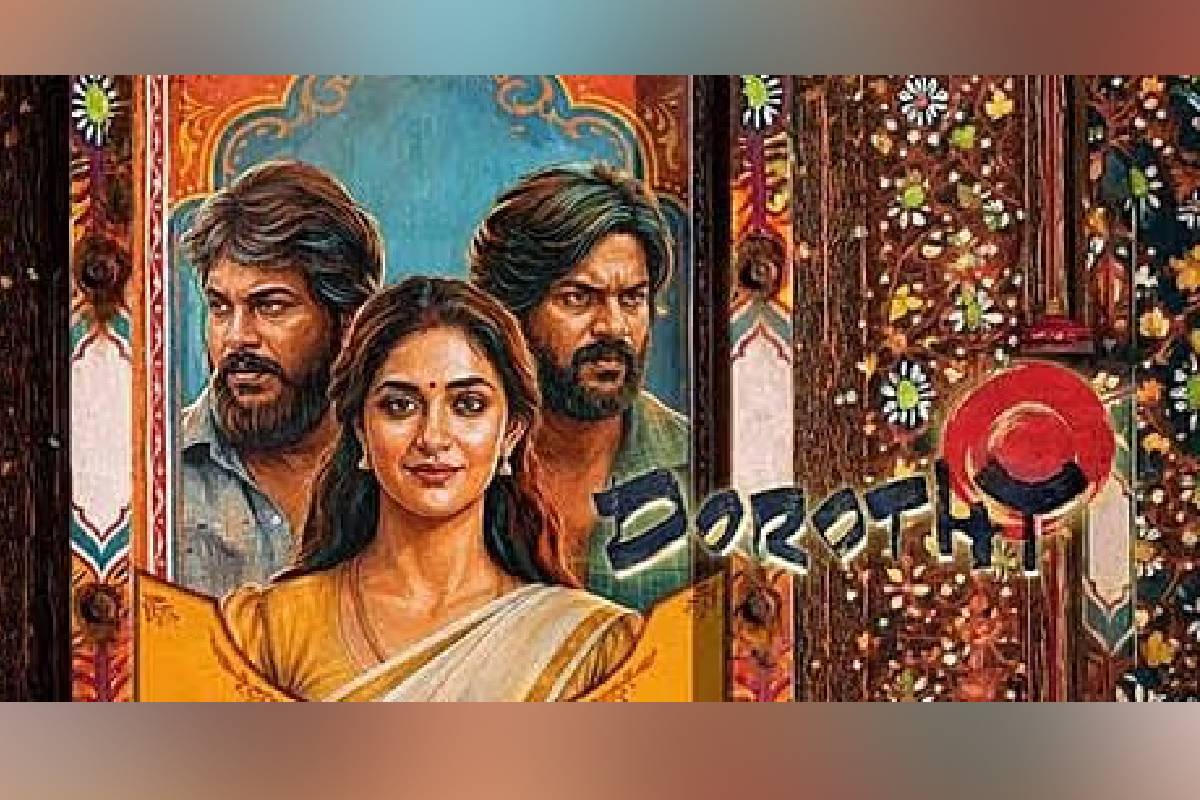

Synopsis: Karthik Subbaraj-directed Tamil film Dorothy asks an uncomfortable question: how can someone challenge caste discrimination while still reproducing the prejudices of a patriarchal society? What happens when friendship across caste boundaries is accepted, but love that challenges gender expectations becomes intolerable? And what does it reveal about our progressiveness when our principles falter at the point where they demand that we change ourselves?
“The first act of violence that patriarchy demands of men is not violence toward women. Instead, patriarchy demands of all men that they engage in acts of psychic self-mutilation.”
— bell hooks, ‘The Will to Change: Men, Masculinity, and Love‘.
The recently released Tamil film Dorothy, directed by Karthik Subbaraj, explores the violence of patriarchy — not only against women and those who challenge society’s prescribed gender boundaries, but also within men themselves.
Through the intertwined forces of caste, class, gender and family, the film examines how social hierarchies shape our relationships, identities and understanding of one another.
At its heart, Dorothy asks an uncomfortable question: how can someone challenge caste discrimination and yet reproduce the prejudices of a patriarchal society? What happens when friendship across caste boundaries is accepted, but love that challenges gender expectations becomes intolerable? And what does it reveal about our progressiveness when our principles falter at the point where they demand that we change ourselves?
These contradictions become visible in the film’s everyday relationships.
When the parotta shop owner thinks of Subbu, who has been coming to his shop since childhood, he breaks down in tears. His grief reveals an affection that has grown beyond formal family ties. But even in his grief, he remains bound by the rules of the world he inhabits, advising Karthi to consider euthanasia as an act of mercy. Elsewhere, a gangster from a world of violence asks Karthi, “Who are we to decide who should live? Are we God?”
Through such characters, Dorothy examines how caste, patriarchy and gender shape not only the lives people are permitted to lead, but also the ways they learn to think, love and judge one another. Its most unsettling argument is that discrimination can survive even within people who believe they have rejected it.
Also Read: Daughters inherit, but men decide: Meghalaya’s unique matrilineal paradox
The first half of Dorothy explores a familiar contradiction in Tamil society: friendships across caste boundaries may be tolerated, but relationships that threaten caste endogamy are treated differently.
People may share meals, visit one another’s homes and form close friendships across caste lines. Such relationships can even become evidence of one’s progressiveness. Yet, when intimacy threatens the caste boundaries preserved through marriage and family, the limits of that progressiveness become visible.
Karthi challenges caste discrimination. He asks why people consider their caste superior and treat others differently. But when Subbu embraces her identity as a transgender woman, Karthi reacts with disgust and struggles even to tolerate her touch.
The contradiction is central to the film. The same person who questions caste prejudice can reproduce the rigid gender expectations of the society he criticises. His acceptance of Subbu has limits: he can be her friend, but her transformation unsettles his understanding of masculinity and their relationship.
If Subbu and Karthi had remained friends, their relationship might have continued within the familiar boundaries of social acceptance. The difficulty arises when their bond moves towards love. Just as caste-crossing friendship may be tolerated until marriage becomes a possibility, affection towards someone who challenges conventional gender expectations exposes prejudices that people may not even recognise in themselves.
By leaving the characters’ caste identities unnamed while letting the hierarchy emerge through social cues, Karthik Subbaraj helps the audience recognise how caste operates without always being spoken aloud. The film exposes the distance between opposing discrimination in principle and confronting it when it demands change in one’s own life.
B.R. Ambedkar’s argument that caste depends on endogamy is crucial here. In ‘Castes in India: Their Mechanism, Genesis and Development’, he examines how marriage regulation sustains caste boundaries. Caste is not merely a matter of social distance; it is reproduced through control over intimacy, marriage and lineage.
Dorothy extends this argument to gender. The question is not simply whether Karthi can accept Subbu. It is whether he can unlearn the ideas of masculinity through which he has learnt to judge her.
In ‘The Will to Change: Men, Masculinity, and Love’, feminist writer bell hooks examines how patriarchy demands psychological violence from men themselves. Its expectations require them to suppress vulnerability, reject femininity and treat emotional openness as a threat to their masculinity.
This conditioning shapes Karthi’s journey. His discomfort with Subbu is not an isolated reaction; it connects to a social order that teaches men which bodies they may accept, which forms of affection they may express, and which identities they must reject. His transformation requires more than accepting someone else’s identity. He must confront the rules that have shaped his own.
This is where Dorothy becomes more than a story about love overcoming prejudice. Love creates the possibility of change, but it does not automatically erase discrimination. Karthi must recognise the prejudice within himself before he can move beyond it.
Also Read: How Shivani Sibal’s ‘Moms’ reveals the cracks in a perfect life and the anxiety of elite motherhood.
The film’s critique sharpens when it turns to the family, an institution often treated as sacred and beyond scrutiny. Beneath its language of love, protection and honour lies a system that can preserve caste, property and lineage by regulating individual choices.
Ambedkar’s observation that caste cannot sustain itself without endogamy helps explain why women’s sexuality and marriage choices become central to caste preservation. Feminist historian Uma Chakravarti’s concept of ‘Brahmanical patriarchy’ similarly examines how caste and gender hierarchies reinforce one another, placing particular burdens on women to maintain the caste boundaries.
In Dorothy, the family is not always a refuge from social violence. It can become the institution through which that violence is enforced.
The deaths of Whistle Viraiya’s wife and teenage daughter, both associated with a well, cast a disturbing shadow over his household. The film does not fully establish the circumstances of their deaths, leaving the audience to confront the possibility of violence concealed beneath the language of family honour. Their stories point to a world where women’s lives and choices can be subordinated to male authority and the preservation of social standing.
The well carries another, equally unsettling meaning. Associated with the deaths of women, it also becomes a space where Subbu can explore and express her femininity. For Subbu, a place marked by the possibility of destruction becomes a place of self-recognition.
The contradiction captures the film’s larger argument: the same social order that punishes women for crossing prescribed boundaries also denies transgender people the freedom to inhabit their identities. The forms of oppression are not identical, but they emerge from a system determined to regulate gender and control those who refuse its definitions.
The male-dominated household extends this idea. It begins to resemble a graveyard of women’s possibilities, where masculinity maintains its authority by suppressing femininity. When someone raised in this household embraces a feminine identity, the family’s claim to unquestioned authority is challenged.
The violence is therefore not only what men do to women or transgender people. It is also the violence patriarchal expectations inflict on men who are taught that their worth depends on conformity. The family demands obedience in the name of honour, even when that obedience requires a person to erase a part of themselves.
Also Read: The stones that remember: Elgandula and the birth of modern Karimnagar
Against this oppressive structure, Dorothy places the instinctive affection of Karthi’s mother, who belongs to an oppressed-caste family. Her response to Subbu contrasts sharply with the judgement and exclusion practised elsewhere.
When Subbu embraces her identity as a woman, Karthi’s mother tells her, “Amma kitta vandhirukkalaam la, saami (you could have come back to your mother, dear.)”
The tenderness of the moment lies in what she does not demand. She does not ask Subbu to justify her identity or explain why she has departed from society’s expectations. She simply offers affection. In a film where belonging is repeatedly made conditional on caste, gender and family honour, her response suggests another basis for kinship: care rather than conformity.
This character’s significance goes beyond individual kindness. The film subtly shows how a dominant social order can shape the consciousness of people it oppresses. Caste and patriarchy do not operate only through those who hold the most power; their assumptions can be absorbed and reproduced by those lower down the hierarchy, too.
Yet Dorothy refuses to suggest that everyone living within an oppressive structure must reproduce its prejudices. Women repeatedly create the emotional space in which Subbu can explore her identity.
Subbu’s school friend Thanam, who has experienced oppression herself, gives Karthi the bangles from her own hands and asks him to pass them on to Subbu. The gesture is small but deeply significant: she offers something personal to affirm a woman who is being denied the freedom to live openly.
Keerthi, who appears as Dorothy, offers Subbu another kind of recognition. Quiet and gentle, she gives Subbu the space to speak about her identity without immediate judgement. When she kisses Subbu on the forehead, the gesture affirms her without demanding an explanation.
These women do not erase the violence of the world around them. They create moments in which its rules can be refused. Their solidarity shows that people can challenge the prejudices of the very structures in which they live.
Also Read: Tools that enslave: Ivan Illich’s questions for India
The film’s tenderness does not guarantee Dorothy’s safety. Dorothy enters a world dominated by men, and her eventual death leaves the audience confronting the limits of affection in a society organised around power.
The film does not explicitly establish how she dies. Viewers may suspect that the men around her are responsible, or that she becomes a victim of Whistle Viraiya’s sexual desire, but the circumstances remain unresolved. The uncertainty is disturbing because it leaves open several forms of violence to which a transgender woman may be exposed.
The sequence’s theatrical intensity makes that vulnerability hard to ignore. The question is not simply who caused Dorothy’s death, but what kind of social world makes such a fate imaginable.
Dorothy’s kiss on Subbu’s forehead offers recognition and tenderness. Karthi’s kiss on Subbu’s lips signals a different kind of transformation: a movement away from the rigid codes of masculinity that once made Subbu’s identity repellent to him.
Neither gesture resolves the contradictions the film exposes. Instead, they show what becomes possible when a person begins to see beyond society’s imposed boundaries.
The film’s other characters deepen this moral complexity. The shopkeeper’s grief reveals affection constrained by the rules of the system. The gangster’s question challenges the presumption that anyone has the right to decide who deserves to live. Thanam’s solidarity offers a counterpoint to society’s exclusion.
Together, these characters prevent Dorothy from dividing its world neatly into good and evil. People carry their own contradictions, and even those who participate in an unequal social order can recognise its cruelty. The challenge is whether that recognition can lead to a refusal of the rules that sustain it.
Also Read: When a language fights to avoid being eaten: The Tulu lesson for India
Any discussion of Dorothy would be incomplete without Ilaiyaraaja’s music. His compositions do more than accompany the images; they give emotional expression to experiences that the characters struggle to articulate.
The placement of Muthumanicharam is particularly powerful. Its lyrics invoke ‘Mathangi’, ‘Maragathamani’, ‘Meenakshi’ and ‘Kamatchi’, names associated with the feminine divine. The song becomes a celebration of transgender womanhood, allowing Subbu’s identity to occupy an emotional and cultural space from which society often excludes it.
For transgender women who have claimed songs written for and about women as expressions of their own identities, this moment carries a particular resonance. The song does not merely place Subbu in the film’s emotional world. It allows her to inhabit that world on her own terms.
Music changes how we experience an image. In Dorothy, Ilaiyaraaja’s compositions lend tenderness to vulnerability and give shape to unspoken longing. The violence on screen is undeniable, but the emotional atmosphere created by the performances, screenplay, and music often stays with us most insistently.
Sananth’s performance is central to this effect. His portrayal traces Subbu’s journey through gestures, posture, and body language: femininity surfaces even when Subbu tries to conceal it, and the effort to suppress it shows in the smallest moments. The shift when Subbu sees her father, the everyday gestures that reveal her identity, and Dorothy’s eventual emergence give the character emotional continuity beyond dialogue.
Rishikanth’s portrayal of Karthi must carry a different burden: the gradual unravelling of a masculinity he has taken for granted. The film’s emotional power depends on the tension between these two journeys — one towards self-recognition, the other towards the difficult recognition of another person.
Ilaiyaraaja’s music binds these experiences together. Muthumanicharam becomes more than a song placed at an important moment; it offers an emotional language for a person struggling to find companionship and acceptance. As the film’s questions linger, How to Name It seems to give that accumulated feeling wings.
Also Read: Free to think? When public universities lose their freedom
Dorothy asks uncomfortable questions about the boundaries of progressive thought. Why can someone challenge caste discrimination yet reproduce gender prejudice? Why is the family’s honour treated as more important than an individual’s dignity? And why does a person’s refusal to conform become a threat to the people who claim to love them?
The film does not treat caste, patriarchy and gender as interchangeable forms of oppression. Each has its own structures and consequences. But it shows how they intersect in the regulation of belonging: who may enter a family, whose identity may be recognised, whom one may love and what happens when someone refuses the role assigned to them.
Its most important question is not whether love can overcome every boundary. It is whether we are willing to examine the prejudices that make those boundaries seem natural in the first place.
Friendship may bring people close to caste limits. Love may give them the courage to cross gender boundaries. But neither can replace the harder work of confronting the beliefs inherited from family and society.
The shopkeeper’s grief, the mother’s embrace, Thanam’s bangles and Dorothy’s kiss offer different glimpses of affection beyond prescribed roles. The tragedy surrounding them reminds us that such moments of tenderness cannot, on their own, dismantle the structures that threaten them.
Ultimately, Dorothy asks us to imagine a world in which belonging does not require obedience, love does not demand the erasure of identity, and the preservation of caste or family honour is never valued above a person’s right to live with dignity.
The first step towards that world is not simply learning to love someone different from us. It is unlearning the hierarchies that taught us to see them as different in the first place.
(Edited by Fayisa CA).



