

Published Oct 19, 2026 | 7:19 PM ⚊ Updated Oct 19, 2026 | 7:19 PM

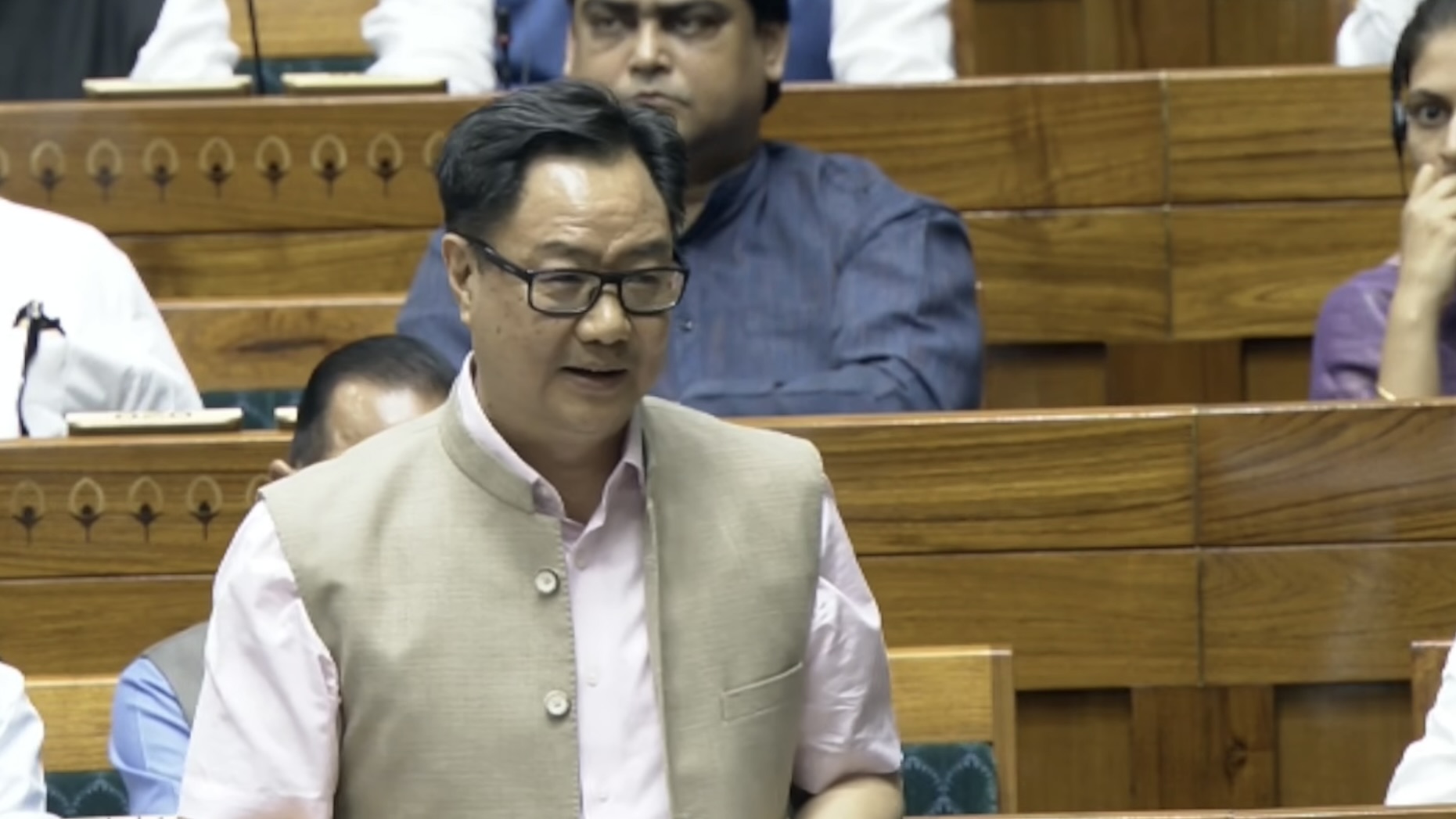
Parliamentary Affairs Minister Kiren Rijiju.

Synopsis: Union Parliamentary Affairs Minister Kiren Rijiju has said the government held consultations with several Opposition parties outside the NDA, including the DMK on the proposed Delimitation Bill and the 131st Constitution Amendment Bill. Rijiju also defended the decision not to prorogue Parliament after the Monsoon Session was adjourned sine die on 13 August, saying there was no constitutional requirement to do so within a specified period.
The Union government held consultations with Opposition parties outside the National Democratic Alliance (NDA), including the DMK, Samajwadi Party, YSR Congress Party, Nationalist Congress Party, Shiv Sena (Uddhav Balasaheb Thackeray), All India Majlis-e-Ittehadul Muslimeen and Biju Janata Dal, on the proposed Delimitation Bill and the 131st Constitution Amendment Bill, Union Parliamentary Affairs Minister Kiren Rijiju has said.
In a letter to Congress president Mallikarjun Kharge on Monday, 19 October, Rijiju said the consultations were held with a “view to facilitating dialogue and building a broader consensus in support of the proposed legislation”. The letter responded to Kharge’s representation to Prime Minister Narendra Modi seeking an all-party meeting to discuss the contentious Bills, which are expected to be reintroduced when Parliament reconvenes.
The Constitution (131st Amendment) Bill, 2026, was introduced in April alongside the Delimitation Bill, 2026, and the Union Territories Laws (Amendment) Bill, 2026. The government said the Bills were intended to expedite the implementation of 33 percent reservation for women in the Lok Sabha and State Assemblies.
Opposition parties criticised the proposed legislation, arguing that the delimitation exercise could reduce the parliamentary representation of southern States under the guise of implementing women’s reservation.The DMK has been among the most vocal critics of the proposed bills.
The Constitution Amendment Bill failed to secure the required two-thirds majority in the Lok Sabha, following which the government withdrew all three Bills.
Rijiju asserted that the government had no reason to convene another all-party meeting, asserting that it had repeatedly approached the Congress, the principal Opposition party, for cooperation on the proposed legislation.
“Government has reached out to the Congress Party being the principal Opposition party on several occasions. I wrote to you on 16 March 2026, 26 March 2026 and 12 April 2026 in this regard. Besides these written communications, I had also discussed the matter with you personally and sought your support and cooperation. During the Monsoon Session, I also met Shri Rahul Gandhi, Leader of Opposition in Lok Sabha personally for discussion and sought his cooperation on this subject,” he wrote.
“However, after repeated requests the Congress Party didn’t give dates for discussion after which the Government’s outreach had extended to other political parties.”
Rijiju said the government remained willing to consult all parties and engage with them in Parliament.
“These efforts reflect the Government’s firm willingness to undertake consultation and constructive parliamentary engagement. I reiterate that the Government remains committed to the basic principles of parliamentary democracy and to facilitating meaningful dialogue through the effective functioning of Parliament,” he wrote.
“We value the participation of all political parties in deliberations and discussions on all matters of national importance. I also hope that Congress Party will play a constructive role and will not obstruct important future legislations.”
Also Read: Democracy’s shame: Delhi Police’s violence reverberates across India
Rijiju also defended Parliament’s not being prorogued in the 64 days after the Lok Sabha was adjourned sine die on 13 August, saying there was “no constitutional requirement” to do so within a specified period after such an adjournment.
“The mere fact that a House has not been prorogued during such an interval does not, by itself, give rise to any constitutional or procedural impropriety or irregularity. There have been innumerable instances in the past in which Houses remained unprorogued (sic) for long periods, extending up to 87 days. In 2008, the Lok Sabha sat for two days, on 21 and 22 July, for the confidence motion; the House was then kept unprorogued, reconvened on 17 October 2008, and was adjourned on 24 October to meet again on 10 December,” he said.
“There are several other such instances: 1987 (76 days), 1989 (54 days), 2006 (49 days), 2013 (49 days) and 1963 (41 days).”
The Lok Sabha met for just three minutes and 40 seconds on the final day of the Monsoon Session, before Speaker Om Birla adjourned the House sine die, drawing the curtain on one of the stormiest sessions the incumbent NDA government has faced since it came to power in 2014.
(Edited by Dese Gowda)



