

Published Aug 08, 2026 | 1:07 PM ⚊ Updated Aug 08, 2026 | 1:09 PM

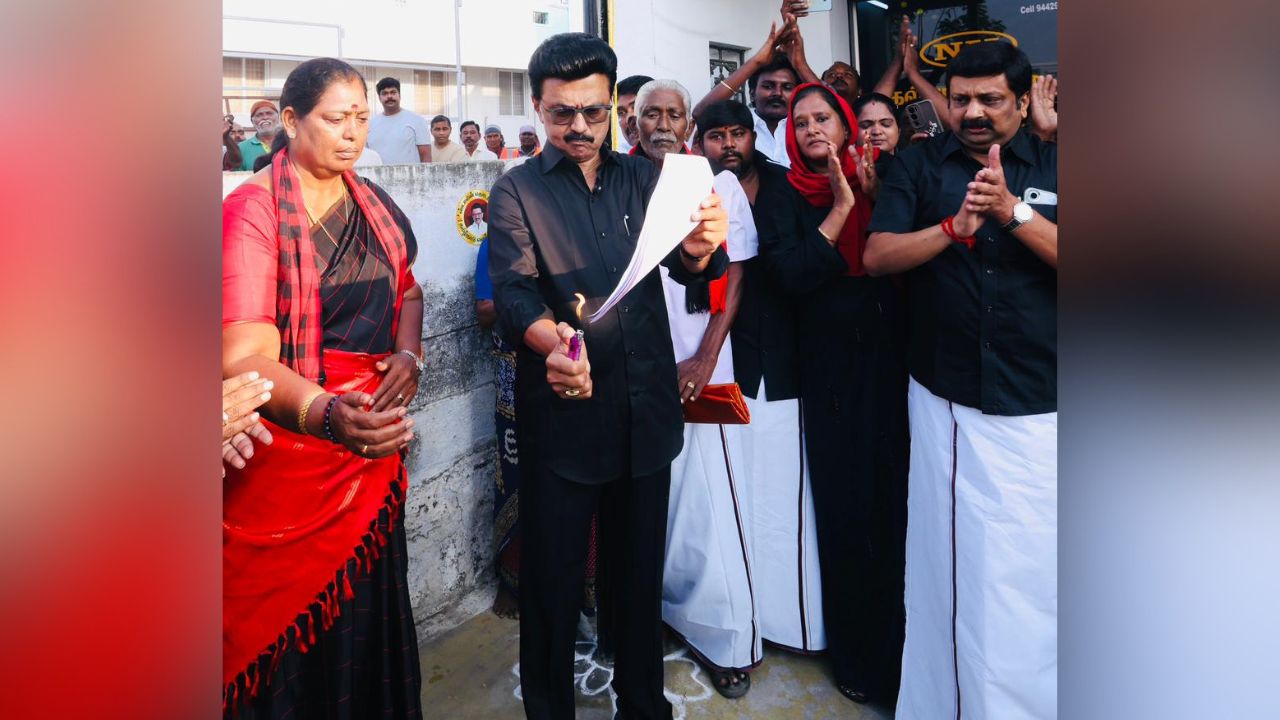
Then Tamil Nadu Chief Minister MK Stalin seen burning a copy of the delimitation Bill. (File Photo | Special Arrangement)

Synopsis: The Tamilaga Vettri Kazhagam (TVK) government’s first consultation on parliamentary delimitation has triggered a political confrontation even before the Union government has introduced a revised Bill. What drove the state’s two principal opposition parties, the DMK and the AIADMK, to boycott it? And has the DMK’s stand changed?
The Dravida Munnetra Kazhagam and the All India Anna Dravida Munnetra Kazhagam, the two principal opposition parties in Tamil Nadu, will boycott the all-party meeting of Members of Parliament convened by Tamil Nadu Chief Minister C Joseph Vijay on August 8 to discuss the Union government’s proposed delimitation exercise.
This comes amid mounting speculation that the DMK may eventually support the delimitation legislation proposed by the BJP-led Union government. The opposition parties’ decision to boycott the meeting has only added fuel to the speculation.
But what exactly is the DMK’s position? If the Union government introduces a delimitation Bill in Parliament, will the DMK support it?
Deputy General Secretary and Member of Parliament Kanimozhi Karunanidhi stated that the party’s position on delimitation has not changed and that it had valid reasons to boycott the meeting.
“As far as delimitation is concerned, the DMK’s earlier stand remains unchanged. There is nothing further to discuss on this issue. Under the guise of a consultation meeting for Members of Parliament, the TVK government is staging a political drama, and the DMK will not participate in it,” she said.
Kanimozhi further reminded that it was former Chief Minister MK Stalin who had first raised the alarm over the dangers posed by the proposed delimitation exercise. According to her, Stalin united Chief Ministers from several states and spearheaded a strong movement against the proposal. She also claimed that when the BJP attempted to introduce a related Bill in Parliament during the elections, the opposition fought against it and ensured that the legislation was not passed.
Kanimozhi pointed out that there is currently no indication that the Union government intends to pass a delimitation law during the ongoing Parliament session, nor has any revised draft legislation been circulated.
She recalled the resolutions passed at the all-party meeting held in Tamil Nadu and reiterated the following demands:
Kanimozhi questioned the necessity of another consultation when all the parties that participated in the earlier all-party meeting, including the Communist parties, the Indian Union Muslim League, Viduthalai Chiruthaigal Katchi and the Congress, continue to adhere to the same position.
“After these resolutions have already been unanimously adopted and communicated, what is the purpose of convening another consultation? Is this meeting being held to persuade these parties to change their stand?” she asked.
She also criticised the TVK government for not convening an all-party meeting on the Mekedatu dam issue despite repeated demands from various political parties, even as protests over the Cauvery water dispute continue across Tamil Nadu. Citing this as another reason, she reiterated that the DMK would not participate in the August 8 consultation.
When contacted, an AIADMK Member of Parliament, speaking on condition of anonymity, said that if the government intended to convene an all-party meeting, invitations should have been formally addressed to the leadership of each political party.
“The party leadership decides whether to attend such meetings and determines the issues to be raised. However, invitations for this meeting were sent directly to Members of Parliament instead of the party leadership. Therefore, we will not be participating. An official announcement will also be issued shortly,” the MP said.
Responding to questions about the party’s stand, senior DMK leader and party spokesperson TKS Elangovan echoed Kanimozhi’s views and said that the DMK’s demand has always been for “Fair Delimitation.”
“As far as we are concerned, our demand is for Fair Delimitation. Delimitation has to be carried out as mandated by the Constitution. But it must be conducted fairly. The rights of the southern states should not be taken away. Until an appropriate framework is evolved to ensure that, the exercise should continue to be based on the 1971 Census,” he said.
“Let the Union government first table the Bill in Parliament. Only after examining what has actually been proposed can anyone make a decision,” Elangovan went on to add.
From political leaders to discussions on social media, allegations have been made that the DMK, after opposing delimitation earlier, is now preparing to support the BJP-led Union government’s proposal.
The debate intensified after senior Congress leader Rahul Gandhi visited Chennai recently to participate in a party meeting.
Speaking at the event, Rahul Gandhi said, “Those who support the proposed delimitation exercise are betraying Tamil Nadu. They are the Ettappans of the 21st century.”
His remarks were widely interpreted as being directed at the DMK.
A closer examination of the DMK’s documented position, however, supports what Elangovan and Kanimozhi said.
The DMK has never officially demanded “No Delimitation.” Instead, its consistent position has been one of “Fair Delimitation.”
This position is reflected in two major initiatives undertaken by the party:
The Chief Ministers’ conference on March 22, 2025, had brought together Chief Ministers from the southern states, the Chief Minister of Punjab, and several prominent national and regional opposition leaders.
Convened under the leadership of then Tamil Nadu Chief Minister MK Stalin, the meeting adopted several significant resolutions on the proposed delimitation exercise.
The major resolutions adopted by the Joint Action Committee (JAC) on Delimitation were:
Significantly, even at this conference, the demand wasn’t “No Delimitation.” Instead, the emphasis was firmly on “Fair Delimitation.”
The High-Level Committee on Union-State Relations, constituted by the previous DMK government, also devoted extensive attention to parliamentary delimitation and made several far-reaching constitutional recommendations.
According to the committee, the proposed post-2026 delimitation exercise raises serious constitutional and federal concerns.
It observed that while the Delimitation Commission’s orders have the force of law, the Commission itself is an unelected body that functions with very little executive or legislative oversight.
Since its decisions are also subject to only limited judicial review, the committee argued that the present framework raises important questions about democratic accountability.
The report further noted that lifting the freeze on the inter-state allocation of Lok Sabha seats while Total Fertility Rates (TFRs) continue to differ significantly across states would fundamentally alter India’s federal balance.
States that successfully implemented the Union government’s population-control policies would end up losing parliamentary representation, while states with higher population growth would gain additional seats.
Referring to the constitutional intent behind the 42nd, 84th and 87th Constitutional Amendments, the committee argued that the existing freeze on the inter-state allocation of Lok Sabha seats should be extended until 2126 as a long-term constitutional settlement.
At the same time, it recommended that periodic delimitation and boundary readjustments within individual states should continue whenever necessary.
Ultimately, the political debate over delimitation is unlikely to be settled until the Union government places a revised Bill before Parliament. Only then will it become clear whether the amendments and safeguards sought by the DMK and other opposition parties have been incorporated. Going by the DMK’s stated position, there is little chance of the party supporting the Bill otherwise.
The same question also confronts the ruling Tamilaga Vettri Kazhagam (TVK). The Vijay-led government needs to decide if it will endorse and pursue the recommendations made by the Justice Kurian Joseph Committee on Union-State Relations.
Also Read:
Delimitation, democracy and federal balance: An Ambedkarite view from the South
Delimitation and South India’s compulsions: Not wrath, but a test of federal maturity
(Edited by R Rajesh Kumar.)



