

Published Jun 18, 2026 | 12:46 AM ⚊ Updated Jun 18, 2026 | 12:46 AM

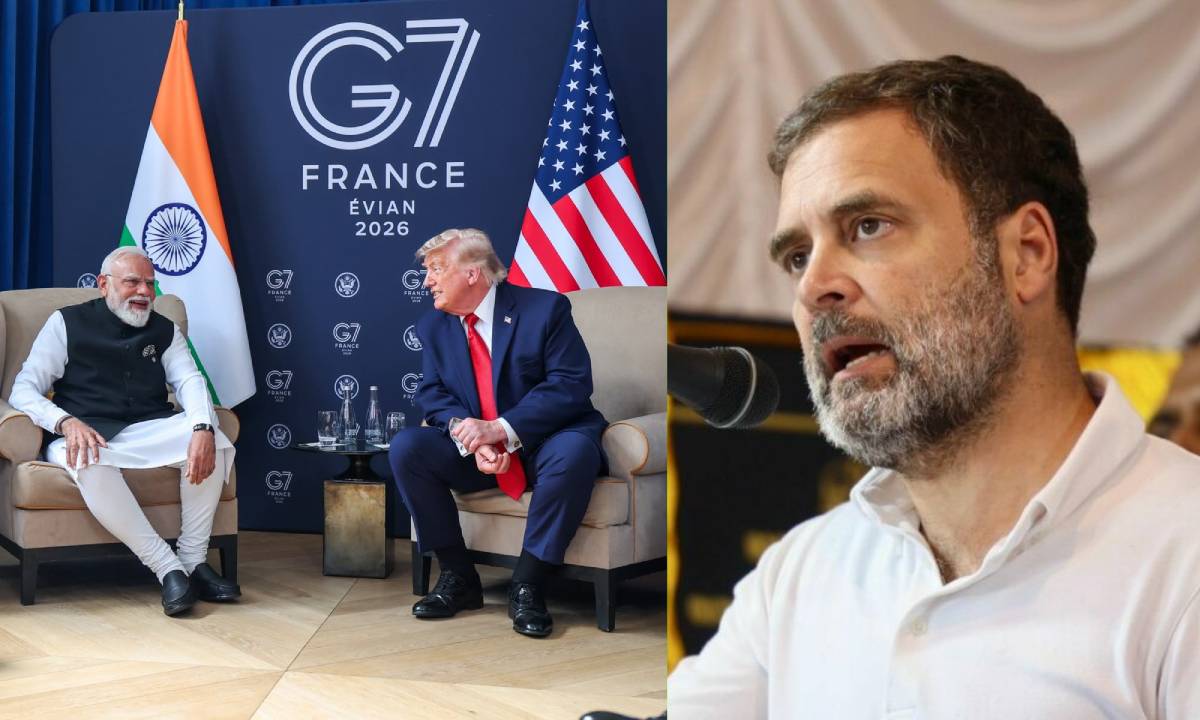
Prime Minister Narendra Modi held talks with US President Donald Trump in Évian-les-Bains, France; Rahul Gandhi launched an outreach programme at Kota

Synopsis: Two events, two leaders, miles apart. One on a diplomatic mission, the other on a campaign trail to highlight the cause of students in India. One is called ‘cool’ and ‘a killer’ as an eerie silence remains on Indian sailors killed by US armed forces, while the other hears the woes of students and parents seeking accountability for student suicides.
The bonhomie between US President Donald Trump and Indian Prime Minister Narendra Modi looked intact as the two leaders met face-to-face after 16 months on the sidelines of the G7 Summit in Évian-les-Bains, France, on Wednesday, 17 June. Ironically, even as Trump heaped praises on Modi, an eerie silence lingered around questions about the US armed forces killing three Indian sailors last week.
Thousands of miles away, back home in India, deaths of other Indians — students who have died by suicide over NEET exam mishandling — were highlighted at LoP Lok Sabha Rahul Gandhi’s campaign in Kota.
Much water has flown down to the River Rhone from the Lake Geneva — upon which the holiday resort and spa town Évian is located — during the 16 months which saw disagreement on an array of issues, including trade, tariffs, immigration policies, and strategic priorities, besides a very recent incident in which three Indian sailors were killed in a US attack on an unarmed commercial vessel, MT Settebello, near the volatile Strait of Hormuz.
The meeting reportedly glossed over the attack and the loss of Indian lives as the two leaders talked on the proposed India-US trade agreement, which Trump later said was nearing a breakthrough.
Trump did not leave the opportunity to praise Modi’s negotiation skills. “We’ve been there for a little while, and he’s a very tough negotiator, one of the toughest, actually,” he told reporters.
“He looks like an angel, but actually, he’s as tough as a killer,” the US President echoed what he had said about Modi at the Summit: “Calm, cool and a total killer!”
Trump’s characteristic colourful description of Modi was not missed. Nor were his words about India.
He also highlighted India’s growing strategic importance and reaffirmed the US’s support for New Delhi. Trump emphasised the close relationship between the two leaders and signalled Washington’s willingness to stand by India during times of crisis.
Also Read: US CENTCOM justifies deadly attack on Settebello
The US president, in fact, broached the topic of Indian sailors separately. Speaking to reporters — who raised the issue — on the sidelines of the Summit, he said the mariners have a rough profession.
He was asked whether he had a message for the victims’ families. “Yeah, I do,” he said, adding that he “loves all those people” working in maritime trade.
“I heard about the Indian sailors. It’s a rough profession. We love all those people,” Trump said.
There was no apology for the incident. Neither Trump’s love nor an apology will bring back what three bereaved Indian families will miss for the rest of their lives. Interestingly, PM Modi maintained a stoic silence over the matter.
However, Trump was not short of praise for Modi. “India has a big role in West Asia as long as Prime Minister Modi is the leader, he said, in response to the Indian leader’s emphasis on the need for peace, stability and uninterrupted maritime trade routes, including the vital Hormuz.
Miles away across the ocean in Modi’s homeland, things were not as sweet or light for him as President Trump’s praises. In India, Gen Z has started speaking up, and the many palaces and gardens in Rajasthan’s Kota reverberated with their voice on Wednesday.
The youngsters were raising concerns over what they and the country need the most: education and opportunities.
Also Read: Will bringing education back on State List end NEET-linked suicides?
The Indian education system has been seeing unprecedented scenes of late. A highly tough and professional examination will be conducted under military-grade security, and memories of a war-like scenario have been evoked when the government put a temporary ban on Telegram to conduct the NEET (UG) re-test.
Indian teens punched holes in the CBSE’s ‘fool-proof’ systems, exposing an apparent ill-thought-out examination and evaluation process that put lakhs of students into hardship.
There have been no apologies from the ruling dispensation at the Centre for these gaffes that have even pushed a few students to death.
Against this backdrop, Leader of the Opposition in the Lok Sabha Rahul Gandhi launched a nationwide campaign on Wednesday. Rajasthan’s Kota hosted the campaign’s first mega rally, ‘Chhatron Ki Goonj Maha Rally‘.
Also Read: India’s exam system has reached a breaking point
India’s education system is putting pressure on children, stresses them and crushes them, Gandhi said in Kota, where the state government had allegedly tried to scuttle the Congress party’s launch of the nationwide student outreach programme.
Gandhi clarified the purpose of the rally at the outset. “This is not a political meeting. This meeting is about you, the young people struggling to get a future,” he explained, outlining the daily challenges of students across the country.
On stage with him were three girls and two boys, NEET, JEE and civil services aspirants. They represented the “stressed and crushed” student community.
The BJP, however, had a different optics on the rally. The campaign, the party alleged, would distract aspirants preparing for examinations. The country’s biggest coaching hub, Kota, has about 1.2 lakh students from across India, preparing for competitive exams.
Gandhi spoke about the future plans of the students, the reasons for preparing for exams, their aspirations and the financial burden of preparing for tests.
On Tuesday, he had emphasised the Centre’s fundamental responsibility in securing the future of the youth. Addressing young and Gen Z friends on X, he said, “Securing the future of every young Indian is the government’s responsibility. Yet, both responsibility and integrity are concepts alien to the Modi government”.
Also Read: Babus must be held accountable too
Launching a broadside at the Union government from Kota, Gandhi said students and their families were spending enormous amounts on competitive examinations while receiving little assurance of quality education or employment in return.
He claimed that families of NEET aspirants collectively spent around ₹1.32 lakh crore annually on coaching and related expenses. He said the amount was comparable to the Centre’s education budget.
Going further, he cited figures spent on preparing for five major examinations, SSC, UPSC, RRB, JEE, and NEET. He claimed students spent nearly ₹3.5 lakh crore annually — expenditure equivalent to the combined budgets allocated to five central ministries dealing with women and child development, labour, education, health and science.
Gandhi questioned whether the existing expensive model created opportunities for young Indians. The education system limited career choices, constraining students to pursue only a handful of professions.
Also Read: NEET leakage: Are authorities endorsing systemic failure?
An emotional moment came when he held up on stage the death note of a NEET aspirant.
“This is not good for the country. I want all of us to work together to ensure that no student in this country ever feels what this girl felt,” he said, referring to NEET aspirant Akanksha Chaturvedi, who died by suicide after the NEET (UG) 2026 paper leak.
Akanksha had aspired to become a doctor, but the system crushed her. No one apologised for the failure that took her life.
Gandhi further said students should not be made to feel responsible for systemic failures. He called for the creation of an environment conducive for the youth to pursue their dreams without fear or pressure.
The Congress leader also listened to students and parents who met him during the rally.



