

Published May 14, 2026 | 6:57 PM ⚊ Updated May 14, 2026 | 6:57 PM

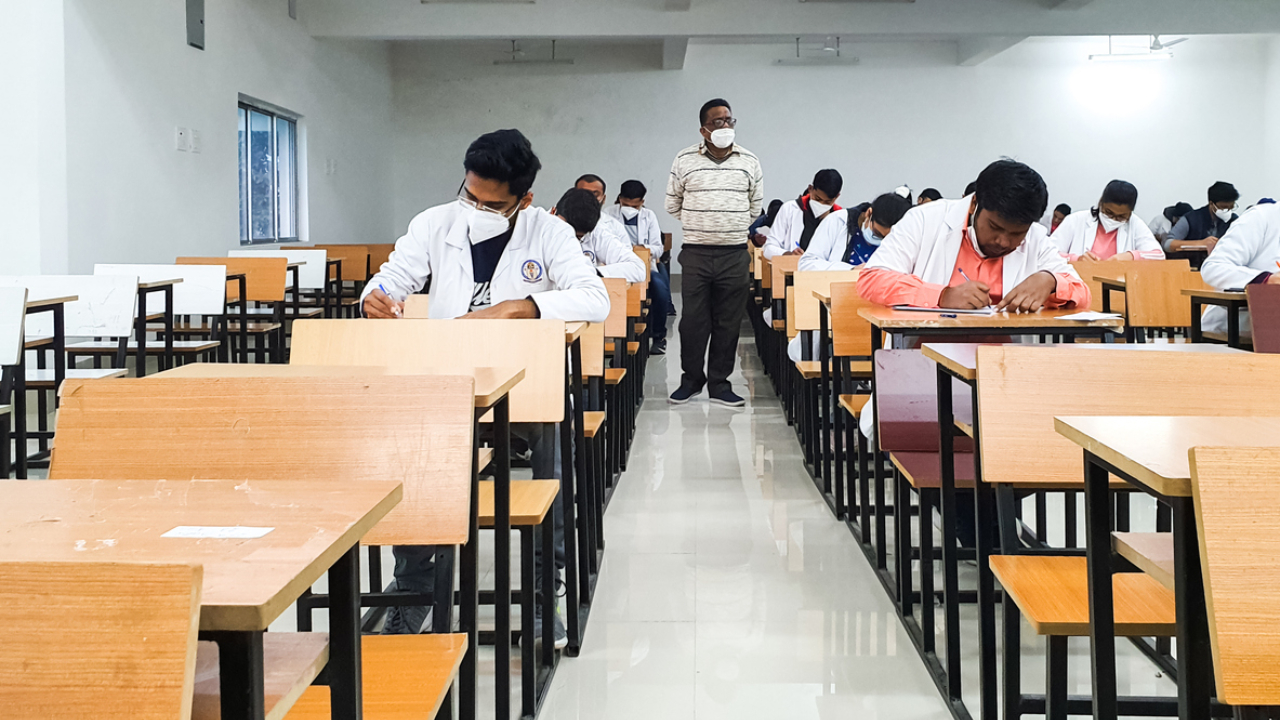
NEET alone determines entry into over one lakh MBBS seats, over 27,000 dental seats and thousands of allied medical seats.

Synopsis: When the futures of millions depend on a single examination conducted on a single day, one operational breach is enough to create nationwide disruption. A paper leak is no longer a local malpractice issue. It becomes a national credibility crisis.
On 3 May, more than 22 lakh students across India appeared for NEET UG-2026, making it one of the largest entrance examinations in the world. Nine days later, the examination was cancelled following allegations of a paper leak, with the CBI taking over investigations into what officials described as an organised interstate racket.
For India’s students, this was not merely an administrative disruption. It was the collapse of certainty around one of the country’s most consequential examinations.
The scale of India’s examination ecosystem is unprecedented. NEET alone determines entry into over one lakh MBBS seats, over 27,000 dental seats and thousands of allied medical seats across the country. Each year, lakhs of families spend significant portions of their income on coaching, relocation, accommodation, test preparation, and repeat attempts.
According to estimates from multiple industry reports, India’s test preparation and coaching economy is already valued at well over ₹60,000 crore and continues to grow rapidly.
The consequences of failure in such an ecosystem are no longer academic alone. They are social, financial, and psychological.
Also Read: NTA has failed students once too often
Over the last decade, India has steadily centralised admissions into a small set of national-level entrance examinations. Engineering admissions revolve around JEE. Medical admissions revolve around NEET. Several recruitment examinations and eligibility tests have followed similar patterns. The intention behind centralisation was understandable – standardisation, transparency, and merit-based filtering at scale.
But hyper-centralisation also creates systemic fragility.
When the futures of millions depend on a single examination conducted on a single day, one operational breach is enough to create nationwide disruption. A paper leak is no longer a local malpractice issue. It becomes a national credibility crisis.
Also Read: NEET UG-2026 cancelled after paper leak row
The role of the National Testing Agency (NTA) now comes under unavoidable scrutiny. Created to professionalise and standardise India’s examination system, the NTA today faces growing questions around operational preparedness, examination security, crisis response, and institutional accountability.
An agency responsible for examinations at this scale cannot afford repeated failures without damaging public trust in the larger education system itself.
This is not an isolated trend. In recent years, multiple recruitment and entrance examinations across states faced allegations of paper leaks, impersonation rackets, or irregularities. Public reports have documented repeated disruptions in examinations linked to teaching recruitment, police recruitment, public service commissions, and entrance testing systems.
The issue is no longer about isolated misconduct. It points toward deeper structural stress within India’s examination architecture.
At the school level, the effects are already visible. Students are entering Class 9 and 10 with examination anxiety, once associated only with final-year aspirants. Conversations around percentile, ranks, attempts, and cut-offs now begin several years before students even complete school education.
The coaching ecosystem has expanded partly because high-stakes filtering rewards specialised examination training over broader intellectual development. In many urban centres, school education increasingly operates parallel to coaching schedules rather than independently of them.
Also Read: Scrapping NEET only solution to halt student suicides, irregularities
The emotional consequences are substantial. India has already witnessed growing concern around student mental health, especially among competitive examination aspirants. Reports of burnout, severe anxiety, academic fatigue, and student suicides linked to examination pressure have become disturbingly frequent across major coaching hubs.
The cancellation of an examination after students have already appeared for it intensifies that emotional exhaustion further. Students are forced back into preparation cycles with uncertainty replacing closure.
The larger concern, however, is institutional trust. Examinations function only when students believe the process is credible. The legitimacy of a competitive system depends not merely on difficulty, but on fairness. Once that confidence weakens repeatedly, the consequences extend far beyond admissions.
India’s ambition of becoming a global knowledge economy depends heavily on human capital. Yet a human capital system cannot function effectively if students begin associating merit with uncertainty and process failure.
Also Read: CM Vijay demands to scrap NEET
Several reforms now deserve urgent policy attention.
First, examination governance requires greater institutional independence and accountability. Conducting agencies should not remain the sole authorities managing administration, oversight, grievance handling, and crisis response simultaneously.
Second, examination security systems require substantial technological modernisation. Encrypted distribution systems, decentralised paper generation mechanisms, AI-based anomaly detection, real-time logistics tracking, and stricter chain-of-custody monitoring need far greater investment.
Third, India must gradually reduce excessive dependence on single-exam filtering systems.
No large education system can sustainably place millions of students into one-day, winner-takes-all assessment environments indefinitely. Universities and professional institutions will eventually need broader admission frameworks incorporating multiple assessment indicators, aptitude measures, school performance, interviews, portfolios, or staged evaluation systems, depending on disciplines.
Globally, many higher education systems already rely on diversified evaluation models rather than one examination determining an entire academic future. Most importantly, educational reform must begin treating student wellbeing as a systemic issue rather than an individual coping problem. An education system designed entirely around elimination eventually produces exhaustion at scale.
India’s students are capable of extraordinary resilience and hard work. What they increasingly need now are institutions capable of matching that seriousness with credibility, competence, and reliability. Because, in the long run, the strength of an examination system is not measured by how competitive it becomes. It is measured by how deeply students trust it.
(The writer is General Secretary, Managements of Independent CBSE Schools Association – Karnataka. He is also a board member of the Delhi Public Group of Schools in Bengaluru and Mysuru, and the founder of the School of India. Views are personal. Edited by Majnu Babu)



