
Published Jun 06, 2026 | 4:33 PM ⚊ Updated Jun 06, 2026 | 4:33 PM

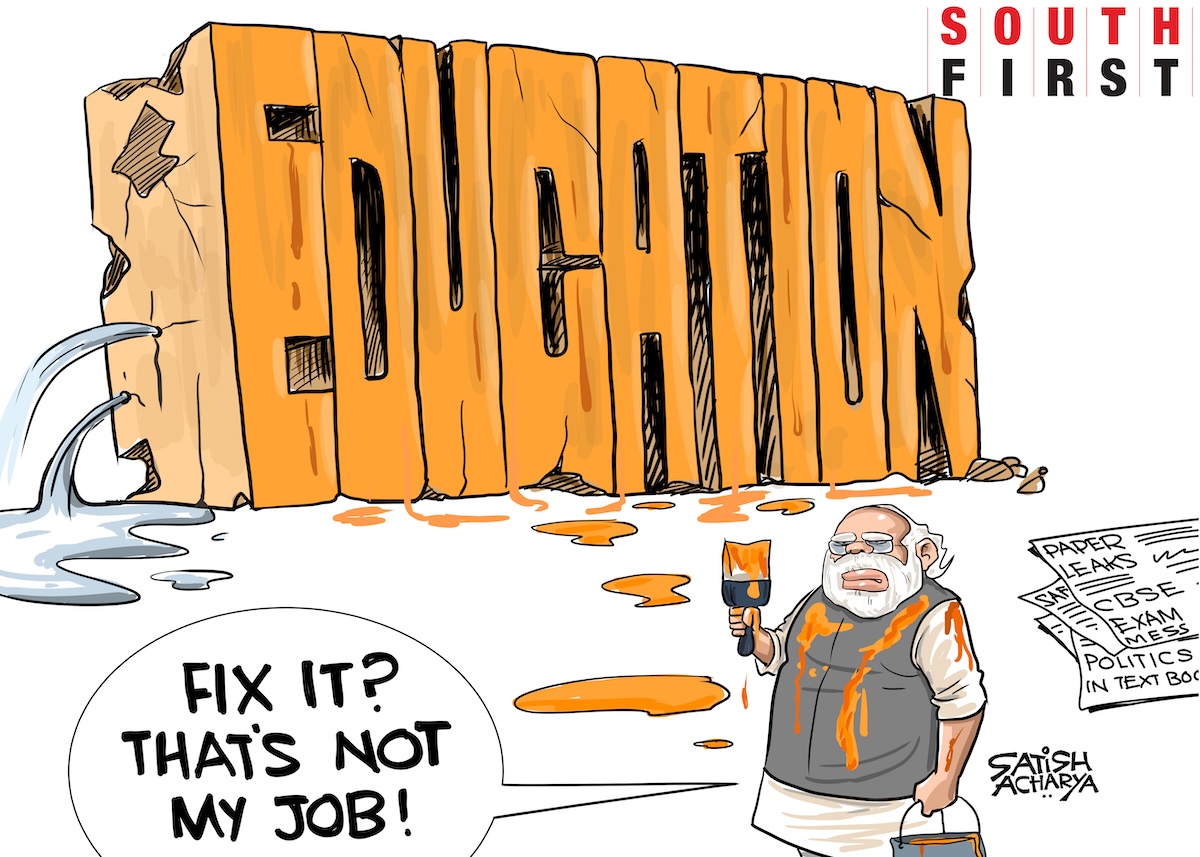
Education fails, WhatsApp university wins. Cartoon: Satish Acharya

Synopsis: CBSE and NEET flaws have got the students worked up, and understandably so. But public scrutiny must go beyond questioning just the minister. The bureaucrats must not be allowed to go scot-free either.
Across India, student dissatisfaction is growing. The controversies surrounding CBSE results, the NEET cancellation and now the agitation by the so-called Cockroach Janata Party are all symptoms of a deeper problem.
Students are angry. Parents are frustrated. Confidence in institutions is weakening. The question is whether we are identifying the real causes of these failures or merely reacting to their symptoms.
The recent controversies surrounding CBSE results have raised serious concerns among students and parents. Many have complained about unexpectedly low marks. Questions have been raised regarding digital evaluation, scanned answer sheets, re-evaluation procedures and the overall transparency of the system.
These concerns cannot be dismissed lightly because examinations decide admissions, scholarships and the future careers of lakhs of students.
Naturally, people are demanding accountability. However, whenever such a problem arises in India, the public discussion almost immediately reaches a single conclusion: the minister must resign.
Political accountability is important. Ministers cannot escape responsibility. But is that the end of the matter?
At this point, it is important to understand the role of a minister in a parliamentary democracy.
A minister is both a member of the legislature and the political head of a department within the executive. His primary responsibilities include policy formulation, legislative work, budgetary decisions, welfare programmes, setting priorities and providing overall direction to the department. It is neither practical nor intended that a minister personally supervise the day-to-day functioning of every office, institution, board, regulator, school, university or agency under his control.
Also Read: India’s exam system has reached a breaking point after NEET fiasco
That is precisely why there exists a permanent bureaucratic structure consisting of secretaries, commissioners, directors, controllers, regulators and other officials. Therefore, while ministers must certainly be held accountable for policy failures and major lapses, bureaucratic accountability cannot disappear merely because a minister occupies the top political position. When operational failures occur, responsibility must be traced through the entire administrative chain and not stop at the minister’s office.
The purpose of a hierarchical bureaucracy is not merely to occupy offices and process files. It exists to ensure the efficient, lawful and day-to-day functioning of government departments and public institutions. From the level of the Secretary down to the field officer, every layer of the administrative structure has been created to provide supervision, monitoring, implementation and accountability. That is precisely why senior bureaucrats are entrusted with significant authority, extensive service protections, substantial salaries, allowances, official privileges and, ultimately, generous pension benefits funded by taxpayers.
If ministers alone were expected to ensure the operational functioning of every department, institution, regulator, board, university, hospital and agency, there would be little need for such an elaborate administrative hierarchy. A minister and a few clerical staff would have been sufficient. The very existence of a vast bureaucratic structure is recognition of the fact that governance requires continuous professional oversight beyond the tenure and capacity of any individual minister.
Therefore, accountability cannot stop at the political level. Those who exercise administrative authority must also accept administrative responsibility. If senior officials expect society to honour the privileges, protections and benefits attached to their positions, they must also be prepared to answer difficult questions when systems fail. Public accountability should accompany public authority. The taxpayer who funds the system has a right to expect both.
When an operational failure occurs, several questions need answers.
Who designed the system? Who approved the process? Who selected the technology? Who monitored implementation? Who ignored warning signs? Who conducted audits and reviews?
Unless these questions are answered, real accountability remains incomplete.
The same issue was seen during the NEET controversy. Paper leak allegations, grace mark disputes, court cases and investigations shook public confidence. Yet the discussion again focused mainly on political leadership while the larger administrative machinery remained largely invisible.
This is not merely a CBSE problem or a NEET problem. It is a broader issue concerning accountability within our governance system.
In India, politicians often become the public face of success and failure. Their names and faces are known to everyone. But many important decisions are actually taken within the permanent administrative system.
Files move or stop moving because of administrative decisions. Technical approvals are given by officials. Tenders are examined by officials. Warnings are assessed by officials. Yet public scrutiny rarely reaches the entire chain of responsibility.
This does not mean that all officials are inefficient or corrupt. Many work honestly and sincerely. But a system should be judged not by the effort put into it, but by the results it produces.
A worker may spend an entire day digging pits and filling them again. He may work very hard and sweat throughout the day. But if the final output is zero, the effort alone cannot be considered success.
The same principle applies to governance. Citizens are not interested in how many meetings were held or how many files were processed. They are interested in outcomes. Did the system deliver results? Did public money create value? Did the service improve people’s lives?
Also Read: NEET UG-2026 cancellation: Students count cost, coaching institutes grab opportunity
This is where another uncomfortable question arises.
Government employees and officers frequently and legitimately demand their dues, salary revisions and dearness allowance arrears. They are entitled to do so. But accountability must accompany rights.
Consider the example of GST administration. Kerala collected approximately ₹3,000 crore in GST during March. Let us suppose better enforcement, compliance monitoring and administrative efficiency could have increased that figure to ₹3,200 crore or even ₹3,300 crore. Will the senior officials responsible for GST administration appear before the Legislative Assembly and publicly explain the shortfall? In most cases, the answer is no.
This highlights a larger problem. Many sections of the bureaucracy are meticulous when it comes to claiming their legitimate dues, including salary revisions, dearness allowance arrears and service benefits. There is nothing wrong with demanding what is legally due.
However, the same degree of seriousness is rarely visible when questions are raised about performance, efficiency, revenue leakages or administrative failures. Rights and responsibilities must go together. Accountability cannot be a one-way street.
The same issue can be seen in many departments and public institutions. When a bridge develops defects, attention immediately turns towards the contractor or the minister. But accountability does not stop there. Engineers, inspectors, supervisors and administrative authorities are also part of the chain.
When problems arise in healthcare, education, transport or infrastructure, public anger generally focuses on ministers. Meanwhile, the permanent administrative structure continues largely unaffected.
This imbalance weakens accountability.
Ultimately, the issue is larger than CBSE, NEET, bureaucracy or any individual minister.
The real issue is accountability.
Those who exercise power must answer for their decisions. Those who spend public money must explain the results. Those who administer public institutions must be evaluated on performance, not merely on procedures.
Taxpayers have the right to ask simple questions.
What was achieved with the money spent?
What value was delivered to citizens?
Who is responsible when systems fail?
India will become stronger not when blame is shifted from one group to another, but when accountability reaches every level of authority.
Politicians cannot be the only targets of public scrutiny. Bureaucrats, regulators, public institutions and government departments must also be judged by outcomes, efficiency and results.
Students deserve fair examinations. Taxpayers deserve value for their money. Citizens deserve transparency.
Until accountability reaches every level of governance, controversies like CBSE and NEET will continue to appear in different forms while the deeper problem remains unresolved.
Only then will our examination systems improve.
Only then will our public institutions improve.
And only then will citizens receive the quality of governance they deserve.
(The views are personal.)



