

Published Sep 01, 2026 | 6:10 PM ⚊ Updated Sep 01, 2026 | 6:44 PM

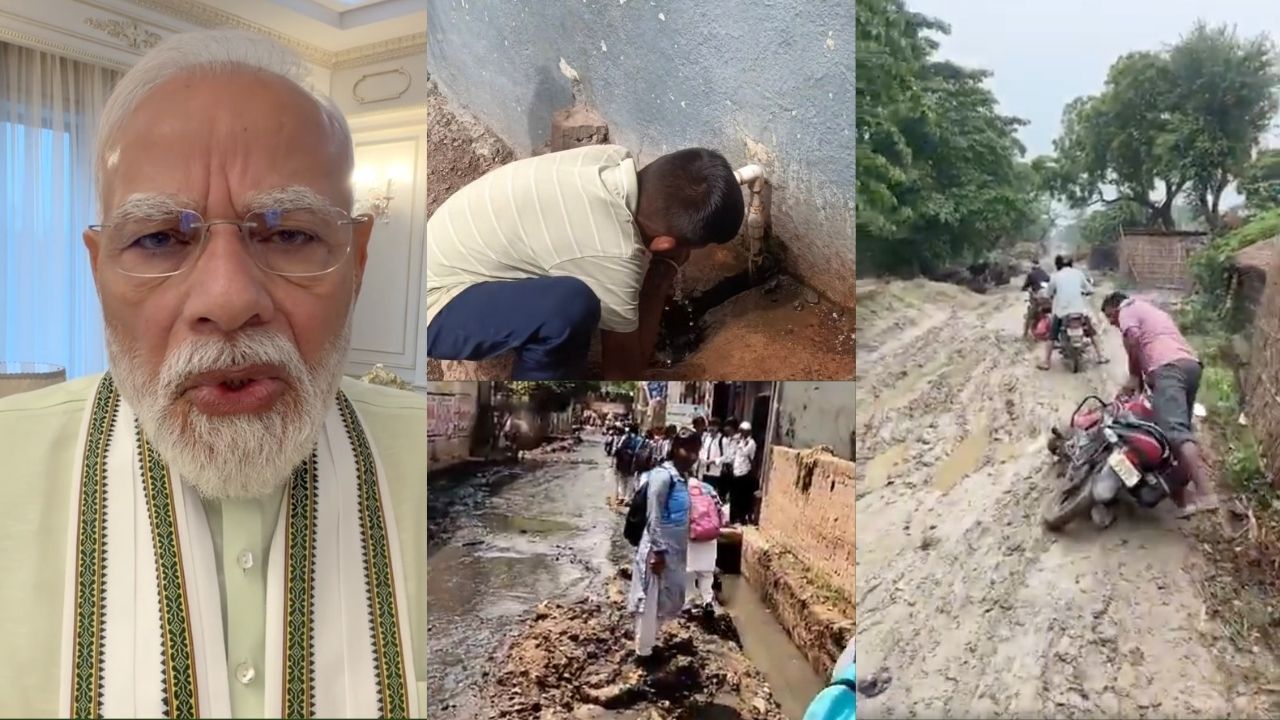
AICC president and Leader of Opposition in the Rajya Sabha Mallikarjun Kharge said the headline numbers meant nothing to the common man.

Synopsis: India recorded 7.8 per cent official GDP growth in the first quarter of 2026-27. Yet, Prime Minister Narendra Modi in a video celebrating the feat urged Indians to avoid non-essential foreign travel, overseas weddings and gold purchases. Why? And what about the comments from citizens that actor Prakash Raj drew our attention to?
On the morning of Tuesday, 1 September, Prime Minister Narendra Modi, in one of his now-routine face-to-camera videos on social media, had an unusual request to the nation: do not “travel abroad merely for leisure and sightseeing”, do not “hold weddings abroad”, and “unless it is necessary”, do not “even buy gold”.
The request was odd because, moments earlier in the same video, he had congratulated the nation for recording 7.8 per cent Gross Domestic Product (GDP) growth in the first quarter of 2026-27.
The figures, released a day earlier by the Ministry of Statistics and Programme Implementation (MoSPI), showed that India’’s GDP at real prices had grown by 7.8 per cent in the first quarter of 2026-27. By contrast, it had grown by 6.9 per cent during the same period last year.
7.8% growth.
Strong numbers.
Even stronger confidence. pic.twitter.com/ZVPpnAXrVU
— Narendra Modi (@narendramodi) September 1, 2026
Modi’s announcement, however, has not evoked the jubilation the Prime Minister perhaps hoped for.
AICC president and Leader of Opposition in the Rajya Sabha Mallikarjun Kharge said the headline numbers meant nothing to the common man, and pointed to the education, unemployment and inflation crises plaguing the nation.
“This is the story of Modi ji’s PR when it comes to the Economy. Narendra Modi ji, you are saying that the country is celebrating GDP Growth. You may have that luxury, but the Aam Aadmi does NOT! Our Common people are burdened by 3 ‘U’s and YOU are responsible for that! 3 ‘U’s –> Unprecedented Unemployment, Unbearable Price Rise & Unbridled Inequality!” Kharge wrote in a post on X.
Also read: ‘You have a lot to lose’: Zee founder Subhash Chandra warns Mukesh Ambani over ‘witch-hunt’
Cockroach Janata Party founder Abhijeet Dipke posted a picture of a child drinking water from a tap in an unkempt building in response to the Prime Minister’s video, contrasting the latter’s claim with the ground reality in parts of the country. He followed it with a picture of a dilapidated building surrounded by rubbish.
“Washroom of a govt school in a tribal village. 7.8 per cent growth sir!!!” he wrote.
7.8% growth pic.twitter.com/bjkSg6ieeG
— Abhijeet Dipke (@abhijeet_dipke) September 1, 2026
Several users followed Dipke’s example, posting pictures and videos showing the woeful state of infrastructure, including roads and schools, with the caption “7.8 per cent growth”.
Fraands … please see the citizen s comments for this tweet #justasking https://t.co/DAWTonW18C
— Prakash Raj (@prakashraaj) September 1, 2026
Meanwhile, Kharge cited a 50-year-high unemployment rate, with 40 per cent of young graduates jobless and one in six Indians aged 15 to 29 unemployed in July 2026, and said the Modi government’s promise of two crore jobs a year had been “shattered”.
He also pointed to a 19-month high in retail inflation, saying the prices of sugar, onion, tomato, dal, cooking oil, rice and milk were putting pressure on households, while petrol, diesel, LPG and CNG were becoming unaffordable.
Kharge said the top 1 per cent owned 40 per cent of India’s wealth, while the bottom 50 per cent had 15 per cent. He accused the government of presiding over a transfer of wealth from the poor to the rich, calling crony capitalism its “only Economic Policy”.
He also cited over ₹16 lakh crore in corporate loan write-offs since 2014.
“The nation has seen that the Prime Minister of India is functioning as a personal travel agent for a crony friend!” Kharge said.
“Your repeated sermons of asking Indians not to buy gold and not to travel abroad show the ground reality. Fact remains: Nothing has changed except your ability to LIE to the people!” Kharge added.
Also read: ‘Female judge lost job for refusing to dance at male colleague’s anniversary party’: Indira Jaising
The ‘impressive GDP growth’ has come against all expectations amid soaring energy prices, turbulence in the global economy and inflation.
In fact, the RBI, in its Monetary Policy Statement on 1 August, noted: “Looking ahead, the turbulent global economic environment is likely to have some bearing on domestic economic activity. Energy prices and supply chain pressures remain elevated and uncertain. The adverse impact is being contained with various supply-side measures. Even though the situation is still evolving, a deficient and uneven south-west monsoon amidst El Niño conditions poses some risks to the agriculture sector’s outlook and rural demand.”
Thus, it forecast real GDP growth for 2026-27 at 6.7 per cent, with Q1 growth at 7.0 per cent.”The world is engulfed in war. News of wars is coming from all around. The world is surrounded by crises. Supply chains have been completely disrupted. Ever since the COVID period began in 2020, we have not seen stability anywhere. And yet, India is progressing at a rapid pace,” Modi himself put the contrast in clear terms.
“On the other hand, even within India, there are people who are drowning in a pit of despair, spreading an echo of lies and trying to spread hopelessness everywhere. Rising above all these things, cutting through all these challenges, the country has achieved 7.8 per cent growth,” he said.
But as journalist Aunindyo Chakravarty first noted, the figures provided by the Union government give cause for scepticism. As South First previously reported, India’s GDP numbers over the past two decades may have been misestimated, with growth between 2005 and 2011 understated and between 2012 and 2023 overstated.
This “mismeasurement” stems from flaws in the methodology introduced in January 2015, which shifted the calculation mainly to the market-price method, measuring GDP using final prices.
More importantly, measuring GDP in real terms requires accounting for the impact of inflation on purchasing power. GDP at current prices is therefore “deflated” to determine real growth.
According to MoSPI, nominal GDP grew by 10.3 per cent in the April-June quarter. After adjusting for inflation, the Ministry estimated real GDP growth at 7.8 per cent. This means the nominal growth was “deflated” using an inflation rate of 2.3 per cent.
But MoSPI’s own inflation data for the same period do not match that figure. Retail inflation averaged 3.9 per cent during the quarter, while wholesale inflation averaged 9.3 per cent.
As Chakravarty noted: “If we assume that two-thirds of the economy is affected by retail inflation, and the rest by wholesale inflation, then effective inflation in the economy would work out to 5.7 per cent…The gap between the GDP deflator and effective inflation – which has mostly stayed within 1.2 percentage points on either side, and never exceeded 1.9 percentage points – is now a massive 3.4 percentage points.”
The GDP deflator is not necessarily a weighted average of retail and wholesale inflation. It also includes the trade deflator and the imputed prices of goods and services that are not bought and sold.
Nevertheless, the mismatch in the Ministry’s own data has led to accusations of data manipulation on social media.
Also Read:
India in 2050: The world’s second-largest economy—and its hundredth-poorest nation
‘It’s the economy, stupid’: The making of India’s Gen Z discontent
(Edited by Dese Gowda)



