

Published Jul 07, 2026 | 7:00 AM ⚊ Updated Jul 07, 2026 | 7:00 AM

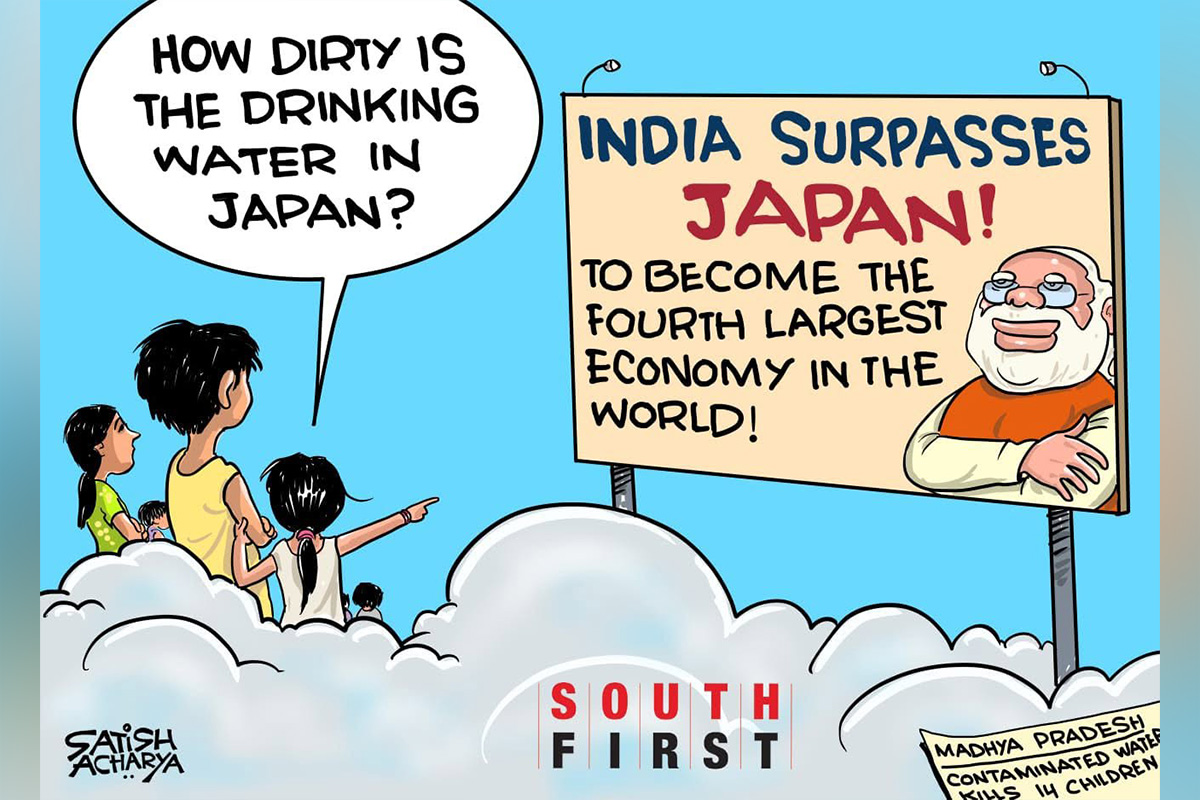

Synopsis: India is set to climb the economic rankings, but even as it becomes a richer nation, its people will remain poor. Find out why.
In February 2017, PwC published a landmark report titled “The World in 2050: The Long View—How Will the Global Economic Order Change?”
Such long-range forecasts often make headlines briefly before fading into obscurity. Now, with 2050 only 24 years away, it is worth revisiting that document to assess where India stands in this long view—and what its rise to economic superpower status will actually mean for its citizens.
The PwC report’s central projection is stark: China will become the world’s largest economy, followed by India in second place, with the United States pushed to third. India’s share of global GDP is expected to grow from approximately 7% today to around 15% by 2050—the largest gain of any country in the model. China’s share will rise to around 20%. So, the two countries together will account for roughly 35% of global economic output.
The European Union’s share, meanwhile, is projected to fall from around 15% to just 9%—smaller than India alone. Indonesia is set to be the decade’s great climber, displacing France from the top ten and rising to fourth place globally. France will drop out of the top ten entirely, and the United Kingdom falls to tenth. Of today’s top ten economies, most will still be present in 2050—but their relative positions will shift dramatically. The world economy itself is projected to more than double in size, with the fastest growth concentrated in South and South-East Asia.
PwC was careful to attach conditions to these projections. Two passages from the report deserve to be quoted directly, because they are so often glossed over in Indian commentary on the forecast:
“Assuming broadly growth-friendly policies (including no sustained long-term retreat into protectionism) and no major global civilisation-threatening catastrophes.”
“To realise this growth potential, emerging market governments need to implement structural reforms to improve macroeconomic stability, diversify their economies, and develop more effective political and legal institutions.”
These are not decorative caveats; they are the load-bearing conditions on which the entire forecast rests, and are especially pertinent to India. If India becomes mired in internal civilisational tensions, or if its political and legal institutions weaken to a point where international capital and trade are affected, the projections for 2050 will simply not be realisable. Economic growth and institutional credibility are not parallel tracks—they are the same track.
Here lies the report’s most important and least-discussed finding.
Of the projected top ten economies in 2050, six—China, India, Indonesia, Brazil, Russia and Mexico—will not appear anywhere near the top of the global rankings on a per-capita income basis, even measured in purchasing power parity (PPP) terms. A nation can be rich. Its people can still be poor. That paradox will be sharper in India in 2050 than it is today.
Between 2016 and 2026, both China and India roughly doubled their GDP on a PPP basis (in nominal dollar terms, the increases were around 85% and 80% respectively, reflecting exchange rate effects). China’s per-capita PPP income rose from approximately USD 13,800 to USD 31,600 over this period; India’s grew from USD 6,760 to around USD 12,800. India doubled its per-capita income in a decade—a meaningful achievement, though partly driven by slowing population growth.
India’s Viksit Bharat@2047 vision targets a nominal per-capita income of between USD 15,000 and USD 18,000 by 2047. Taking the upper bound and extrapolating to 2050, India’s per-capita PPP income would be in the range of USD 26,000 to 28,000, while China’s would approach USD 43,000 to 44,000.
In practice, this means three things.
First, India will close the per-capita gap with China considerably—where China’s PPP per-capita income is currently nearly double India’s, by 2050 that margin narrows to around 50%. Second, both countries will remain well below most Western economies: the United States, despite falling to third in total GDP, is projected to maintain a per-capita PPP income of around USD 100,000—roughly twice China’s and three times India’s. Third, among the E7 group of major emerging economies, India will continue to rank at the very bottom on per-capita income, behind Indonesia, Brazil, Mexico, Turkey and China.
The global ranking tells the story most plainly. Today, India ranks 119th in the world on per-capita PPP income. By 2050, that ranking is projected to improve to around 100th—a gain of roughly 20 places over a quarter-century. Among the 32 to 33 largest economies in the PwC model, India ranks 28th to 30th on per-capita income: effectively at the bottom of the group. So, while India ascends to become the world’s second-largest economy by total output, its citizens’ relative standing in global income terms barely shifts. In absolute terms, incomes will rise—but India’s position relative to the rest of the world will remain near the foot of the middle-income table. For the majority of ordinary Indians, the gap between India’s economic weight and their individual prosperity will remain as wide in 2050 as it is today.
The PwC forecast points to two overarching conclusions for India that are worth stating plainly. India as a nation will be the world’s second-largest economy by 2050 in PPP terms—a remarkable rise by any historical standard. But on a per-capita basis, which is what actually determines whether people can afford food, healthcare, education and housing, India will still rank around 100th in the world. The per-capita income gap between India and China will narrow significantly, but it will not close. And the gap between India and the advanced economies will remain very large.
There is also a deeper point. The per-capita gap is not an accident of measurement. It is the direct consequence of India’s population size—a feature that simultaneously drives aggregate GDP growth and dilutes per-person income gains. Managing this arithmetic is one of the central economic policy challenges of the next 25 years.
Indian policymakers face a dual imperative.
The first task is to create the conditions that allow India to actually reach the PwC projections: macroeconomic stability, institutional integrity, the rule of law, and a foreign policy posture credible enough to sustain the confidence of international capital. These are not soft governance ideals — they are hard prerequisites. An India that slides into majoritarian politics, weakens its judiciary, or entangles itself in civilisational conflicts, at home or abroad, will not reach the 2050 projections. The report is explicit on this.
The second task is harder still: narrowing the gap between aggregate economic size and individual prosperity. Even if every PwC projection is met in full—the most optimistic scenario—India will still be ranked around 100th in the world on per-capita PPP income in 2050. Economic growth is necessary but not sufficient. What is also required is growth that is inclusive, that reaches the bottom of the income pyramid, and that translates aggregate wealth into individual welfare through investment in health, education and social infrastructure. Investment in education, health and social infrastructure drives growth through productivity and innovation – something that all developed nations of today and, for that matter, China have achieved over the last few decades.
Growth and social justice are not in tension in India’s case—they are prerequisites for each other. Inclusion, pluralism, and equal treatment of all citizens are not aspirational ideals. They are structural requirements for reaching the 2050 projections. An India that fails on social cohesion will also fail on economics.
India’s 2050 story is not simply one of ascent. It is a story of what ascent does and does not deliver—and whether a nation has the wisdom to know the difference.
Also Read:
No, India’s ‘great’ Global Capability Centres aren’t transformational yet
When banks like HDFC fail customers, don’t dismiss it as a mere glitch
(Edited by R Rajesh Kumar.)



