

Published Jul 30, 2026 | 8:39 PM ⚊ Updated Jul 30, 2026 | 8:39 PM

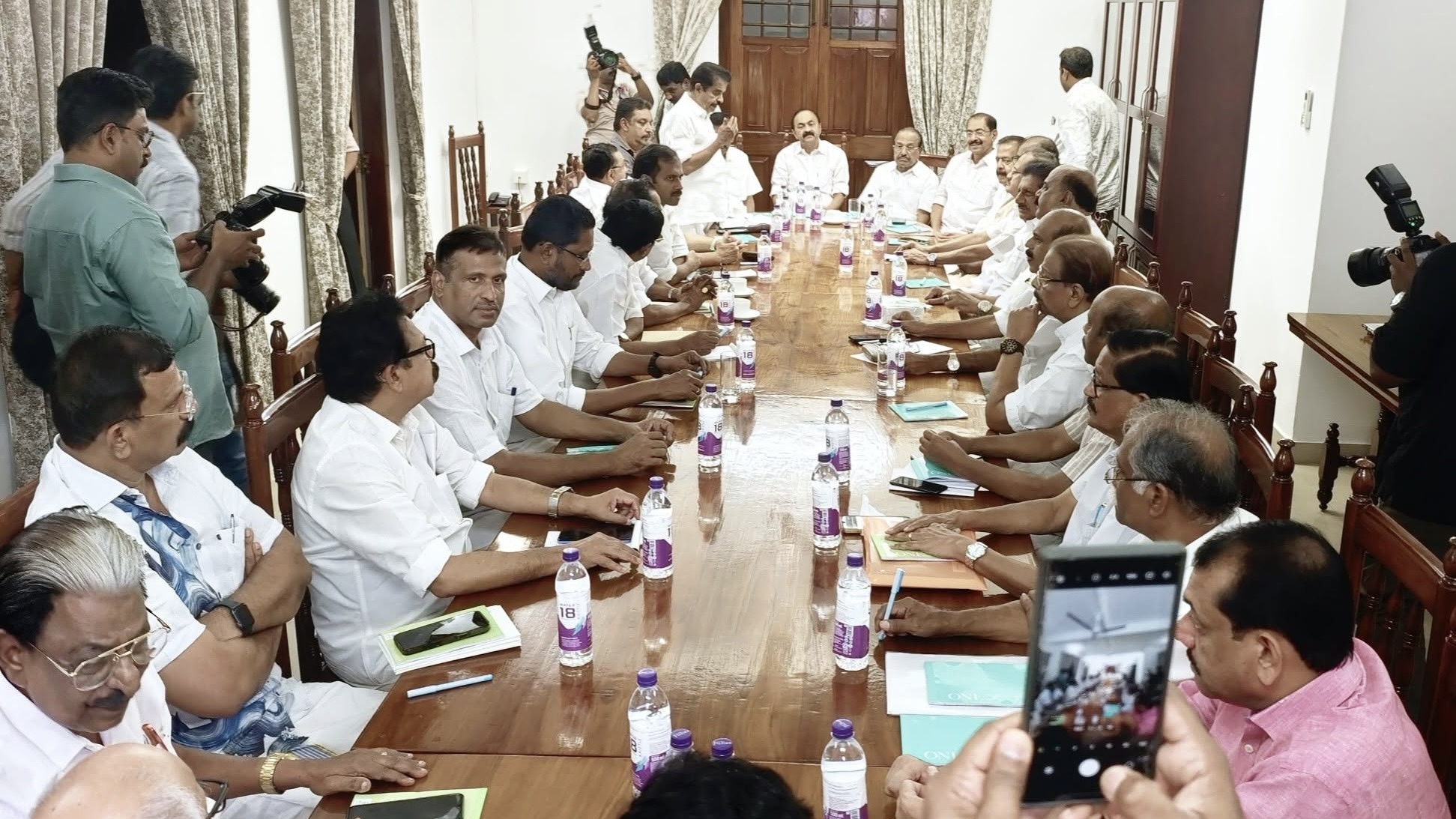
UDF leaders at the meeting on 30 July.

Synopsis: The UDF coalition has decided to go ahead with implementing the Centre’s PM SHRI scheme, saying Kerala cannot back out of the agreement already signed and that abandoning it could put over ₹2,000 crore in Central education funds at risk. The LDF has strongly opposed the move, accusing the Congress-led government of yielding to the BJP’s agenda and warning of statewide protests if the scheme is rolled out.
The UDF has decided to press ahead with the Centre’s PM SHRI scheme, arguing that Kerala cannot walk away from an agreement already signed with the Union government.
The decision, announced after the coalition’s first meeting since coming to power in May, on 30 July, drew sharp criticism from the Opposition LDF, which warned of protests if the project is implemented.
While the coalition has decided to proceed with the scheme, it has also promised closer scrutiny of the schools proposed for inclusion and other aspects, including the syllabus.
It was in October 2025 that the then Left government led by Pinarayi Vijayan signed the MoU with the Centre for implementing PM SHRI. But later, owing to political developments within and outside the front, the government decided to postpone its implementation.
When the UDF came to power, it took the stance that the state has no legal provision to unilaterally withdraw from the agreement once it has been signed, as the power to terminate the scheme rests solely with the Centre.
Also Read: How CPI(M) lost Kerala: Inside the party’s account of its electoral collapse
The UDF government earlier stated in the Assembly that if the state withdraws from PM SHRI, it could cost Kerala nearly ₹2,000 crore, including ₹1,151.48 crore in pending SSK funds and other Central allocations that could be withheld.
The PM SHRI scheme, a Centrally Sponsored Scheme, is intended to develop selected schools into model institutions showcasing the principles of the National Education Policy (NEP) 2020 while mentoring neighbouring schools.
Replying to questions in the Assembly in June, General Education Minister N Shamsuddin said the previous LDF government had signed the MoU after concluding that refusing the scheme would lead to the loss of substantial Central funding, including allocations under the Samagra Shiksha Kerala (SSK) programme.
The Minister maintained that the state has no legal provision to unilaterally terminate the agreement once it has been signed. Under the terms of the MoU, he said, only the Union government has the authority to withdraw from the arrangement.
Shamsuddin said the financial implications are significant.
Kerala has already been denied ₹1,151.48 crore due under the Samagra Shiksha scheme.
In addition, implementation of PM SHRI would make 304 schools spread across 152 blocks eligible for funding, with each school entitled to ₹1 crore over three years under the Centre-State funding pattern of 60:40. The Centre’s share alone would work out to ₹912 crore.
Taken together, the withheld Samagra Shiksha allocation and the Central assistance linked to PM SHRI amount to more than ₹2,000 crore, the Minister said.
He also informed the House that no separate allocation has yet been released under the PM SHRI scheme. However, after Kerala signed the MoU, the Centre released ₹99.27 crore as its share for Samagra Shiksha Kerala during 2025-26.
Also Read: Operation Toofan: Cyber fraud racket targeting people in USA unearthed in Thiruvananthapuram
The controversy connected with PM SHRI dates back to October 2025, when the then LDF government led by Pinarayi Vijayan signed an MoU with the Union Ministry of Education for implementing the PM SHRI scheme. The agreement was signed on behalf of the state by then General Education Secretary K Vasuki.
However, what began as Kerala’s entry into the Centre’s flagship PM SHRI Schools programme ended in one of the shortest-lived policy reversals in recent years, with a Cabinet sub-committee constituted to break a political deadlock ultimately failing to hold even a single meeting.
The signing, however, triggered an immediate political storm within the ruling coalition itself.
Several LDF constituents said the decision had been taken without prior discussion within the front, with the CPI emerging as the strongest critic. The then Congress-led Opposition also accused the government of entering into the agreement without adequate consultation or public debate.
As the backlash intensified, the CPI(M) decided to put the implementation of the scheme on hold within days of signing the MoU.
At a Cabinet meeting on 29 October 2025, then Chief Minister Pinarayi Vijayan announced the formation of a seven-member Cabinet sub-committee to examine the issue before the state proceeded any further.
The committee was chaired by then General Education Minister V Sivankutty and comprised Revenue Minister K Rajan, Agriculture Minister P Prasad, Water Resources Minister Roshi Augustine, Law Minister P Rajeev, Electricity Minister K Krishnankutty and Forest Minister AK Saseendran.
Announcing the decision, the Chief Minister said the committee would conduct a detailed review in view of the controversy surrounding the scheme.
Following the Cabinet decision, the state government wrote to the Union Ministry of Education on 12 November 2025, informing it that implementation of the provisions of the MoU signed in October would remain postponed until the Cabinet sub-committee submitted its report.
That report, however, never came.
After the United Democratic Front (UDF) assumed office, the government informed the Kerala Assembly that the Cabinet sub-committee had not convened even a single meeting, effectively leaving the review process incomplete.
Even without the state government’s participation in the scheme, Kerala currently has 47 PM SHRI schools: 33 run by the Kendriya Vidyalaya Sangathan and 14 Jawahar Navodaya Vidyalayas, both functioning under the Union Ministry of Education.
Also Read: After 3 teachers, Kerala MDMA trail takes SIT to delivery worker
Once the UDF government came to power, it revisited the contentious scheme and, at the Cabinet meeting on 17 June, it was decided to constitute a second Cabinet sub-committee to examine the implementation of the PM SHRI scheme.
The four-member panel, headed by General Education Minister N Shamsudeen, with Ministers Roji M John, PC Vishnunath and M Liju as members, was asked to study the implications of the scheme before recommending the state’s future course of action.
Though the committee convened its first meeting on 24 June, a final report is yet to be submitted to the government.
Then Chief Minister VD Satheesan made it clear that while Kerala has already signed the PM SHRI agreement and received substantial Central assistance, the government continues to have serious reservations over certain provisions of the scheme.
Addressing the media after the Cabinet meeting, Satheesan said more than ₹99 crore that had earlier been withheld by the Union government was released after Kerala signed the agreement and had since been utilised. He added that another ₹106 crore had also been sanctioned.
Even so, the Chief Minister said the government would not compromise on what it considers the state’s constitutional rights in the education sector.
According to him, Kerala’s principal concern is the Centre’s role in curriculum-related matters. The state, he said, must retain the authority to frame its own curriculum and decide which schools should be brought under the PM SHRI scheme. The newly formed committee has been asked to examine these issues in detail and submit its recommendations before the government communicates its position to the Union government.
Satheesan also pointed out that several features proposed under the National Education Policy are already part of Kerala’s education system, but maintained that this should not dilute the state’s powers over school education.
The Chief Minister said Kerala would also seek to build a common position with other non-BJP-ruled states on protecting the rights of states while implementing Centrally Sponsored education schemes. He said discussions had already been initiated with their Chief Ministers to evolve a coordinated approach.
Also Read: Echoing the BJP line? Central university of Kerala’s praise for Dharmendra Pradhan raises eyebrows
The Left leadership launched a sharp counterattack after the UDF meeting decided to support the implementation of the PM SHRI scheme, accusing the Congress-led front of aligning with the BJP’s agenda.
Former General Education Minister V Sivankutty rejected UDF Convener Adoor Prakash’s claim that the state was bound to proceed with the scheme because the previous LDF government had signed the MoU.
He said the MoU, signed last year, was subsequently kept in abeyance and the Centre was informed of the government’s decision to withdraw cooperation with the project.
Stressing that Kerala had not received “even a single rupee” under PM SHRI, Sivankutty maintained that the state had no obligation to implement the scheme and warned that the LDF would intensify its protest if the project was pushed forward.
CPI State Secretary Binoy Viswam was even more scathing, describing the UDF as the “B-Team of the BJP” and accusing it of concealing facts to justify its stand.
Undermining the UDF’s argument that accepting the scheme was necessary to protect Central assistance, Viswam said Central grants were a constitutional entitlement, not a favour, and asserted that any attempt to use financial pressure to introduce PM SHRI should be challenged legally.
He also alleged that the scheme would open the door to the Sangh Parivar’s influence in Kerala’s education sector and vowed that the LDF would resist its implementation.



