

Published Jul 29, 2026 | 11:06 AM ⚊ Updated Jul 29, 2026 | 1:22 PM

Centring the campaign on one person — Pinarayi Vijayan — also contributed to the CPI(M)-led UDF's debacle. (South First)

Synopsis: The CPI(M)’s post-poll review has flagged political miscalculations, organisational weaknesses and a growing disconnect among the party leadership, government and grassroots workers for its 2026 Kerala Assembly rout. It also put the Pinarayi Vijayan-led government and state leadership under scrutiny. However, state secretary MV Govindan rejected individual blame for the defeat, calling it a collective failure, as the party prepares for an extended state committee meeting in September to chart course correction.
The CPI(M) Central Committee’s review of the Left Democratic Front’s crushing defeat in the 2026 Kerala Assembly election has turned into a stinging indictment of the Pinarayi Vijayan government and the party’s state leadership headed by state secretary MV Govindan.
Adopted at the Central Committee meeting held from 11 to 13 July, the review described the electoral setback as unprecedented in the party’s history.
It also acknowledged that the state leadership misread the political mood and failed to assess the ground situation correctly, leading to a series of flawed political assessments, including its inability to foresee the scale of the defeat.
The document also called for introspection into whether the principles of democratic centralism were properly implemented and whether violations of those principles went unaddressed.
Even as the Central Committee’s assessment laid bare the reasons behind the poll debacle, Govindan, on Tuesday, 28 July, denied any personal lapse in the election defeat, but insisted that the responsibility rested collectively with the party leadership.
In the 9 April election to Kerala’s 140-member Legislative Assembly, the UDF routed the CPI(M)-led LDF 102-35. Three seats went to the BJP.
Also Read: If not Pinarayi Vijayan, who? A question LDF struggles to answer
The party’s post-poll review has laid bare the political and organisational failures that led to the collapse of its bid for a third straight term, placing Politburo member and two-time chief minister Pinarayi Vijayan at the centre of a candid self-assessment.
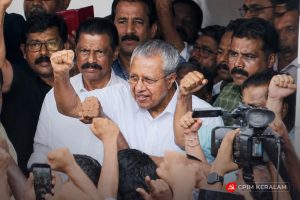
Pinarayi Vijayan and M V Govindan
The review acknowledged that the party had entered the election determined to secure an unprecedented third consecutive term for the LDF, but admitted the outcome fell far short of expectations.
Describing the result as a “debacle”, it noted that for the first time since 1977, the CPI(M) was no longer in power in any state. It also placed the defeat in the larger national context of the BJP’s growing political ascendancy.
One of the sharpest observations concerned Vijayan’s projection during the campaign.
The review noted that a widespread narrative emerged that the entire election campaign revolved around one individual: Vijayan.
While acknowledging that Vijayan had led the government efficiently, it said the decision to personalise the campaign around him inadvertently handed the United Democratic Front (UDF) an opportunity to launch a focused attack on the chief minister.
As a consequence, the CPI(M) lost the political initiative to expose what it described as the Congress-led UDF’s reactionary and ruling-class character.
The document also identified several controversies that, in its assessment, damaged the party’s secular credentials.
It said the decision to read out a message from Uttar Pradesh chief minister Yogi Adityanath at the Global Ayyappa Sangamam could have been avoided.
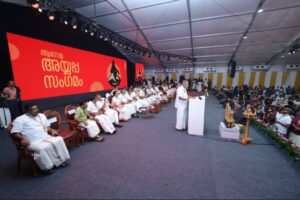
Chief Minister Pinarayi Vijayan at the Global Ayyappa Sangamam.
The review termed the episode a major embarrassment to the party’s secular image, particularly because the message came from “an avowed Hindutva fanatic” and was read by a state minister, who is also a member of the CPI(M) State Secretariat.
Although the Travancore Devaswom Board organised the event, the review said it remained perplexing why a message was sought from the Uttar Pradesh chief minister and why a party minister agreed to read it out.
The incident, it said, created an impression among the public that the party was becoming soft towards Hindutva communal forces, adversely affecting its election campaign.
Uttar Pradesh Chief Minister Yogi Adityanath.
The review was equally critical of the party’s response to anti-Muslim remarks made by Vellappally Natesan, the general secretary of the Sree Narayana Dharma Paripalana (SNDP) Yogam.
While noting that the state secretariat had issued a statement condemning the remarks, it said the response lacked sufficient political force. Subsequent statements by some party leaders, it added, further alienated sections of the public. Taken together, these developments enabled opponents to create an impression that the CPI(M) was compromising in its fight against communalism.
The review also pointed to institutional weaknesses within the party-government relationship.
It recalled that during previous Left administrations, the party had constituted sub-committees to monitor the implementation of government schemes and maintained an active cabinet fraction committee to guide ministers and discuss political issues.
The regular functioning of these mechanisms had ensured close coordination between the party and the government, minimised policy errors and denied political space to both allies and opponents. Their weakening, the report suggested, contributed to the government’s disconnect from the organisation.
The state committee also recorded widespread dissatisfaction among party workers and the public over what it described as the high-handedness of the police and sections of the bureaucracy. It noted complaints about the inaccessibility of some ministers and an excessive dependence on officials in governance.
Also Read: Why Pinarayi Vijayan is now part of CPI’s conversation
The post-election review also turned the spotlight inward, placing state secretary Govindan and the party state leadership under intense scrutiny for what it described as a series of political, organisational and leadership failures that contributed to the disappointing performance.
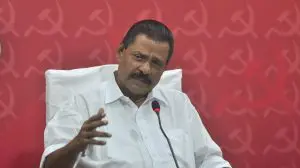
MV Govindan, CPI(M) Kerala state committee secretary. (KB Jayachandran)
The review portrayed the setback as the outcome of deeper structural weaknesses that had accumulated within the party over the years. It spoke of growing parliamentary opportunism, organisational drift, flawed candidate selection, delayed disciplinary action, leadership arrogance and an increasing disconnect between the leadership and the grassroots.
Candidate selection came in for particularly sharp criticism. The report admitted that mistakes committed during the selection process, especially in Kannur, damaged the party’s credibility across Kerala. The controversy fuelled allegations of nepotism and favouritism, charges the party failed to counter effectively, leaving its image bruised.

KK Shailaja, former health minister.
The review also revisited the decision to field 54 sitting MLAs, stating that “winning” was treated as the overriding criterion. Most of them were retained in their existing constituencies. Against this backdrop, the opposition successfully built a campaign around the decision to shift former health minister KK Shailaja from her constituency. Although the party advanced organisational reasons for the move, the report conceded that public perception remained unfavourable.
It was equally candid about the selection of candidates in Taliparamba and Payyannur. The review accepted that adequate care was not exercised while finalising the nominees. It recorded that the Kannur District Committee had already admitted those lapses in its review and further acknowledged that both the State Secretariat and the State Committee also committed mistakes while approving the district’s recommendations.
Another striking observation in the review concerned the unprecedented rebellion by senior party leaders.
It noted that three senior CPI(M) cadres defied the party’s decision, entered the fray against official LDF candidates with the backing of the UDF and defeated the Left in its own traditional bastions of Taliparamba, Payyannur and Ambalapuzha.
Three former MLAs also deserted the party and contested against CPI(M) nominees.
The report said the episode demands serious lessons.
It warned that parliamentary opportunism had emerged as a worrying tendency within the party. It said the defeats in long-standing Left strongholds reflected a widening gap between the leadership and ordinary party members, resulting in an erosion of the party’s mass base.
It called for urgent corrective measures to eliminate parliamentary deviations and rebuild the connection between the leadership at every level and the rank and file.
The review also questioned whether the party had remained faithful to the principles of democratic centralism.
While reaffirming that democratic centralism and inner-party democracy were the organisational foundations of the CPI(M), it said the leadership must introspect on whether those principles were properly implemented. It stressed that violations, wherever they occurred, must be identified and corrected to ensure the organisation functions democratically while avoiding anarchic tendencies.
Also Read: CPI(M) faces a rare rebellion in two of its Kannur strongholds
The review also identified delayed disciplinary action as a major failing.
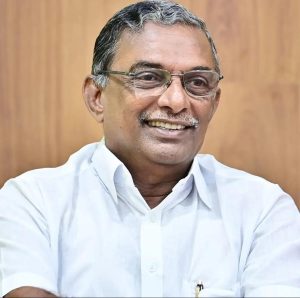
A Padmakumar
Referring to the alleged gold smuggling case involving former Travancore Devaswom Board president and Pathanamthitta District Committee member A Padmakumar, the party acknowledged that it failed to respond swiftly after his arrest.
Although he was in judicial custody, the report said the extraordinary political situation demanded immediate action and that the delay was a lapse on the party’s part.
The review noted that the CPI(M)’s central leadership had advised the Kerala unit to consider disciplinary proceedings immediately after Padmakumar’s arrest. It said that prompt action at that stage could have reduced at least some of the political damage the party suffered.
The report also criticised the public conduct of some senior leaders, observing that careless remarks made at public meetings and during media interactions often provided ammunition to political opponents.
It reminded party functionaries that every public statement has been recorded and circulated and could be selectively used or distorted to damage the party’s image. It said avoidable comments by leading comrades on several occasions helped anti-Left campaigns gain traction.
The review concluded by calling for changes in the party’s style of political communication.
Public meetings, it said, have increasingly become lengthy, unfocused and lacking in political sharpness. Speeches often failed to clearly identify and challenge political opponents on issues, while programmes meant for sympathisers were poorly organised. The report said meetings called for greater discipline, sharper messaging and better communication if they were to become effective instruments for political mobilisation once again.
Also Read: Intolerant of criticism, ‘cyber comrades’ target journalists
At the same time, in a news conference convened on 28 July, Govindan rejected suggestions that individual leaders were responsible for the party’s setback in the Assembly polls, saying the defeat should be viewed as a collective failure of the leadership.
Govindan said no personal lapse could be attributed to any leader and that the responsibility rested with the party leadership as a whole.
He also made it clear that there would be no immediate changes in the state secretariat or the state committee, pointing out that such organisational decisions would be taken only through the party’s conference process and the party congress.
Govindan said the review report submitted to the Central Committee was prepared by a team that included him and Vijayan, among others. “The shortcomings were identified as shortcomings,” he said, adding that the party had not tried to hide the issues that contributed to the electoral loss.
The state secretary also said he had no objection to the party making the State Committee review report public. The document, which the State Committee had adopted, reportedly contained critical observations about the functioning of both the government and the party leadership.
The State Committee review acknowledged that the defeat was the result of a combination of political, administrative and organisational shortcomings. It pointed to weaknesses within the party structure and called for corrective steps to rebuild its connect with the people.
The CPI(M) has now decided to hold an extended State Committee meeting in Kozhikode from 13 to 15 September to discuss the issues raised in the review. The meeting would examine the reasons behind the erosion of public support, shortcomings in organisational functioning and the changes needed to strengthen the party at the grassroots level.
Govindan said the focus would be on improving the party’s relationship with the public and restoring public confidence. He said the exercise would involve a deeper review of the party’s functioning and the changes required to make it more effective.
While ruling out immediate organisational changes, the state secretary’s remarks indicated that the September meeting could become a crucial platform for internal discussions on course correction, including changes in political approach, public outreach and party functioning.
(Edited by Majnu Babu).



