

Published Apr 29, 2026 | 7:03 PM ⚊ Updated Apr 29, 2026 | 7:04 PM

The TMC is projected to maintain its dominance in the Presidency Division.

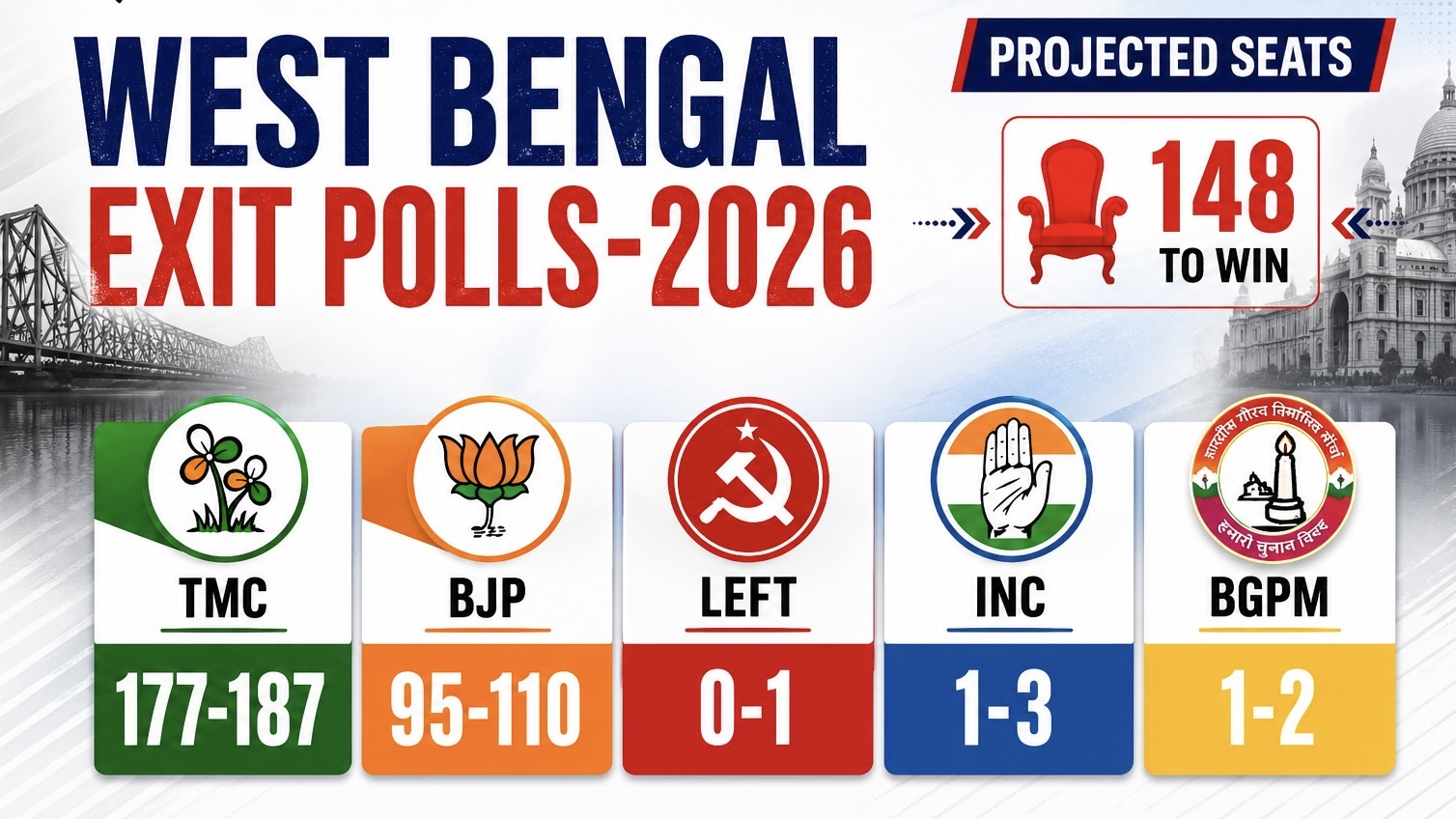
Synopsis: The Trinamool Congress is projected to return to power in West Bengal with a clear majority, winning 177–187 seats and 46.5 percent of the vote, while the Bharatiya Janata Party (BJP) is expected to secure 95–110 seats with 41.5 percent, according to a People’s Pulse exit poll. The Congress and the Left are projected to win only a handful of seats.
The ruling All India Trinamool Congress (TMC) is set to return to power in West Bengal with a comfortable majority, according to People’s Pulse exit poll.
The survey projects the TMC will secure 46.5 percent of the vote, translating into an estimated 177 to 187 seats in the 294-member Assembly. The Bharatiya Janata Party (BJP), its principal rival, is projected to obtain a 41.5 percent vote share and win between 95 and 110 seats.
The Congress is expected to secure a 2.1 percent vote share and win 1 to 3 seats, while the Left is projected at a 4.1 percent vote share with 0 to 1 seats.
The Bharatiya Gorkha Prajatantrik Morcha is likely to win 1 to 2 seats with a 0.7 percent vote share. Others are estimated to receive a 5.1 percent vote share but are unlikely to convert this into seats.
The survey findings suggest the TMC has retained its core support base across regions and communities despite pockets of dissatisfaction. The BJP, while holding on to its existing voter base and registering marginal improvements in some areas, has not made sufficient gains.
Also Read: People’s Pulse exit poll: DMK-led alliance poised for return to power in Tamil Nadu
North Bengal, according to the survey, has proved competitive. The BJP continues to have influence among Scheduled Castes, Scheduled Tribes and Gorkha voters, but the TMC has made gains, especially in constituencies such as Cooch Behar.
The presence of the Bharatiya Gorkha Prajatantrik Morcha (BGPM) in Gorkha-dominated areas is expected to support the TMC’s overall tally. Voters in this region appear divided between the two major parties.
In the minority-dominated belt of North and Central Bengal, including Malda and Murshidabad, the survey shows a strong consolidation of Muslim voters in favour of the TMC.
The Congress is likely to win 1 to 3 seats in select constituencies where local factors are favourable, but its overall presence is limited.
The TMC is projected to maintain its dominance in the Presidency Division, comprising Kolkata, Howrah and the 24 Parganas, supported by women voters, minorities and the urban electorate. The BJP has not made substantial gains in this region despite efforts to expand its base.
In the Burdwan division, the TMC is likely to retain its traditional strength, but the BJP has made pockets of inroads, particularly in East Bardhaman.
In the Jangal Mahal region, the BJP is expected to perform relatively well among tribal and backward communities.
Also Read: People’s Pulse post-poll survey projects NDA majority in Puducherry Assembly
Scheduled Castes and OBC groups have shown a split preference between the two key contenders, the survey has found.
But the TMC has strong support among women voters across regions and communities due to its welfare initiatives and financial assistance schemes.
The survey also finds beneficiaries of various state government schemes are largely inclined towards the incumbent TMC government. The continuation of benefits is a key factor influencing their voting decisions, particularly in rural and semi-urban areas.
The TMC is also expected to consolidate Muslim votes in its favour, despite multiple parties attempting to attract this voter base.
The ruling party’s narrative around regional identity against a more aggressive BJP, the survey suggests, is likely to prove successful, with the TMC’s emphasis on cultural identity and regional pride resonating more strongly with voters than the BJP’s campaign messaging.
The BJP, while established as the principal opposition party, continues to face challenges in expanding its grassroots presence and overcoming the perception of being an external political force.
The survey also suggests the impact of voter list revisions and deletions in the Special Intensive Revision has not significantly altered the overall electoral outcome but may have contributed to increased voter participation.
(Edited by Dese Gowda)



