

Published Apr 29, 2026 | 6:40 PM ⚊ Updated Apr 30, 2026 | 3:13 PM

Around 60% believe NDA deserves another term

Synopsis: People’s Pulse post-poll survey for Puducherry Assembly Elections 2026 projects NDA winning 16–19 seats, SPA 10–12, and others 1–2. NDA’s vote share is 34–36%, with AINRC leading. CM N Rangasamy is favoured by 68% respondents. Fragmented opposition votes and youth support for TVK strengthen NDA’s advantage.
People’s Pulse Research Organisation has released its post poll survey for the Puducherry Assembly Elections 2026, projecting a clear advantage for National Democratic Alliance (NDA) and likely government formation.
The survey projects NDA to win 16 to 19 seats, while the Secular Progressive Alliance (SPA) is expected to secure 10 to 12 seats and others 1 to 2 seats.
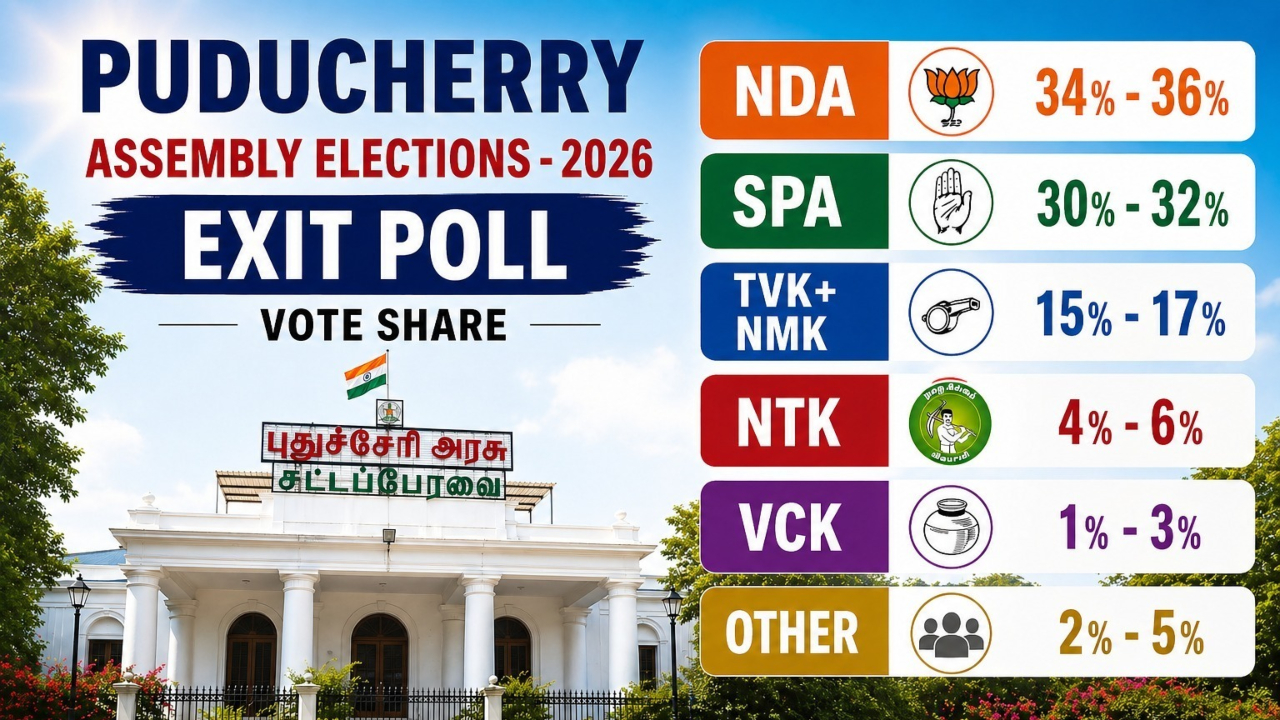
In vote share terms, NDA is estimated at 34 to 36 percent, followed by SPA with 30 to 32 percent. TVK with NMK is projected at 15 to 17 percent, NTK 4 to 6 percent, VCK 1 to 3 percent and others 2 to 5 percent.
Within NDA, the All India NR Congress is likely to emerge as the single largest party with 10 to 12 seats, followed by BJP with 5 to 6 seats, LJK 1 to 2 seats and AIADMK 0 to 1 seat. While in SPA, DMK is projected to win 6 to 8 seats and Congress 1 to 3 seats. TVK and others may secure 1 to 2 seats.
The findings indicate a clear path for an NDA-led government, with CM N Rangasamy likely to return for a fourth term. The alliance appears well placed to secure a workable majority in the Union Territory.

Peoples Pulse conducted the survey between 11 April and 17 April, 2026 across all 30 Assembly constituencies using probability proportional to size methodology. Three polling stations per constituency with 20 to 25 sample each, totalling 2000 respondents. The sample reflects caste, religion, age and gender representation.
Also Read: ‘NDA holds the upper hand in Puducherry’: People’s Pulse pre-poll survey
NDA holds a clear lead across key parameters including development performance, welfare delivery, community preference, choice of Chief Minister and overall party preference, cutting across age groups and gender. Notably, 68 percent of respondents preferred N Rangasamy as CM.
Around 60 percent believe NDA deserves another term, while 36 percent disagreed. Nearly 65 percent believe Puducherry’s development depends on Centre’s support. On development preference, 56 percent favoured AINRC while 24 percent chose Congress.
Voters prioritise party at 40 percent, candidate at 35 percent, money influence at 15 percent and caste and religion at 5 percent. Key issues include unemployment, rising cost of living, lack of development, corruption and liquor availability.
There is also demand for statehood and dissatisfaction over perceived interference by the Lieutenant Governor, along with concerns such as youth unemployment, flooding, poor roads and water scarcity.

The 2026 election differs from 2021 due to the emergence of TVK as a strong political force. Contesting widely, it is projected to secure significant vote share, attracting nearly 40 percent of first time voters and youth, fragmenting traditional Congress and DMK votes. VCK contesting independently has further split Dalit votes, benefiting NDA candidates in reserved constituencies.
Caste dynamics remain crucial. Vanniyars continue to influence northern constituencies, while Mudaliars and Vellalars show divided preferences with younger voters leaning towards TVK. Fragmentation among Dalits, shifts within the Thevar community and divisions within PMK are reshaping outcomes. Minority communities largely lean towards SPA, while in Mahe and Yanam local community factors dominate.
Unlike 2021, when anti-incumbency was consolidated, the opposition vote is now fragmented among SPA, TVK and NTK. This division, along with better vote efficiency of the NDA particularly in rural areas, gives it an advantage in converting votes into seats. Overall, while the SPA may improve its performance, vote splits are likely to limit its gains.
TVK is emerging as a new force, especially among youth. However, NDA holds a clear edge to retain power in Puducherry.



